
Research Symposium
26th annual Undergraduate Research Symposium, April 1, 2026
Ann Parry Poster Session 4: 3:00 pm - 4:00 pm / Poster #98
BIO
My name is Ann Parry, and I am currently a freshman at Florida State University. I am originally from Safety Harbor, Florida. I love working with kids and hope to one day become a pediatric physician assistant. I am very passionate about health and helping others, which is why I chose to major in Athletic Training with a minor in Psychology. I am excited to continue learning more about health and the human body while working toward my future career in pediatric medicine.
The Effect of Isometric Handgrip Exercise Training on Aortic Stiffness Among Adults Not Meeting Exercise Requirements: A Study Protocol
Authors: Ann Parry, Joe VondrasekStudent Major: Athletic Training
Mentor: Joe Vondrasek
Mentor's Department: Department of Health, Nutrition, and Food Sciences Mentor's College: Annes College Co-Presenters:
Abstract
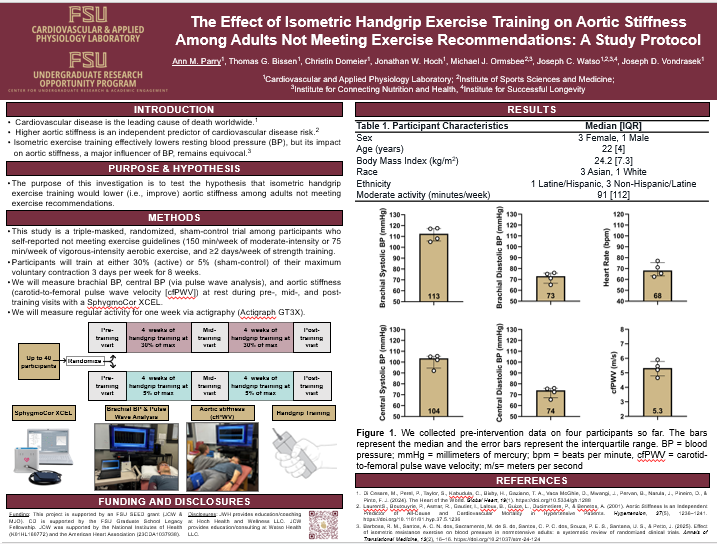
Cardiovascular disease is the leading cause of death worldwide. Aortic stiffness independently predicts cardiovascular disease risk. Regular exercise can lower aortic stiffness, but not enough adults meet the exercise guidelines: 150 min/week of moderate-intensity or 75 min/week of vigorous-intensity aerobic exercise, and ≥2 days/week of strength training. Isometric handgrip (IHG) training is a low-barrier intervention that may lower aortic stiffness. The purpose of this investigation is to test the hypothesis that IHG training reduces aortic stiffness among adults not meeting current exercise guidelines. We will ask participants to self-report if they meet the exercise guidelines before enrolling. We will use a triple-masked, randomized, sham-control study design. Participants will complete IHG training at either 30% (active) or 5% (sham-control) of their maximum voluntary contraction, three days/week for eight weeks. Participants will complete actigraphy (ActiGraph) for one week to characterize their habitual physical activity. We will measure supine brachial blood pressure (BP) with a brachial cuff and aortic stiffness via tonometer (carotid-to-femoral pulse wave velocity [cfPWV]) pre- and post-intervention (SphygmoCor XCEL). We will enroll up to 40 participants. We have collected pre-intervention data on four participants. We report data as median[IQR]. Participant characteristics are Age: 22[4]years, Sex: 75% Female, Body Mass Index: 24.2[7.3]kg/m2, Race: 75% Asian, Ethnicity: 75% Non-Hispanic/Latine. Participants completed 91[112] min/week of moderate-intensity activity. Pre-intervention brachial BP was systolic:113[10]mmHg/diastolic:73[6]mmHg; central BP was systolic:104[6]mmHg/diastolic:74[5]; and cfPWV was 5.3[0.5]m/s. If isometric handgrip training effectively reduces aortic stiffness among adults who do not meet exercise recommendations, it may reduce cardiovascular disease risk.
Keywords: Cardiovascular, Health, Handgrip, Arterial stiffness