
Research Symposium
26th annual Undergraduate Research Symposium, April 1, 2026
Lauren Leis Poster Session 3: 1:45 pm - 2:45 pm / Poster #22

BIO
Lauren Leis is a freshman from Charlotte, North Carolina, pursuing a Bachelor of Science in Behavioral Neuroscience with a minor in Chemistry. She is currently involved in a research project examining predictors of mild cognitive impairment (MCI) through a comprehensive meta‑analysis, working under the mentorship of Dr. Dorota Kossowska‑Kühn. Lauren will continue contributing to this project throughout the summer and fall, expanding her experience in literature synthesis, data evaluation, and the interpretation of cognitive aging research. She will also be shadowing at a Memory and Movement Clinic this summer, gaining firsthand exposure to the clinical care of patients experiencing cognitive and neurological changes.
Her academic interests center on the neural and behavioral mechanisms that shape cognition across the lifespan, and she is particularly motivated by research that informs clinical decision‑making. Lauren aspires to attend medical school and ultimately become a surgeon, where she hopes to integrate scientific inquiry with compassionate, evidence‑based patient care.
Evaluating Predictors of MCI – A Meta-Analysis
Authors: Lauren Leis, Dorota Kossowska-KühnStudent Major: Behavioral Neuroscience
Mentor: Dorota Kossowska-Kühn
Mentor's Department: Psychology Mentor's College: Arts and Sciences Co-Presenters: Alejandra Ortega, Robert Dyer
Abstract
Mild Cognitive Impairment (MCI) is an age‑related condition involving measurable declines in memory and other cognitive abilities. Spatial navigation and related cognitive markers are emerging as early indicators of decline, offering potential for earlier detection. An estimated 12–18% of adults over 60 meet criteria for MCI, and 10–15% of those with MCI progress to dementia, including Alzheimer’s disease (AD), each year. By 2060, roughly 13.8 million people in the United States are expected to be living with AD.
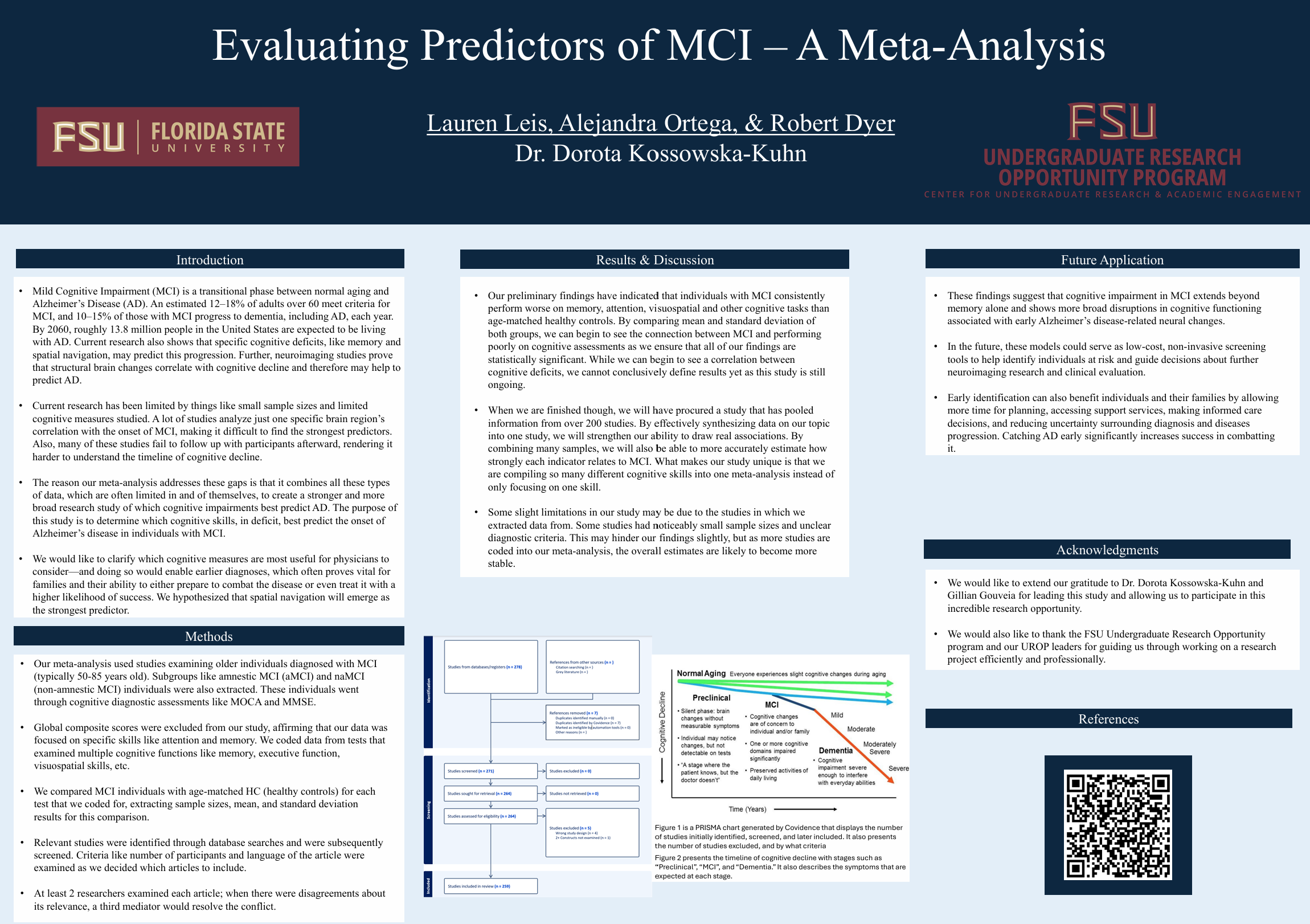
This project conducted a meta-analysis comparing cognitive task performance between individuals with MCI and age‑matched healthy controls (HC). Subgroups included amnestic MCI (aMCI) and non‑amnestic MCI (naMCI). More than 200 studies were reviewed, each including both MCI and HC participants who completed cognitive assessments or underwent brain imaging. Studies were coded by test, extracting statistical measures like mean and standard deviation for each group.
Across studies, individuals with MCI consistently performed worse than HC on tasks assessing memory, attention, visuospatial skills, and other cognitive domains. These findings suggest that cognitive assessments can support early detection and diagnosis of MCI. This is especially important because cognitive testing is non‑invasive, widely accessible, and straightforward for clinicians to interpret.
Overall, cognitive skills‑based models show strong potential for identifying MCI before substantial neurological damage occurs. Future research should incorporate longitudinal designs, standardized cognitive tasks, and diverse participant samples to improve the predictive accuracy of these assessments.
Keywords: MCI, Alzheimer's Disease, Meta-Analysis