
Research Symposium
26th annual Undergraduate Research Symposium, April 1, 2026
Julia Montero Poster Session 1: 9:30 am - 10:30 am / Poster #48

BIO
Julia Montero is a first-year student pursuing a degree in Cell and Molecular Neuroscience at Florida State University. She is on a pre-dental track and hopes to attend dental school after graduation. She is currently a part of the Honors Program, the Presidential Scholars Program, and the Undergraduate Research Opportunity Program (UROP). In the UROP program, she conducted research under her mentor, Jordan Dozier, and team of fellow research assistants during the course of her first year at FSU.
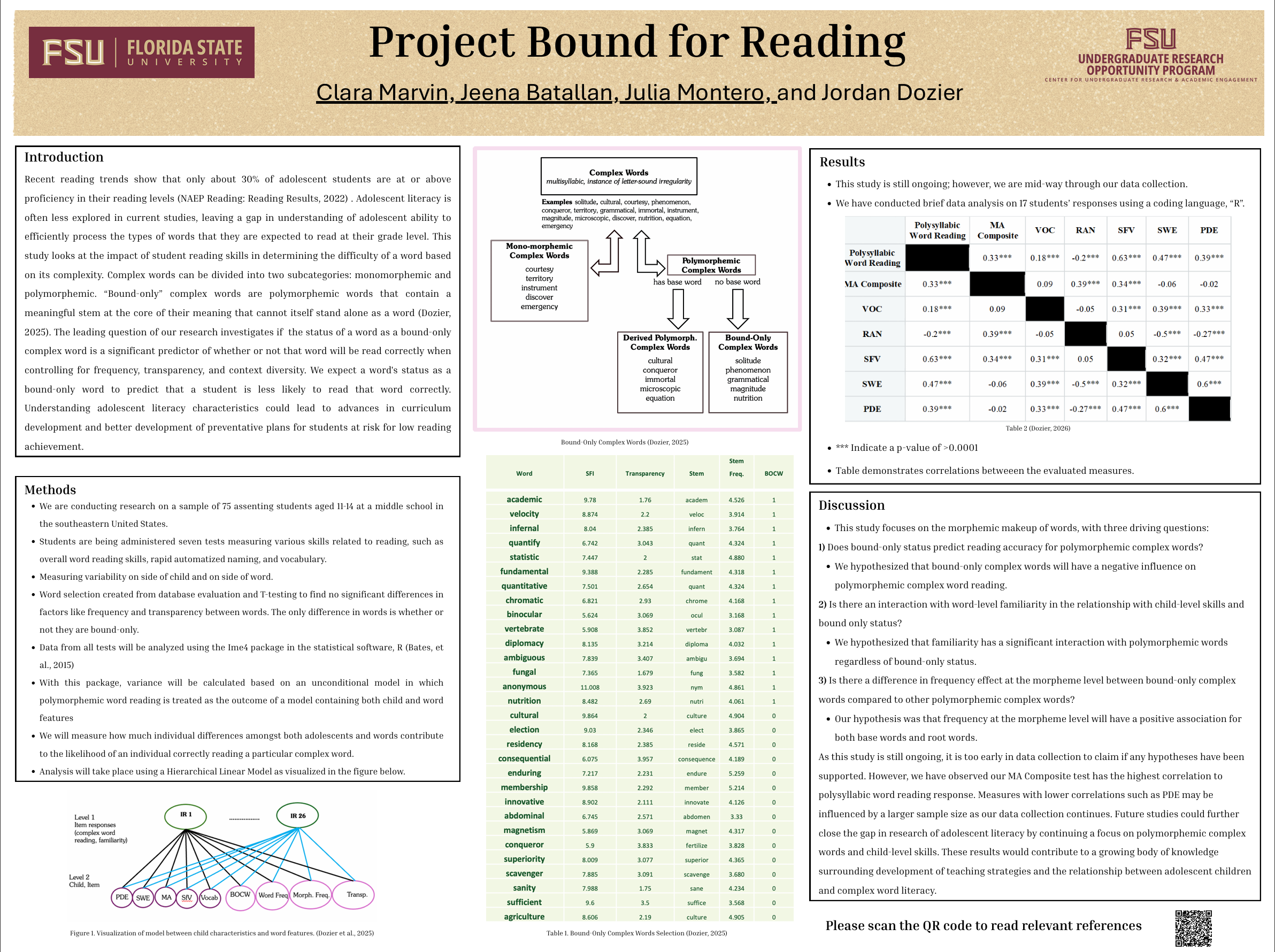
Project Bound for Reading
Authors: Julia Montero, Jordan DozierStudent Major: Cell and Molecular Neuroscience
Mentor: Jordan Dozier
Mentor's Department: CEHHS Office of Research 124000, Florida Center for Reading Research Mentor's College: College of Education, Health, and Human Sciences (CEHHS) Co-Presenters: Jeena Batallan, Clara Marvin
Abstract
When examining the structure of words, complex words can be defined as multisyllabic words with instances of letter-sound irregularity. More specifically, words are divided into monomorphemic or polymorphemic structures. "Bound-only complex words” is a term that describes polymorphemic complex words that do not include a base word with significant meaning (Dozier, 2025). Our research investigates whether bound-only complex words have a more significant variance than polymorphemic complex words with a base word when controlling for frequency, transparency, and context diversity. Because recent reading trends display that about 30% of students are at or above proficiency in their reading levels, we hope to gain insight into the main factors that affect reading development (NAEP Reading: Reading Results, 2022). Data was collected from 75+ middle-school students in the southeastern United States across a variety of assessments that examine different reading skills. The data will be run through a coding platform to determine what categories of words are more challenging for students. We expect that bound-only words will have an increased complexity rating due to the lack of a meaningful base word morpheme that provides important context to readers. The findings of this research could be significant in determining what impedes and improves reading development, particularly for older students who typically are not the subject of reading literacy research.
Keywords: Reading, Adolescent, Complex-words