
Research Symposium
26th annual Undergraduate Research Symposium, April 1, 2026
Makenna Jenkins Poster Session 1: 9:30 am - 10:30 am / Poster #201
BIO
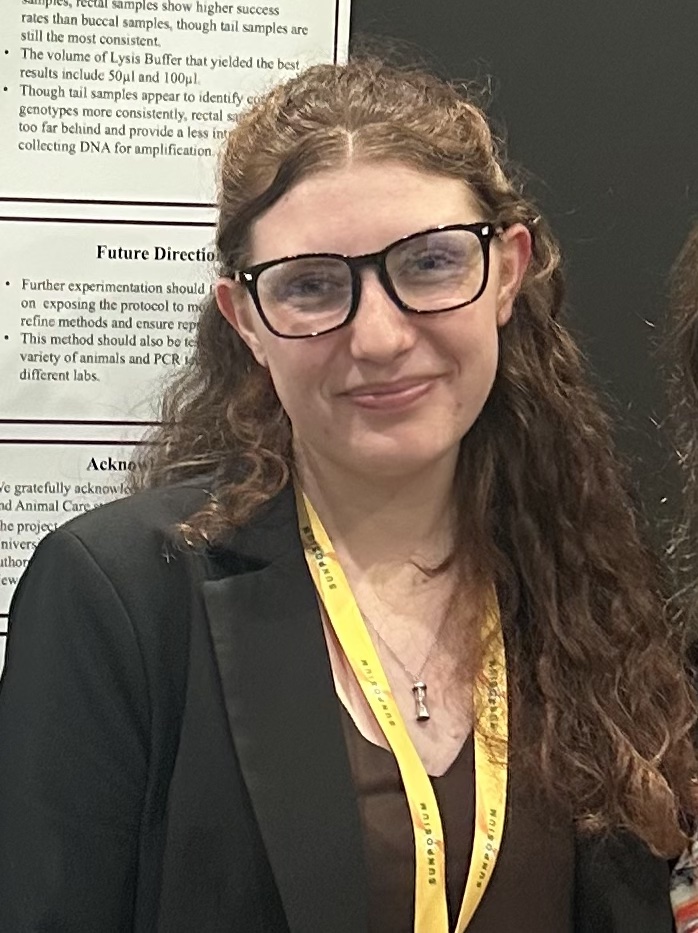
Makenna Jenkins is a fourth year undergraduate student at FSU studying Cell and Molecular Neuroscience, with a minor in Chemistry. She is currently a research assistant in the Hammock lab, a social neuroscience lab with a focus on Oxytocin, where she is also completing an Honors in the Major Thesis under Dr. Elizabeth Hammock's mentorship. She is also a phlebotomist and research assistant in the Joiner lab which is a clinical psychology lab, with a focus on suicide, under Morgan Robison's mentorship. She holds executive positions for both The Undergraduate Chapter of the American Medical Women's Association (AMWA) and the Women Student Union (WSU), and is a Learning Assistant for Dr. Kraft's Biology II lecture. Overall, she intends to pursue an MD/PhD on her path to a career in clinical research, with a focus in neuroscience.
Is Oxytocin Involved: A study on the relationship between ACEs and meta- dehumanization
Authors: Makenna Jenkins, Morgan RobisonStudent Major: Cell and Molecular Neuroscience
Mentor: Morgan Robison
Mentor's Department: Psychology Mentor's College: College of Arts and Sciences Co-Presenters: Cassandra Holder
Abstract
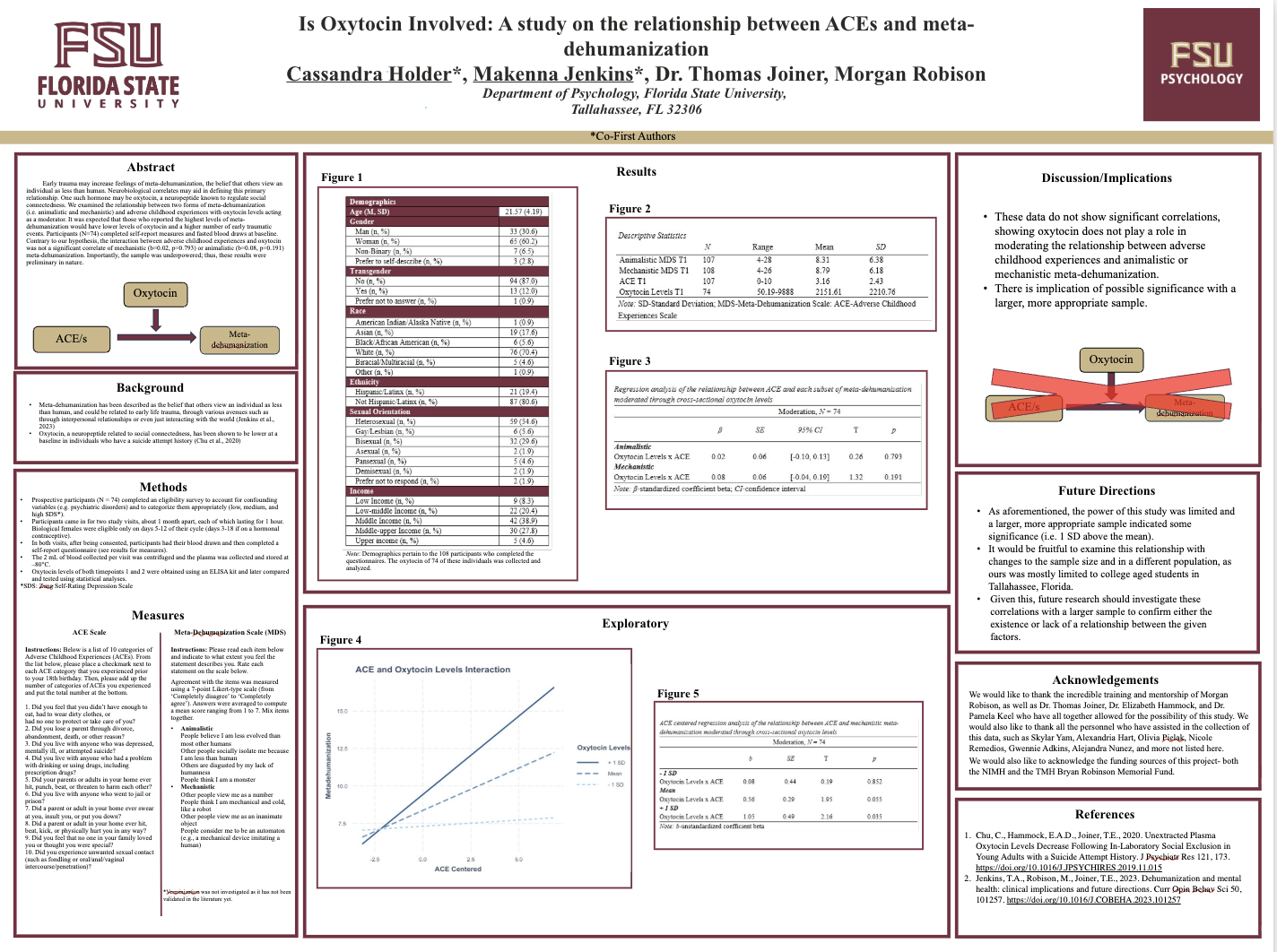
Early trauma may increase feelings of meta-dehumanization, the belief that others view an individual as less than human. Neurobiological correlates may aid in defining this primary relationship. One such hormone may be oxytocin, a neuropeptide known to regulate social connectedness. We examined the relationship between two forms of meta-dehumanization (i.e. animalistic and mechanistic) and adverse childhood experiences with oxytocin levels acting as a moderator. It was expected that those who reported the highest levels of meta-dehumanization would have lower levels of oxytocin and a higher number of early traumatic events. Participants (N=74) completed self-report measures and fasted blood draws at baseline.
Contrary to our hypothesis, the interaction between adverse childhood experiences and oxytocin was not a significant correlate of mechanistic (b=0.02, p=0.793) or animalistic (b=0.08, p=0.191) meta-dehumanization. Importantly, the sample was underpowered; thus, these results were
preliminary in nature.
Keywords: meta-dehumanization, oxytocin, ACE