
Research Symposium
26th annual Undergraduate Research Symposium, April 1, 2026
Megi Gvinjilia Poster Session 4: 3:00 pm - 4:00 pm / Poster #220

BIO
Megi Gvinjilia is a junior at Florida State University pursuing a Bachelor of Science in Accounting. She has been recognized on the Dean’s List for her academic achievement and is actively involved in the university community through research and professional organizations.
She is a participant in the Undergraduate Research Opportunity Program (UROP) and a member of Women in Accounting (WIA) and Beta Alpha Psi (BAP). As an aspiring Certified Public Accountant, Megi is eager to continue gaining experience and expanding her knowledge over time. She is committed to building a strong foundation in accounting and pursuing long-term growth in the field.
Do Nonprofits Benefit from Being Audited by Issuer Audit Partners?
Authors: Megi Gvinjilia, Aleksandra ZimmermanStudent Major: Accounting
Mentor: Aleksandra Zimmerman
Mentor's Department: Accounting Mentor's College: College of Business Co-Presenters: Brooklyn Zappin, Peyton Zawodzinski
Abstract
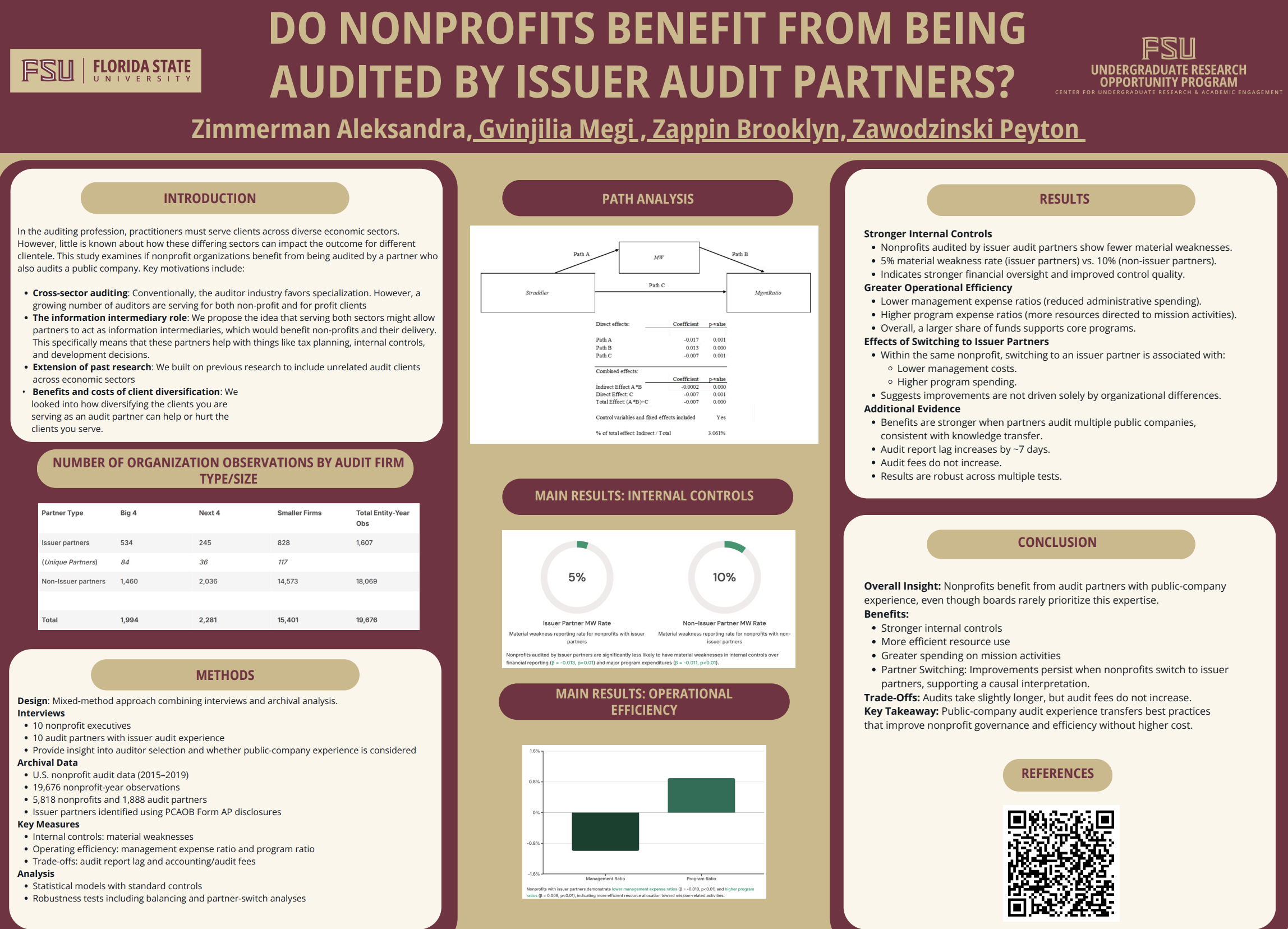
Nonprofit organizations often prioritize auditors with nonprofit expertise, but many audit partners also serve public-company (issuer) clients, which may enable them to transfer best practices across sectors. This study examines whether nonprofits audited by issuer partners have stronger internal controls and greater operational efficiency than those audited by non-issuer partners. This question matters because nonprofits operate under resource constraints, and improvements in controls and efficiency can free more funds for mission-related activities.
The study begins with semi-structured interviews with 10 nonprofit executives subject to Uniform Guidance (Single) audits and 10 issuer audit partners. These interviews provide insight into auditor selection and mechanisms through which issuer experience may influence nonprofit outcomes. The archival analysis uses Uniform Guidance audit data from 2015–2019, identifying issuer partners by matching partner names to the PCAOB Form AP database. Internal control quality is measured using material weakness notifications, while operating efficiency is evaluated through management expense ratios and program ratios. The analysis incorporates robustness tests, including entropy balancing, audit partner changes, and client fixed effects.
The findings show that nonprofits audited by issuer partners are less likely to receive material weakness notifications and exhibit more efficient operations, reflected in lower management expense ratios and higher program ratios, than nonprofits audited by non-issuer partners. These benefits are stronger when issuer partners have more extensive public-company experience, consistent with cross-sector knowledge transfer. One trade-off is longer audit report lags, although audit fees are not higher. Overall, the evidence suggests issuer partners can help nonprofits improve controls and efficiency.
Keywords: Accounting, Nonprofit, Audit