
Research Symposium
26th annual Undergraduate Research Symposium, April 1, 2026
Molly McKenna Poster Session 2: 10:45 am - 11:45 am / Poster #222

BIO
Molly McKenna is a second-year student at Florida State University pursuing a Bachelor of Science in Psychology with a minor in Child Development. Her academic interests include clinical, cognitive, and social psychology, particularly in clinical disorders and trauma-related psychopathology.
She has conducted research on how emotion regulation difficulties moderate the relationship between posttraumatic stress disorder symptoms and dissociation, under the mentorship of Jaime Quiles, M.S., and Dr. Brad Schmidt. Through this work, she has developed an interest in understanding the cognitive and emotional processes underlying trauma-related disorders. In addition to her research, she has been the Events Director of the Honors Student Association, the Induction Ceremony Coordinator of Phi Eta Sigma Honors Society, a member of Pi Beta Phi Sorority, and is currently completing training to serve as an Honors Colloquium Leader.
Molly has been recognized for her academic achievements through the President's List and by earning the Capstone Diploma. After graduating, she plans to pursue a PhD in Clinical Psychology, with the goal of becoming a Clinical Psychologist and conducting research on clinical disorders and trauma-related mental health outcomes.
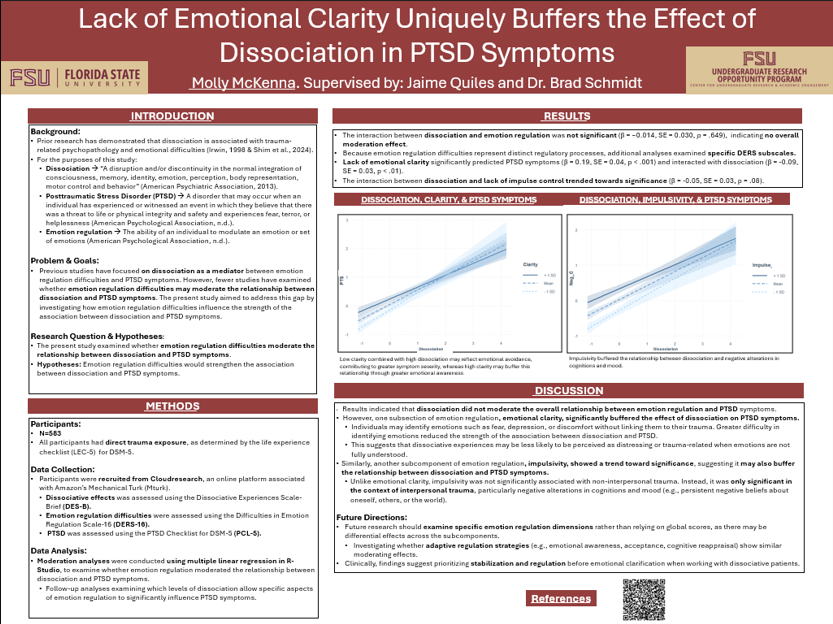
Lack of Emotional Clarity Uniquely Buffers the Effect of Dissociation in PTSD Symptoms
Authors: Molly McKenna, Jaime QuilesStudent Major: Psychology
Mentor: Jaime Quiles
Mentor's Department: Psychology Mentor's College: College of Arts and Sciences Co-Presenters:
Abstract
This study examined the relationships among dissociation, emotion regulation difficulties, and posttraumatic stress disorder (PTSD) symptoms. Prior research has linked dissociation to trauma-related psychopathology and emotional difficulties (Irwin, 1998; Shim et al., 2024). Although recent studies have focused on dissociation as a mediator between emotion regulation and PTSD symptoms, less is known about whether emotion regulation difficulties may function as a moderator, influencing the strength of this association. The present study investigated whether emotion regulation difficulties moderate the relationship between dissociation and PTSD symptoms. A trauma-exposed sample (N = 583) completed the Dissociative Experiences Scale–Brief (DES-B), the Difficulties in Emotion Regulation Scale–16 (DERS-16), and the PTSD Checklist for DSM-5 (PCL-5). Linear regression analyses were conducted in RStudio, followed by analyses examining whether specific facets of emotion regulation interacted with dissociation to predict PTSD symptoms. Results indicated that emotion regulation difficulties did not moderate the overall relationship between dissociation and PTSD symptoms. However, emotional clarity significantly buffered the association between dissociation and PTSD symptoms. Greater difficulty identifying emotions weakened the relationship between dissociation and PTSD. This finding suggests that when individuals struggle to understand their emotions, dissociative experiences may be less likely to be interpreted as trauma-related or distressing. These results highlight the clinical importance of prioritizing emotional regulation and stabilization before emotional clarification in interventions with dissociative individuals to reduce symptom severity and functional impairment overall.
Keywords: psychology, trauma, emotion regulation, dissociation