
Research Symposium
26th annual Undergraduate Research Symposium, April 1, 2026
Ella Cooney Poster Session 3: 1:45 pm - 2:45 pm / Poster #203

BIO
My name is Ella Cooney, I am from Atlanta, GA and I am currently a sophomore at FSU. My passion is the field of psychology, specifically cognitive psychology, and the widespread effects of trauma on individuals. In the future, I hope to pursue law school.
Maladaptive Beliefs Mediate PTSD/MDD Comorbidity After Interpersonal Trauma
Authors: Ella Cooney, Jamie Garcia QuilesStudent Major: Psychology
Mentor: Jamie Garcia Quiles
Mentor's Department: Department of Psychology Mentor's College: College of Arts and Sciences Co-Presenters:
Abstract
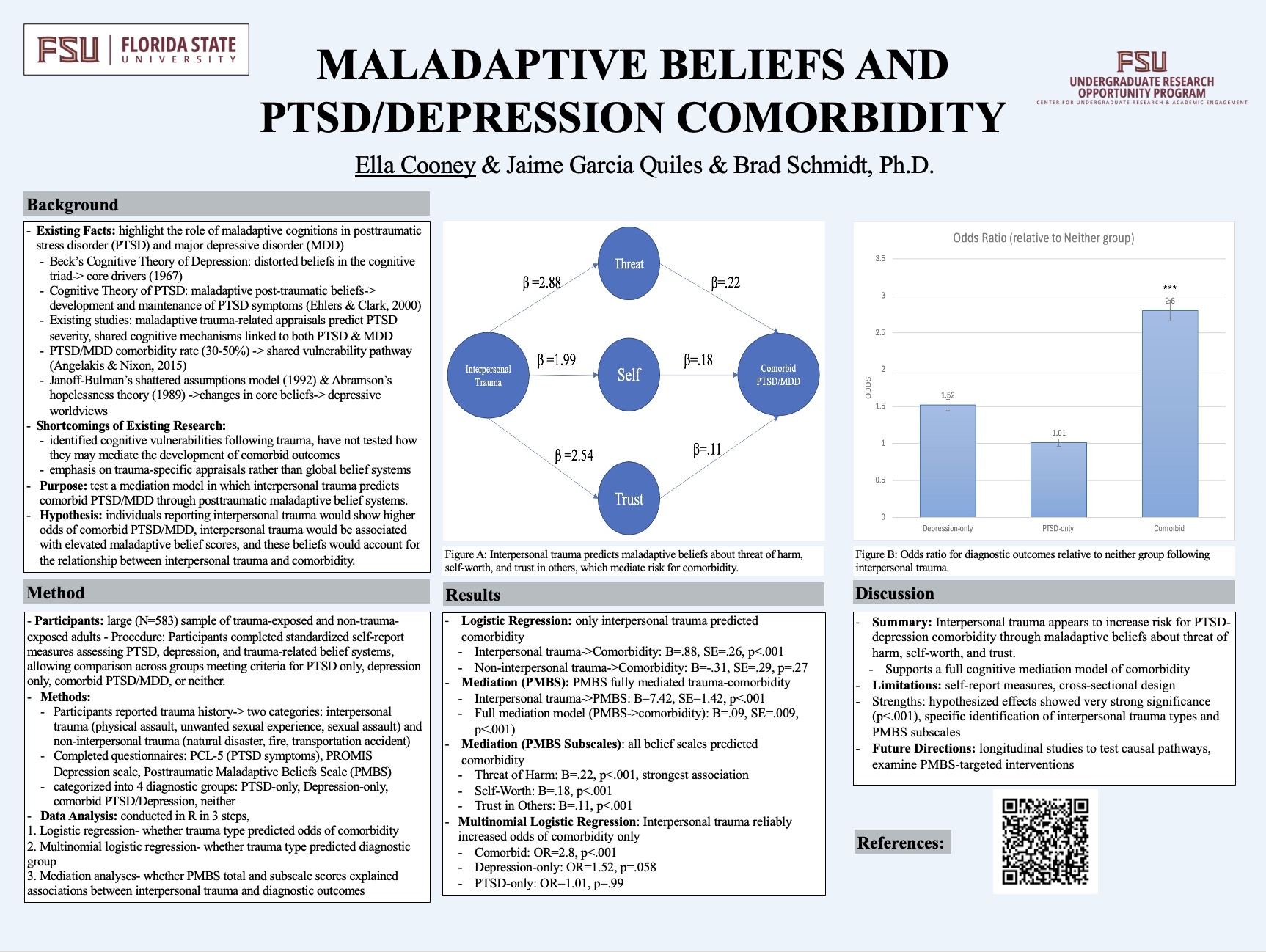
Posttraumatic stress disorder (PTSD) and major depressive disorder (MDD) frequently co-occur, yet the mechanisms underlying this comorbidity remain unclear.The present study examined whether interpersonal trauma is associated with elevated risk for comorbid PTSD and depression and whether this relationship is explained by posttraumatic maladaptive belief systems, a cognitive framework.
Data were drawn from a large sample of trauma-exposed and non-trauma-exposed adults. PTSD symptoms were assessed using the PTSD Checklist for DSM-5 (PCL-5), depressive symptoms were measured with the PROMIS Depression scale, and maladaptive beliefs were evaluated with the Posttraumatic Maladaptive Beliefs Scale (PMBS). Logistic regression, multinomial modeling, and mediation analyses were conducted to examine associations among interpersonal trauma, belief systems, and diagnostic outcomes.
Findings indicate that individuals reporting interpersonal trauma demonstrated nearly threefold higher odds (≈ 2.8) of meeting criteria for both PTSD and depression relative to those with neither condition. Interpersonal trauma significantly predicted higher PMBS scores, and these beliefs were strongly associated with comorbidity. When maladaptive beliefs were included in the model, the association between interpersonal trauma and comorbidity was no longer significant, consistent with full mediation. Multinomial analyses further suggested that interpersonal trauma was more strongly linked to comorbid presentations than to PTSD-only or depression-only.
Together, these results suggest that interpersonal trauma may increase risk for co-occurring PTSD and depression primarily through its impact on core cognitive beliefs. Interventions targeting maladaptive posttraumatic beliefs therefore represent an avenue for reducing vulnerability to trauma-related psychopathology, though additional research is needed to clarify causal processes.
Keywords: PTSD, depression, post-traumatic maladaptive beliefs