
Research Symposium
26th annual Undergraduate Research Symposium, April 1, 2026
Mackenzie Haas Poster Session 4: 3:00 pm - 4:00 pm / Poster #215

BIO
Mackenzie Haas is a freshman majoring in Cell and Molecular Neuroscience and minoring in Child Development. She is a part of the Honors Medical Scholars program and aims to become a pediatrician.
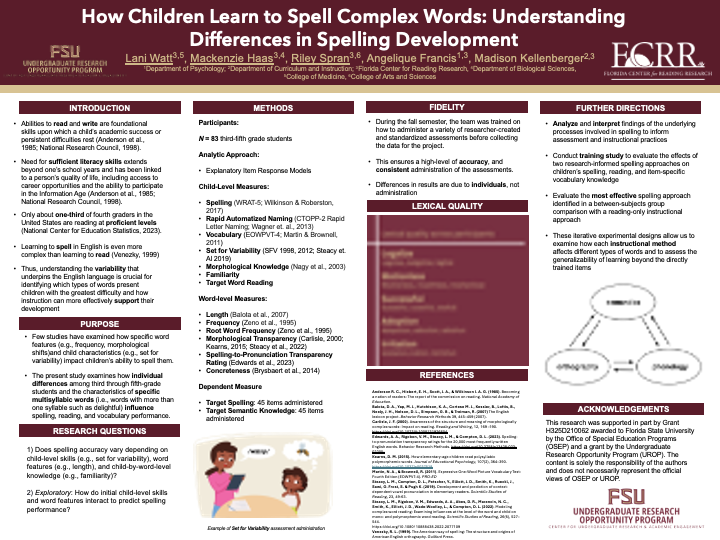
How Children Learn to Spell Complex Words: Understanding Differences in Spelling Development
Authors: Mackenzie Haas, Madison KellenbergerStudent Major: Cell and Molecular Neuroscience
Mentor: Madison Kellenberger
Mentor's Department: Anne Spencer Daves College of Education, Health, and Human Sciences Mentor's College: Department of Curriculum and Instruction Co-Presenters: Riley Spran, Lani Watt
Abstract
The abilities to read and write in elementary school students are foundational skills upon which a child’s academic success or persistent difficulties rest (Anderson et al., 1985; National Research Council, 1998). The overwhelming need for sufficient literacy skills extends far beyond one’s school years and has been linked to a person’s quality of life, including access to career opportunities and the ability to participate in the Information Age (Anderson et al., 1985; National Research Council, 1998). According to the 2022 National Assessment of Educational Progress (NAEP), which is the United States' biannual indicator of academic achievement, only about one-third of fourth graders in the United States are at proficient reading levels (National Center for Education Statistics, 2023).
Learning to spell in English is even more complex than learning to read (Venezky, 1999). Translating spoken words into their correct spelling requires exposure and experience, as many letters have multiple pronunciations and each of these pronunciations often has more than one spelling, creating what Venezky (1999) describes as a “spaghetti-like tangle” (p. 11). Understanding the variability that defines the English language is crucial for identifying which types of words present children with the greatest difficulty and how instruction can more effectively support their development. The present study examines how individual differences among third through fifth-grade students and the characteristics of specific words with more than one syllable influence spelling, reading, and vocabulary performance.
Keywords: Comprehension, Literacy Development, Elementary Students