
Research Symposium
26th annual Undergraduate Research Symposium, April 1, 2026
Emily Williamson Poster Session 2: 10:45 am - 11:45 am / Poster #164

BIO
Emily is a second year Biological Science major with a minor in Chemistry in the College of Arts and Sciences. She is on the pre-medical track with the hope to attend medical school at Florida State University. During her time so far at FSU, she has participated in research at the MagLab with Dr. Jamel Ali and joined several student organizations such as Alpha Chi Sigma, Tri Beta, and Alpha Epsilon Delta. Emily is excited to continue her journey as an undergraduate student in the following semesters as she prepares to take the MCAT and begin the application process to medical school through the support of her mentors and professors.
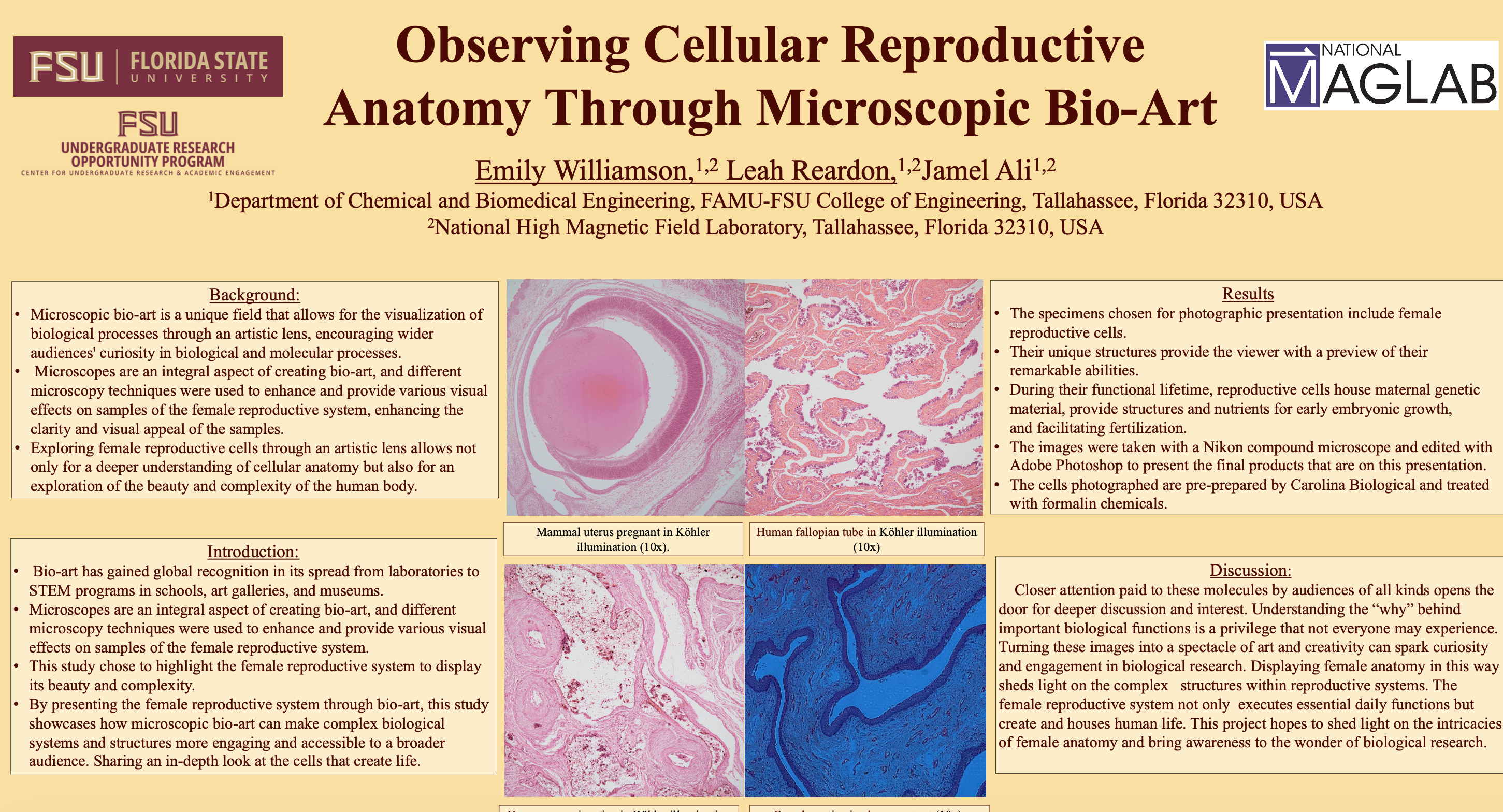
Observing Cellular Reproductive Anatomy Through Microscopic Bio-Art
Authors: Emily Williamson, Dr. Jamel AliStudent Major: Biological Sciences
Mentor: Dr. Jamel Ali
Mentor's Department: Chemical Engineering Mentor's College: The College of Engineering Co-Presenters: Leah Reardon
Abstract
The Microscopic Bioart research project is a project designed to discover the artistic possibilities of biological tissues through microscopic photography. Eye-catching biological molecules bridge scientific and artistic mediums to the molecules that create life and allow us, as organisms, to exist. To be more specific, female reproductive cells are the carriers of our genetic information, and are crucial players in the process of beginning new life. Female reproductive cells were viewed through multiple types of microscopy, such as bright field, dark field, phase contrast, and Köhler illumination to capture the complexity of these cells. These photos were then edited through Adobe Photoshop to appear more aesthetically pleasing to the average viewer that may not know anything about biology. Photographs have been submitted to an annual Bioart competition hosted by Nikon, further spreading the works of art that come from human physiological systems. The unique structure of these complex molecules gives the viewer an idea of the impactful abilities they are able to perform. More attention brought to biological structures, such as female reproductive cells open the door for more conversation and engagement with research pertaining to them.
Keywords: Microscopic Bioart