
Research Symposium
26th annual Undergraduate Research Symposium, April 1, 2026
Alejandro Salcedo Poster Session 4: 3:00 pm - 4:00 pm / Poster #78

BIO
Alejandro is a 2nd-year student assisting the Plant Laboratory with research analyzing social responses to power differentials in society. He is working with Dr. Ashby Plant and Ayanna Brewton to accomplish this research. He is from Miami, Florida. He is pursuing a career in forensic psychology to build rehabilitation programs that can assist those incarcerated with reintegrating into society. He plans to obtain a PhD degree in Clinical Psychology as a prerequisite to acquiring a license for practicing as a psychologist.
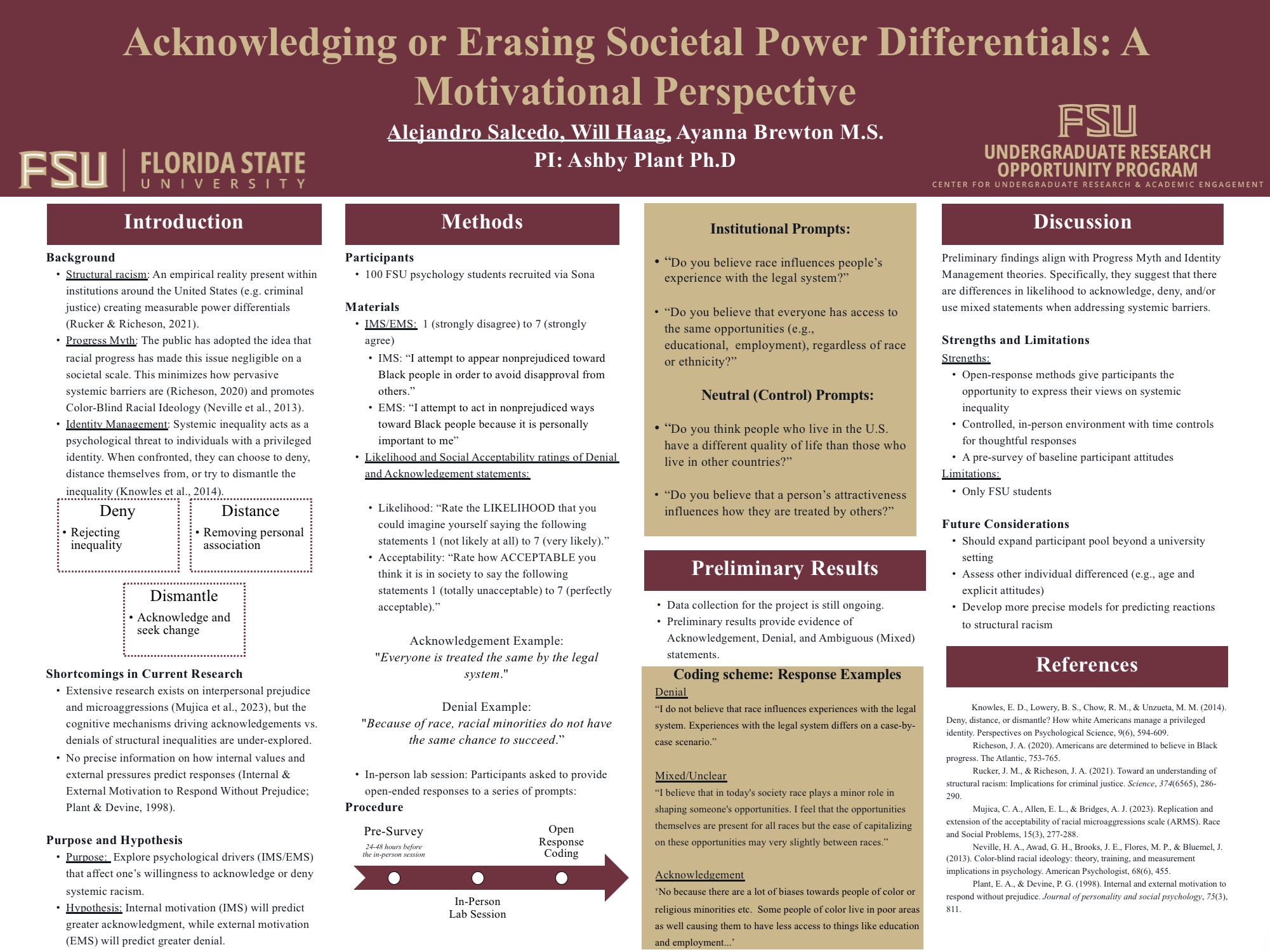
Acknowledging or Erasing Societal Power Differentials: A Motivational Perspective
Authors: Alejandro Salcedo, Ashby Plant Ph.DStudent Major: Psychology & Criminology
Mentor: Ashby Plant Ph.D
Mentor's Department: Department of Psychology Mentor's College: College of Arts and Sciences Co-Presenters: Will Haag
Abstract
The research focuses on whether and why people perceive existing structures, such as laws, the legal and education system, and government influence power differentials between groups. The current work investigates the psychological mechanisms that underlie whether people acknowledge or deny the presence of inequality through the lens of systemic racism. In our work, we gather open-ended responses on participants’ views of whether differences exist in equal opportunities such as employment, education, and the legal system. Of key interest is whether respondents’ motivations (Plant & Devine, 1998; Internal and External motivations to respond without prejudice) determine how participants respond to the questionnaires. We used an acknowledgement and denial coding rubric to score participants’ responses on the extent to which they acknowledge and/or deny the existence of a stated power differential. While data collection is still ongoing, we predict that if a participant is more internally motivated to respond without prejudice (due to their personal views), they will be more likely to acknowledge structural inequality. In contrast, people who are high in external motivation (focused on how others will view them) will be more likely to deny or use ambiguous (mixed) responses that both acknowledge and deny. We seek to demonstrate the ways in which motivational factors inform the perceived realities of structural inequality.
Keywords: Power differentials, inequality, motivation