
Research Symposium
26th annual Undergraduate Research Symposium, April 1, 2026
Gracie Jean-Charles Poster Session 2: 10:45 am - 11:45 am / Poster #212

BIO
From Bradenton, Florida, Gracie Jean-Charles is a first-year Biological Sciences major with a growing interest in medicine, biomedical and psychological research, and public health. She is passionate about improving healthcare systems and exploring new opportunities both within and outside of health science. Dedicated to service and campus involvement, Gracie is actively engaged with the Multi-Cultural Association of Pre-Health Students, the Center for the Advancement of Teaching, NSBWM, the Undergraduate Research Opportunity Program and Boys and Girls Club. Through these experiences, she hopes to continue expanding her understanding of research, healthcare, and community impact. Outside of academics and service, you can find her on the tennis court or strolling through Landis Green.
The Impact of Colorism on Mental Health
Authors: Gracie Jean-Charles, Eugenia Flores MillenderStudent Major: Biological Sciences
Mentor: Eugenia Flores Millender
Mentor's Department: Center of Population Sciences for Health Empowerment Mentor's College: College of Nursing Co-Presenters:
Abstract
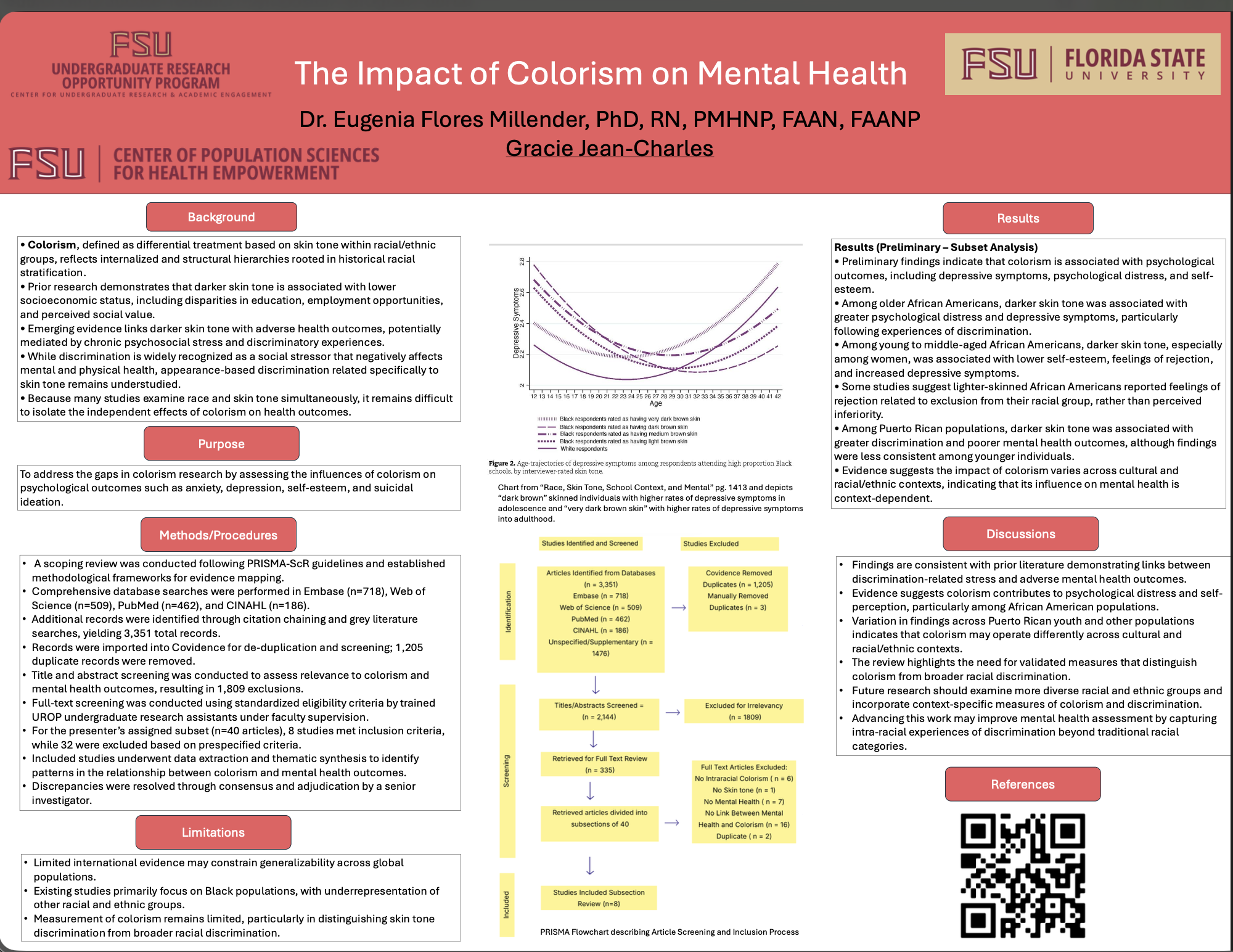
Colorism in this study is defined as discrimination based on skin tone between members of the same racial and ethnic groups.Colorism, although significant, is often overlooked, especially in reference to mental health.The purpose of this research is to examine how colorism affects women’s psychological outcomes, particularly anxiety, self-esteem, depression and suicidal ideation. Understanding this relationship is important because colorism may have the potential to influence the psychological outcomes of the individuals affected through internalized colorist ideals, distress, discrimination based on skin tone and media. In addition, this research also investigates how colorism may differently affect the mental health of lighter and darker toned individuals within the same ethnic or racial group. The data used in this research was collected via systematic review of existing research with relation to colorism and mental health outcomes. Further, the analysis of peer-reviewed psychological, sociological, and public health studies related to colorism and mental health was used to determine the relationship between colorism and psychological outcomes. Studies and articles with pertinent information were further screened and underwent data extraction. Findings from the final eight selected articles suggested that those with darker skin are more susceptible to higher levels of anxiety, depressive symptoms, suicidal ideation, colorist discrimination and lower levels of self esteem. These results suggest that colorism could be a stressor that influences mental health.
Keywords: Colorism, Mental Health, Psychological Outcome