
Research Symposium
26th annual Undergraduate Research Symposium, April 1, 2026
Victoria Blackwell Poster Session 3: 1:45 pm - 2:45 pm / Poster #184

BIO
Victoria Blackwell is a first-year Actuarial Science major, looking to add Accounting as a second major in the Fall. Born in a suburb of New Orleans as one of five children, she moved to Florida in 2022. She is currently involved in the Honors Program, and she is active in Students for Life and her church choir. She is passionate about math and aims to become a full time actuary after she graduates.
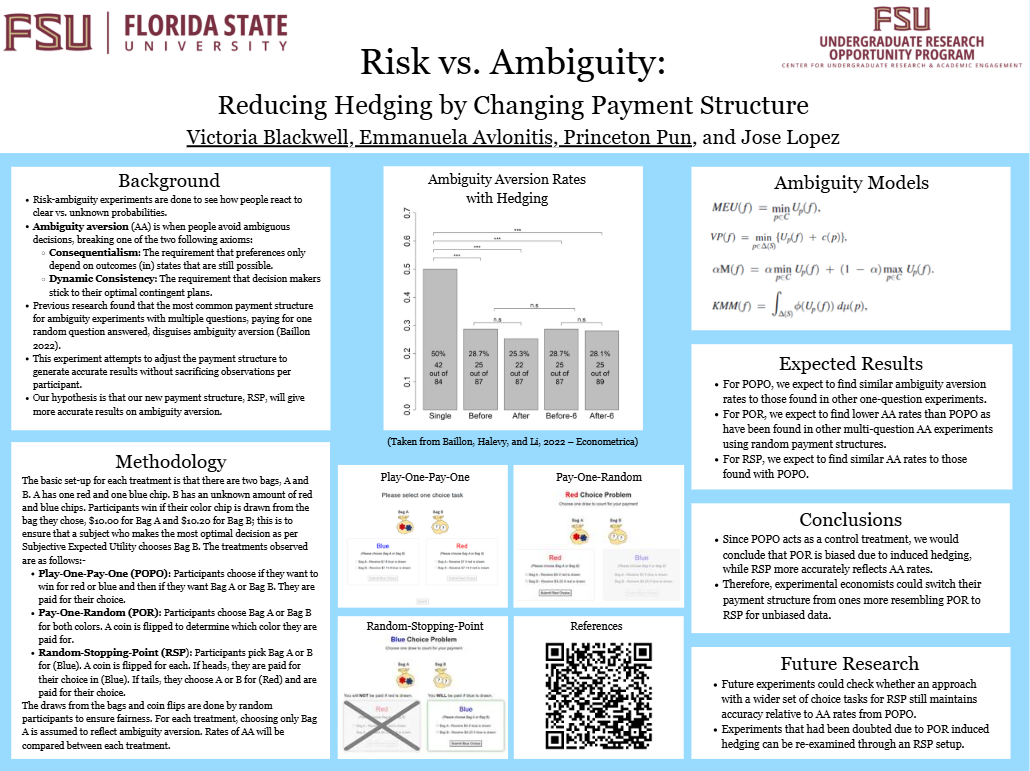
Risk vs. Ambiguity: Reducing Hedging by Changing Payment Structure
Authors: Victoria Blackwell, Jose LopezStudent Major: Actuarial Science
Mentor: Jose Lopez
Mentor's Department: Economics Mentor's College: Social Sciences and Public Policy Co-Presenters: Emmanuela Avlonitis and Princeton Pun
Abstract
Within economics, people are expected to be rational and work to their greatest expected utility. Using this, we would expect that people would always pick the option with the greatest expected value, but people often accept lower payoffs to avoid ambiguity, defined as situations where probabilities are unknown. This irrationality makes it interesting and important to economists.. The validity of previous ambiguity research is being questioned because of hedging, whereby participants can change ambiguous situations into risky situations, which have set probabilities. However, if that can be rectified with changes in how people are paid for and asked questions future research may still be possible. Within this experiment, we asked if hedging behavior can be minimized within risk-ambiguity experiments in multiple question surveys by adjusting the method by which payment is decided. One treatment only has one choice to act as a control. The second has multiple choices where it is randomly determined which one will be paid out, which is the method that had previously had problems with hedging. The final treatment has participants make one decision, be randomly assigned to either be paid based on that decision or answer a second question. We expect that the third treatment’s results to appear similar to the control’s results and the second to underestimate ambiguity aversion as it has in other experiments. This would provide future researchers with a method to ask multiple questions while still receiving accurate results on ambiguity aversion.
Keywords: Ambiguity, Payment Structure, Incentives