
Research Symposium
26th annual Undergraduate Research Symposium, April 1, 2026
Vincent Ochoa Poster Session 3: 1:45 pm - 2:45 pm / Poster #231

BIO
Vincent Ochoa is a second-year undergraduate student pursuing a Bachelor of Science in Biological Science. He is also completing minors in Chemistry and Music, reflecting both his strong interest in the natural sciences and his continued passion for the arts. Through his coursework, Ochoa is developing a solid foundation in biology, chemistry, and other core scientific disciplines.
As part of his studies, Ochoa has gained experience through rigorous coursework that emphasizes scientific reasoning, experimental techniques, and data analysis. These experiences have helped him strengthen his problem-solving skills and deepen his understanding of biological systems and chemical processes. He continues to work closely with faculty instructors who guide his academic development and encourage further exploration of scientific learning.
Alongside his scientific training, Ochoa pursues a minor in music, allowing him to maintain a creative outlet while balancing a demanding academic program. Looking ahead, he aspires to attend veterinary school after completing his Bachelor of Science degree. His long-term goal is to become a veterinarian and contribute to the health and well-being of animals through scientific knowledge, compassion, and dedicated care.
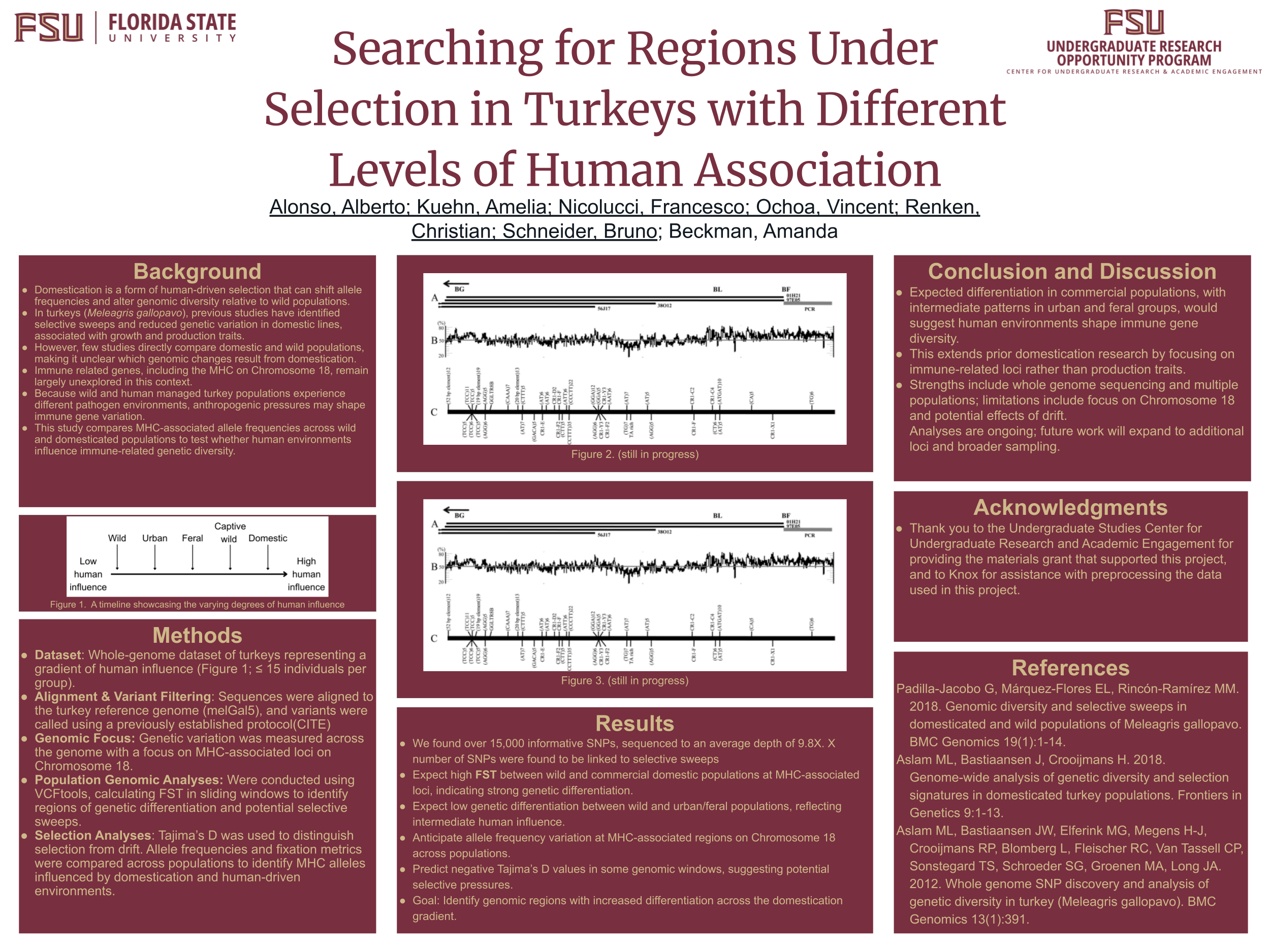
Searching for Regions Under Selection in Turkeys with Different Levels of Human Association
Authors: Vincent Ochoa, Amanda BeckmanStudent Major: Biological Science
Mentor: Amanda Beckman
Mentor's Department: Biological Science Mentor's College: College of Art & Sciences Co-Presenters: Alonso, Alberto; Kuehn, Amelia; Nicolucci, Francesco; Ochoa, Vincent; Renken, Christian; Schneider, Bruno
Abstract
Domestication exposes animals to a variety of novel environments, including differences in the diseases they encounter. Studying the evolutionary processes involved in domestication is important as many modern wild animals are experiencing some degree of pressure to adapt to human-dominated landscapes. Major histocompatibility complex (MHC) genes must rapidly evolve as they play an important role in immune responses and are shaped by pathogen exposure. This project investigated selection in wild versus domesticated turkeys (Meleagris gallopavo) and whether the amount of human interaction influences allele frequencies. We used a Whole Genome Sequencing (WGS) dataset of turkeys that experienced different levels of human association (wild, urban, feral, backyard domestic, and commercial domestic populations). After identifying genetic variants, we used VCFtools to analyze allele frequencies on Chromosome 18. We used FST, a measure of population differentiation, to identify regions with the greatest divergence. We expect differences in MHC-related allele frequencies between domesticated and wild turkeys, suggesting human environments influence immune-related genetic variation. Identifying these regions may highlight genomic regions shaped by selection. Overall, this project helps explain how domestication affects immune gene diversity. Future research could analyze additional turkey populations from different environments and examine allele frequencies on other chromosomes. Further work could also explore genomic differences in other domesticated avian species to better understand the impact of domestication on immune responses.
Keywords: Domestication, Genes, Biology, Allele,