
Research Symposium
26th annual Undergraduate Research Symposium, April 1, 2026
Nikitha Rajagopalan Poster Session 2: 10:45 am - 11:45 am / Poster #290

BIO
Nikitha Rajagopalan is a second-year Computer Science major who is also pursuing double minors in Applied Mathematics and Business Analytics. She is a member of the Florida State University Honors Program, where she participates in advanced academic opportunities and interdisciplinary learning.
Nikitha is particularly interested in Artificial Intelligence and Machine Learning and how these technologies can improve efficiency and solve complex problems in the modern world. Her academic interests include data analysis, intelligent systems, and the application of machine learning to real-world challenges. She enjoys exploring how innovative technologies can enhance existing systems and create smarter solutions across industries.
She plans to pursue graduate studies in both computer science and business in order to combine technical expertise with strategic decision-making skills. Ultimately, she hopes to build a career in Artificial Intelligence Engineering.
Nikitha’s long-term goal is to contribute to the advancement of cybersecurity through the use of machine learning models that can detect and respond to cyber threats. As part of her current research experience, she studies machine learning and unmanned aerial vehicle (UAV) systems through the Center for Advanced Power Systems at Florida State University. Her research focuses on using telemetry and sensor data to detect cyber-physical threats in UAV systems, helping improve the safety and reliability of autonomous technologies.
Machine Learning and UAVs
Authors: Nikitha Rajagopalan, Salma AboelmagdStudent Major: Bachelor of Science in Computer Science with minors in Applied Math and Business Analytics
Mentor: Salma Aboelmagd
Mentor's Department: Electrical & Computer Engineer (ELECT_ENG) 216000 Mentor's College: College of Engineering Co-Presenters:
Abstract
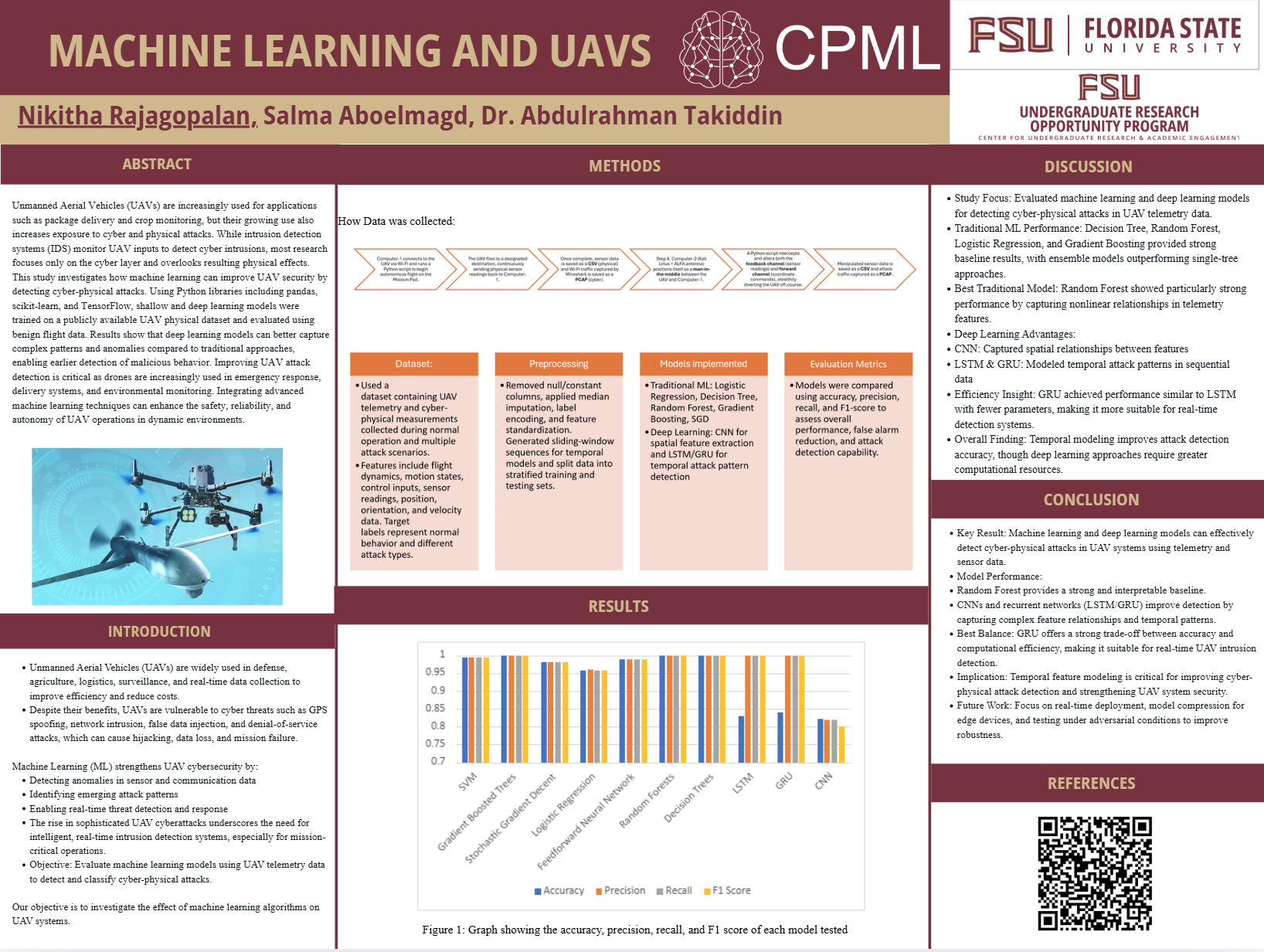
Unmanned Aerial Vehicles (UAVs) are increasingly used for applications such as package delivery and crop monitoring, but their growing use also increases exposure to cyber and physical attacks. While intrusion detection systems (IDS) monitor UAV inputs to detect cyber intrusions, most research focuses only on the cyber layer and overlooks resulting physical effects. This study investigates how machine learning can improve UAV security by detecting cyber-physical attacks. Using Python libraries including pandas, scikit-learn, and TensorFlow, shallow and deep learning models were trained on a publicly available UAV physical dataset and evaluated using benign flight data. Results show that deep learning models can better capture complex patterns and anomalies compared to traditional approaches, enabling earlier detection of malicious behavior. Improving UAV attack detection is critical as drones are increasingly used in emergency response, delivery systems, and environmental monitoring. Integrating advanced machine learning techniques can enhance the safety, reliability, and autonomy of UAV operations in dynamic environments.
Keywords: Machine Learning, Computer Science, AI