
Research Symposium
26th annual Undergraduate Research Symposium, April 1, 2026
Andrea Alvarez Poster Session 3: 1:45 pm - 2:45 pm / Poster #109

BIO
Andrea Alvarez is a sophomore at Florida State University pursuing a Bachelor of Science in Biochemistry. She previously conducted undergraduate research at Miami Dade College, where she studied the effects of nicotine exposure on Daphnia magna, examining of nicotine influences physiological responses to this substance. This early research experience sparked her interest in research.
At Florida State University, Andrea continues to build her academic foundation in chemistry and biology while exploring research opportunities. She would like to thank her research mentor Sadio Fenner and the Anne Spencer Daves College of Education, Health, and Human Sciences for their support.
After completing her undergraduate degree, Andrea plans to attend medical school and pursue a career as a physician.
Effects of 12-Week Endurance Training on Time to Exhaustion in Postmenopausal Women with Obesity and Prediabetes
Authors: Andrea Alvarez, Sadio FennerStudent Major: Biochemistry
Mentor: Sadio Fenner
Mentor's Department: HNFS Mentor's College: Anne Spencer Daves College of Education, Health, and Human Sciences Co-Presenters:
Abstract
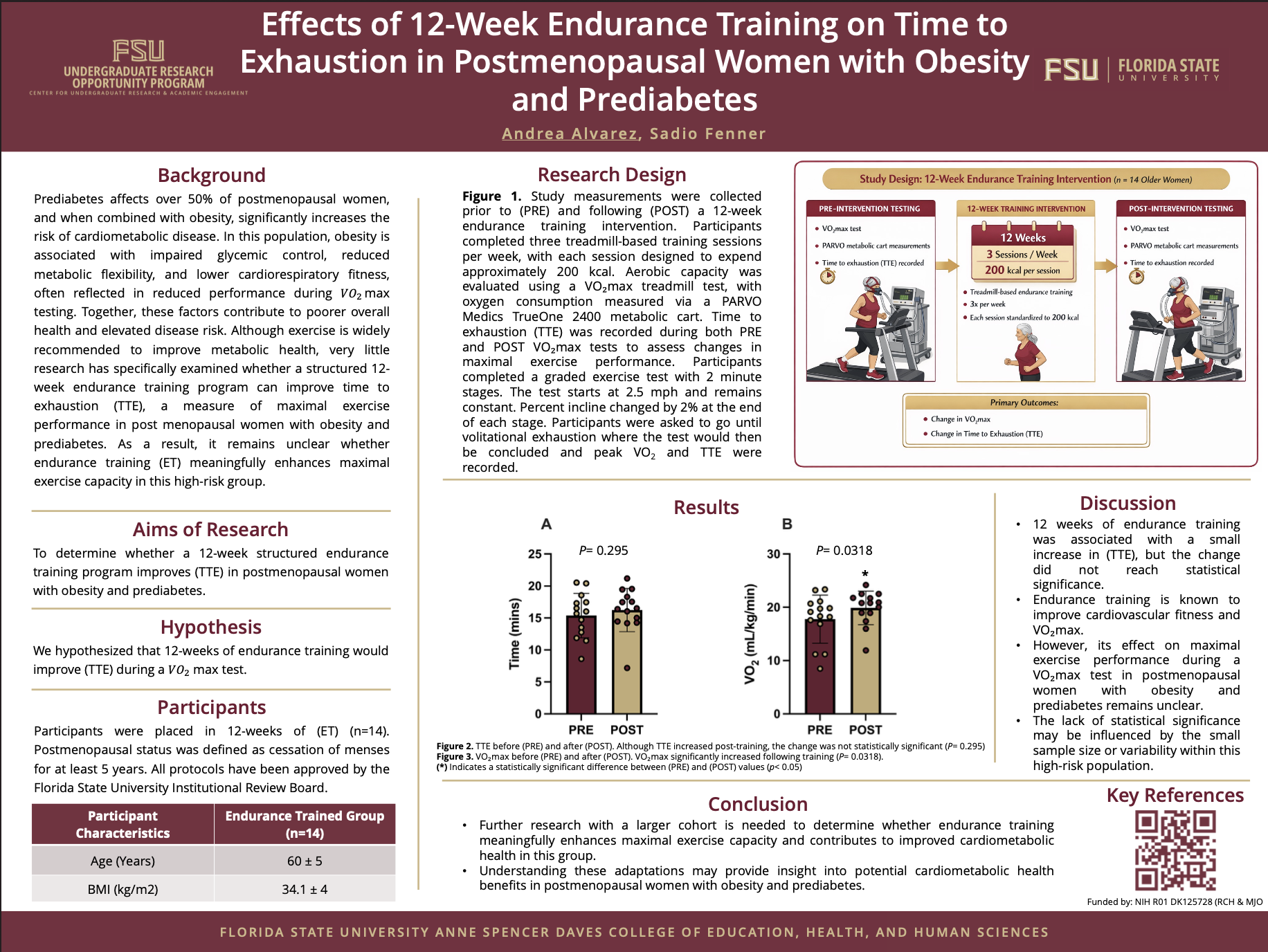
Little is known about how structured endurance training (ET) influences time to exhaustion (TTE) in postmenopausal women with obesity and prediabetes. This population is at an increased risk for cardiometabolic disease. Prediabetes, commonly associated with obesity, serves as a precursor to type 2 diabetes, and affects over 50% of postmenopausal women. Although the health benefits of exercise are well recognized, there is limited understanding of how energy-matched (ET) specifically affects (TTE) during a VO2max test. This analysis represents a preliminary functional ongoing investigation examining metabolic adaptations to exercise training in this population. This study examined whether a 12-week (ET) program improves (TTE). 14 participants completed a VO2max test at baseline and post-intervention. During the 12-weeks of training, participants performed supervised treadmill-based (ET) three times per week, with each session designed to reach 200 kcal. Respiratory exchange ratio and VO2 were measured using a PARVO metabolic cart to assess oxygen consumption and energy expenditure. (TTE) was recorded during the pre- and post-intervention VO2max tests. (TTE) increased from 15.38 ± 3.47 minutes at baseline to 16.24 ± 3.38 minutes post-training (+0.86 minutes; ~5.6%), this change did not reach statistical significance based on a paired sample t-test (p=0.30). These suggest that (ET) was not associated with a statistically significant improvement in (TTE) in this sample. A larger sample size and further analysis of the metabolic data obtained from this study will help determine whether (ET) improves (TTE) as well as other metabolic components, which may reduce cardiometabolic disease risk in this population.
Keywords: Postmenopausal Women with Obesity