
Research Symposium
26th annual Undergraduate Research Symposium, April 1, 2026
Aura Marks-Shafton Poster Session 3: 1:45 pm - 2:45 pm / Poster #59

BIO
Aura Marks-Shafton is a student in the Honors College pursuing a Bachelor of Science in Behavioral Neuroscience with a minor in Chemistry. Her academic interests focus on the biological and neural mechanisms underlying behavior.
Aura conducts research in the Riddle Lab under the mentorship of Dr. Justin Riddle, where she studies neural activity and brain stimulation in clinical populations. Her work involves the use of electroencephalography (EEG), magnetic resonance imaging (MRI), and transcranial alternating current stimulation (tACS) to investigate neural processes related to mental health and behavior.
Through her coursework and research, Aura has developed a strong interest in the relationship between brain function and nutrition. She hopes to further explore the intersection of neuroscience and nutritional science, with the long-term goal of contributing to research that examines how diet and metabolic factors influence cognitive function and mental health.
Substance Use Symptoms and Effort-Based Decision-Making in Anhedonic Depression
Authors: Aura Marks-Shafton, Justin RiddleStudent Major: Behavioral Neuroscience
Mentor: Justin Riddle
Mentor's Department: Psychology Mentor's College: Arts and Sciences Co-Presenters:
Abstract
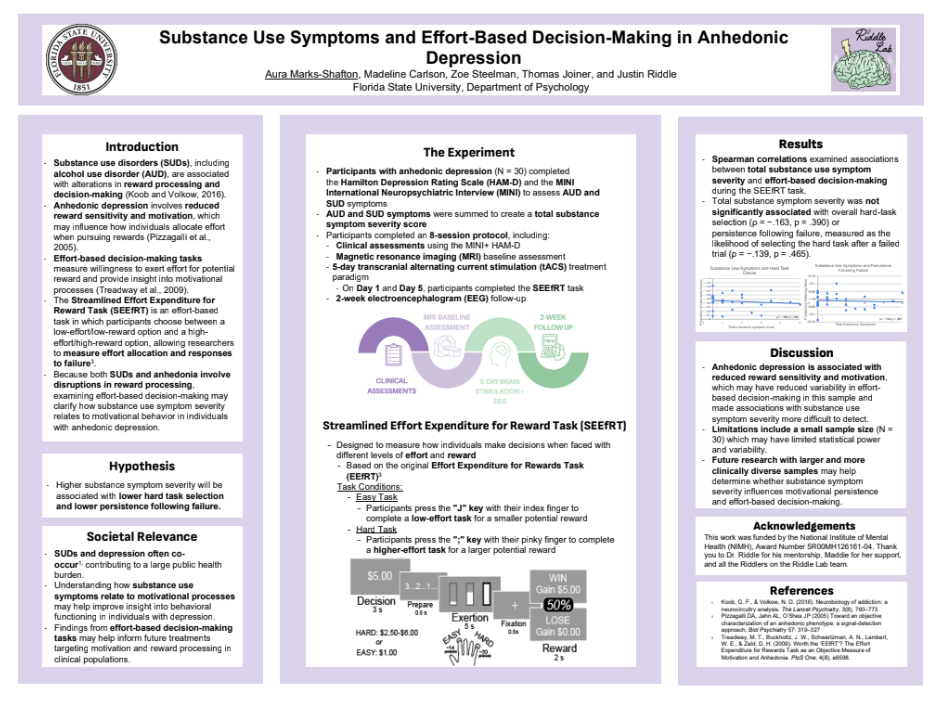
Both alcohol use disorder (AUD) and substance use disorder (SUD) have been linked to alterations in reward processing and value-based decision-making. However, less research has examined how substance use symptoms relate to motivation in individuals experiencing anhedonia, a condition characterized by reduced sensitivity to reward. The present study examined whether substance use symptom severity was associated with effort-based decision-making and behavioral responses to negative feedback in adults with anhedonic depression (N = 30). Participants completed the MINI International Neuropsychiatric Interview to assess alcohol and other substance use symptoms, which were combined into a total substance symptom severity score. They then completed the Streamlined Effort Expenditure for Reward Task (SEEfRT), a measure of effort-based value decision-making. The SEEfRT assesses willingness to select a high-effort (“hard”) task over a low-effort (“easy”) task for potential reward, as well as the likelihood of selecting the hard task following failure, indexing persistence after negative feedback. Spearman correlations were conducted to evaluate associations between substance symptom severity and task performance. Substance symptom severity was not significantly correlated with overall hard-task selection (ρ = −.163, p = .390) or likelihood of selecting the hard task after failure (ρ = −.139, p = .465). These findings suggest that, within an anhedonic sample, substance-related symptom severity was not associated with effort expenditure or persistence following negative feedback. Future research with larger samples and greater variability in substance use severity may clarify whether substance-related symptoms influence motivational persistence in anhedonic depression.
Keywords: Anhedonia, Substance use disorder (SUD), Alcohol use disorder (AUD), Reward sensitivity, Effort expenditure, Persistence