
Research Symposium
26th annual Undergraduate Research Symposium, April 1, 2026
Bailee Simmers Poster Session 3: 1:45 pm - 2:45 pm / Poster #185
BIO
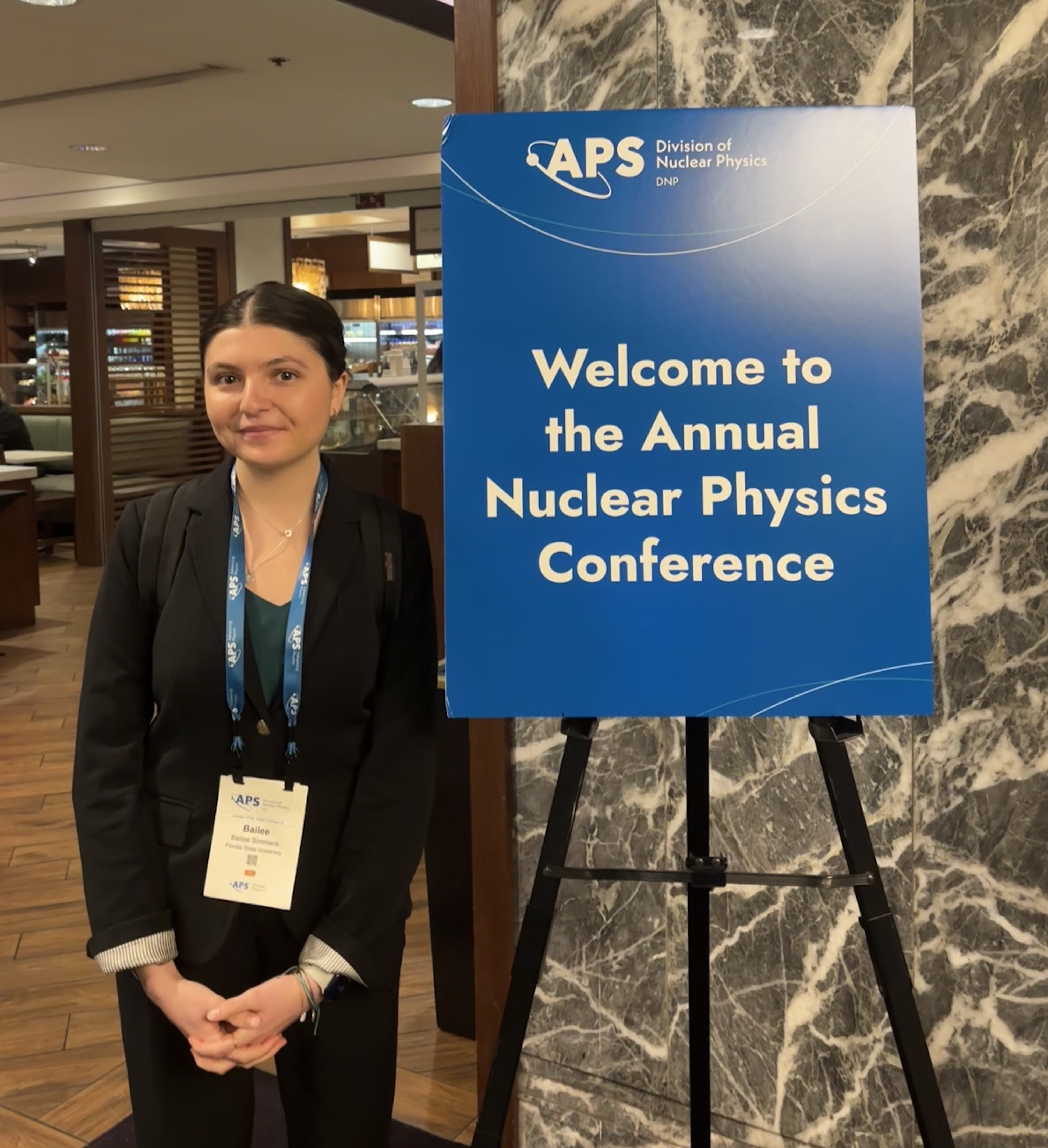
Bailee Simmers is a sophomore majoring in Physics and Astrophysics. She has been involved in Hadronic Nuclear Physics research with the GlueX Experiment since her freshman year. She recently presented her contribution to the Particle Identification Study at the APS Division of Nuclear Physics Meeting in Chicago. After completing her undergraduate education, Bailee plans to pursue a doctorate in nuclear physics. Outside of research, Bailee enjoys spending time with her dog, reading a good book, curating the perfect playlist, and indulging in some good espresso.
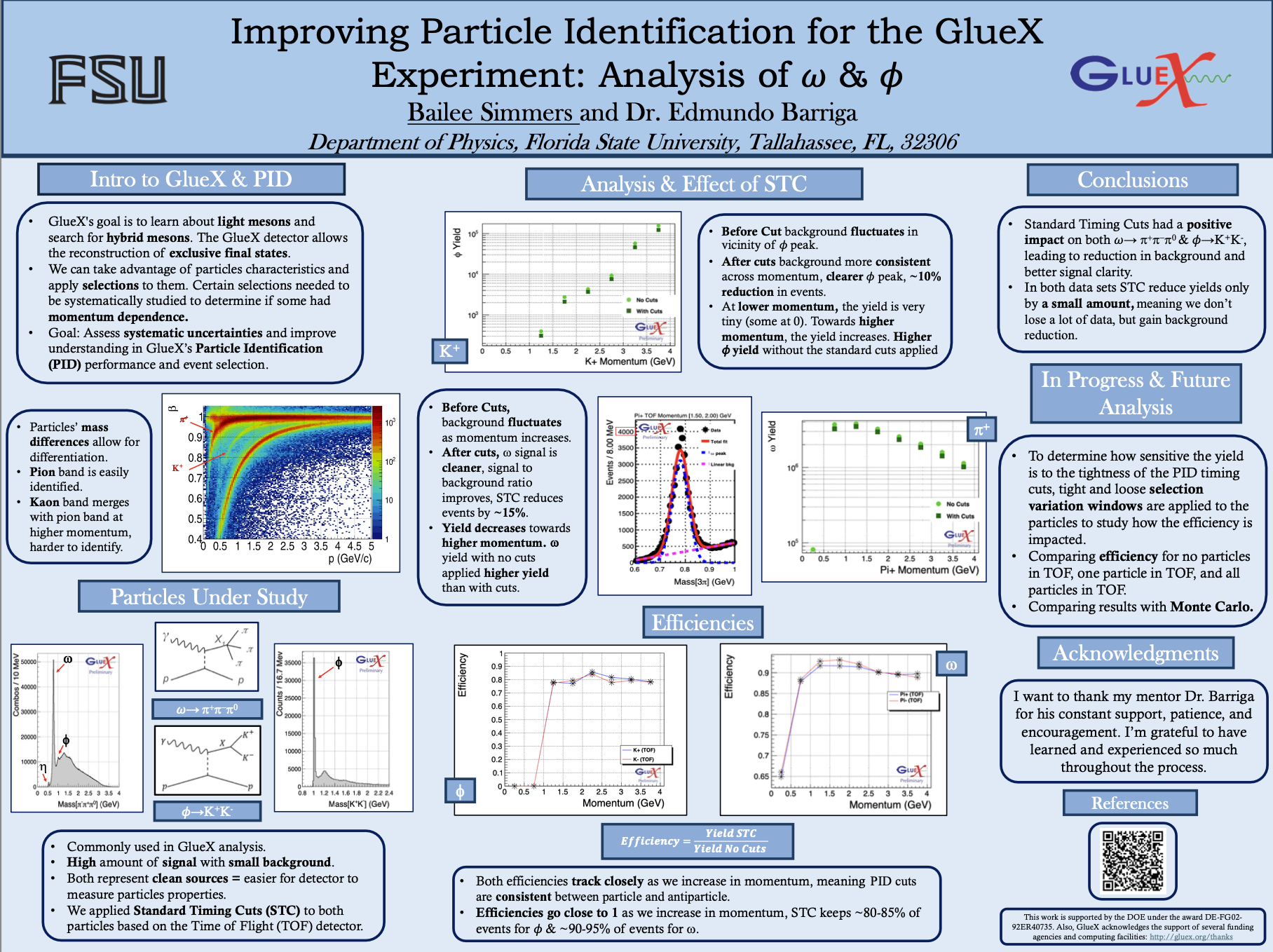
Improving Particle Identification for the GlueX Experiment: Analysis of 𝜔 & 𝜙
Authors: Bailee Simmers, Edmundo BarrigaStudent Major: Physics & Astrophysics
Mentor: Edmundo Barriga
Mentor's Department: Physics Mentor's College: Florida State University Co-Presenters:
Abstract
GlueX is a particle physics experiment located in Hall D at Jefferson Lab in Newport News, Virginia. Its primary goal is to search for hybrid mesons to better understand the light meson spectrum and the strong force. GlueX enables the reconstruction of exclusive final states and the identification of the intermediate particle resonances which produce these final state particles. This project contributes to the Particle Identification (PID) efforts within GlueX by quantifying the efficiency of current PID selections across the detector's kinematic coverage and examining modeling uncertainties between data and Monte Carlo simulations (MC). The particle decay modes used in these studies are 𝜔→𝜋+𝜋-𝜋0 and 𝜙→K+K-. Both particles have long lifetimes and small natural decay widths, and their measured widths are dominated by detector resolution. Thus, any changes in PID criteria that impact the resolution will directly affect their measured widths. To study this, we assess the systematic uncertainty in PID selections by comparing efficiencies in MC to those in data. This process involves extracting the yield of our chosen particles to calculate the efficiency. To determine how sensitive the yield is to the tightness of the PID timing cuts, tight and loose selection variation windows are applied to the particles in order to study how the efficiency is impacted. The results of this study will help assess systematic uncertainties and improve confidence in GlueX's PID performance and event selection.
Keywords: Physics, Nuclear Physics, Hadronic Physics, Particle Physics