
Research Symposium
26th annual Undergraduate Research Symposium, April 1, 2026
Yemaya Adams Poster Session 4: 3:00 pm - 4:00 pm / Poster #108
BIO
Yemaya Adams is a second-year first generation student at Florida State University from Tampa FL. Yemaya is currently hoping to obtain a career as a health clinical analyst combining both technology and healthcare. Yemaya has maintained time management and academic integrity while balancing campus involvements. She is currently involved in HER university as a fall 25 inductee, 2025 Woman of Achievement of Kappa Alpha Psi Fraternity Incorporated, Student Foundation Programming Trustee, Codeducation Event Coordinator and serves a Desk Assistant for University Housing.
Humanists Perception and Engagement in Open Science
Authors: Yemaya Adams, Kassidy Hof-MahoneyStudent Major: Information Technology
Mentor: Kassidy Hof-Mahoney
Mentor's Department: FSU Libraries Mentor's College: College of Engineering Co-Presenters:
Abstract
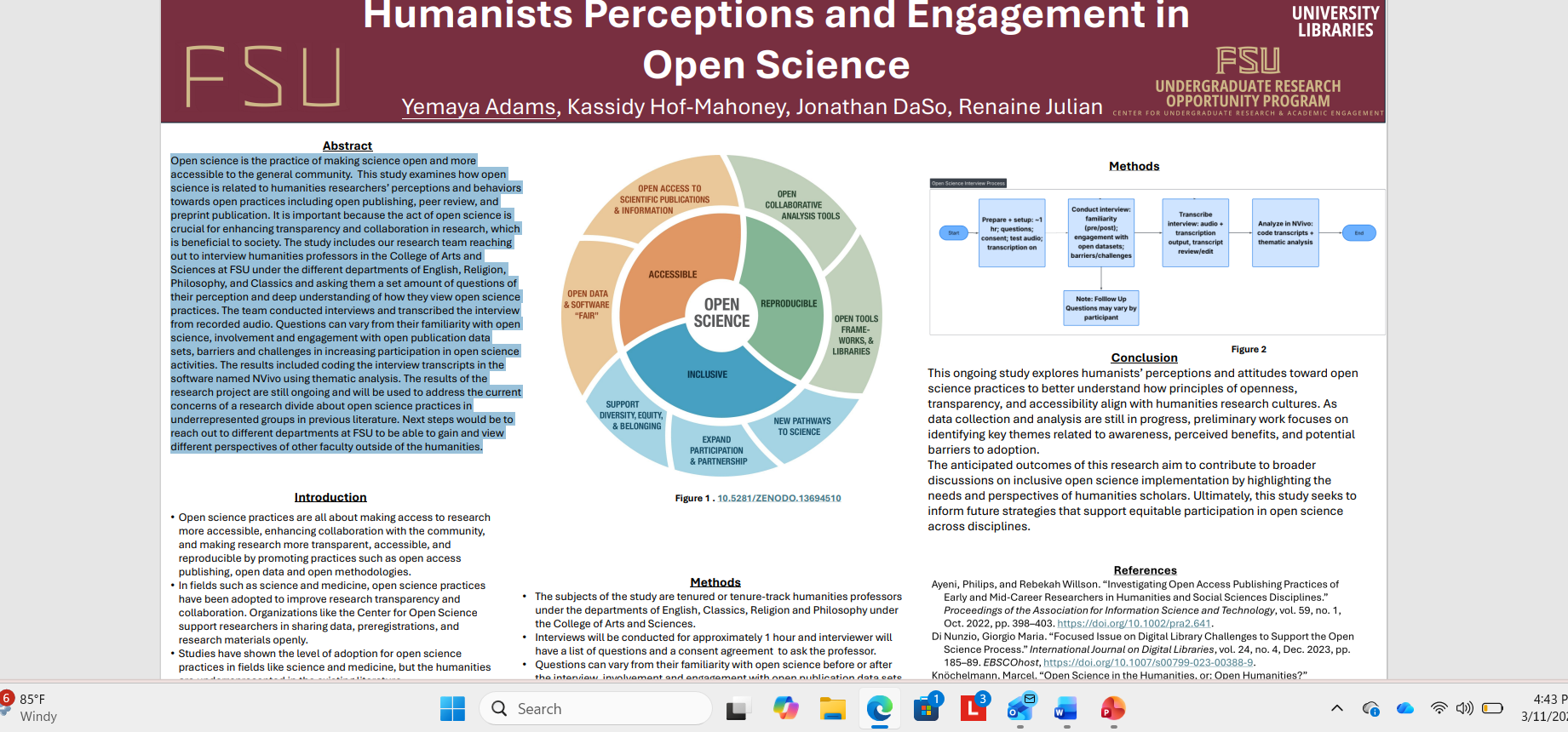
Open science is the practice of making science open and more
accessible to the general community. This study examines how open
science is related to humanities researchers’ perceptions and behaviors
towards open practices including open publishing, peer review, and
preprint publication. It is important because the act of open science is
crucial for enhancing transparency and collaboration in research, which
is beneficial to society. The study includes our research team reaching
out to interview humanities professors in the College of Arts and
Sciences at FSU under the different departments of English, Religion,
Philosophy, and Classics and asking them a set amount of questions of
their perception and deep understanding of how they view open science
practices. The team conducted interviews and transcribed the interview
from recorded audio. Questions can vary from their familiarity with open
science, involvement and engagement with open publication data
sets, barriers and challenges in increasing participation in open science
activities. The results included coding the interview transcripts in the
software named NVivo using thematic analysis. The results of the
research project are still ongoing and will be used to address the current
concerns of a research divide about open science practices in
underrepresented groups in previous literature. Next steps would be to
reach out to different departments at FSU to be able to gain and view
different perspectives of other faculty outside of the humanities.
Keywords: open science, collaborative, accessible