
Research Symposium
26th annual Undergraduate Research Symposium, April 1, 2026
Gioconda Tefel Poster Session 4: 3:00 pm - 4:00 pm / Poster #8

BIO
Gioconda Tefel is a first year student majoring in Anthropology and Environmental Science, with a minor in Museum Studies. She conducted her research on the Botanic Age under Dr. Amy Kowal, and participates in Dr. Eric Shattuck’s SHIRE Lab for disease research. Human history and culture is a guiding interest for her academic career, and defines her goals of better understanding and sharing humanity’s story.
The Botanic Age
Authors: Gioconda Tefel, Amy KowalStudent Major: Anthropology and Environmental Science.
Mentor: Amy Kowal
Mentor's Department: Anthropology Mentor's College: Arts and Sciences Co-Presenters:
Abstract
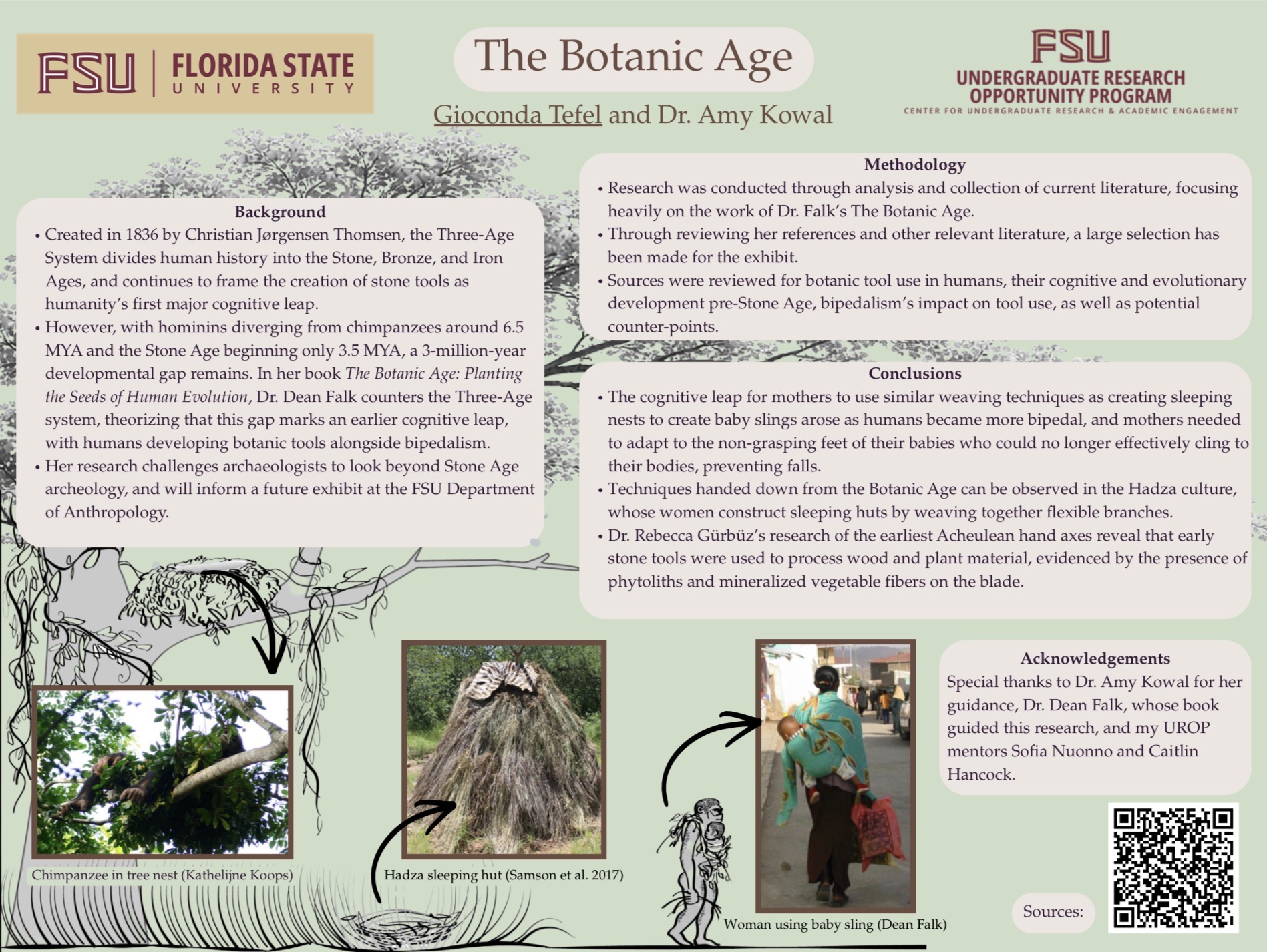
This project explores human cognitive development and evolution during the pre-Stone Age era, or the Botanic Age. Particularly, it focuses on the progress of tool use and bipedalism, and how they interlink with each other and cognitive development. Based upon Dr. Dean Falk’s book titled The Botanic Age (2024) the research counters not only the Three Age System, but the idea that humanity’s great cognitive leap occurred with the advent of stone tools. A strong line of evidence exists to suggest that human’s first cognitive leap occurred before the Stone Age, and instead in the Botanic Age with the rise of bipedalism. Falk theorizes that alongside bipedalism, humans adapted their botanic tree nests into carriers for babies and materials, revealing organized and prefabricated tool use aligned with higher cognition pre-Stone Age. The botanic tree nests, effectively the first ever tools, transitioned with humans as they moved from trees to the ground, becoming ground nests, and then utilitarian tools for mothers and gatherers. Falk’s research thus places women at a central role in the development of the first tools, reframing a traditionally patriarchal view of human history and evolution. This theory and its surrounding research challenge anthropologists to look past the archaeology of the Stone Age to recognize the millions of years of evolution and development occurring beforehand with plant based tools in the Botanic Age. This research will be used by the Museum Anthropology class and will result in a museum exhibit in the Anthropology Department.
Keywords: Anthropology, prehistory, botanic, evolution