
Research Symposium
26th annual Undergraduate Research Symposium, April 1, 2026
Liberty West Poster Session 1: 9:30 am - 10:30 am / Poster #101

BIO
Liberty is a third-year undergraduate student at Florida State University pursuing a dual degree in anthropology and art history with minors in chemistry, museum studies, and Italian. Her research interests include fashion history, art and artifact conservation, illuminated manuscripts, archives, collections management, archaeology, and chemistry. Liberty has experience in archaeology, curation, preventative conservation, and artifact handling through her Bucher-Loewenstein Museum Studies internship in Italy, internship in the Jim Moran College of Entrepreneurship Historic Textiles and Costume Collection, and her Honors in the Major Project focusing on the comparative spectroscopic analysis of Mississippian pottery. After graduation this Spring, Liberty plans to attend a graduate program for book and paper conservation.
Archaeological Spectrometry of Local and Non-local Pottery from the Lower Mississippi Valley
Authors: Liberty West, Dr. Jayur MehtaStudent Major: Anthropology, Art History
Mentor: Dr. Jayur Mehta
Mentor's Department: Anthropology Mentor's College: College of Arts and Sciences Co-Presenters:
Abstract
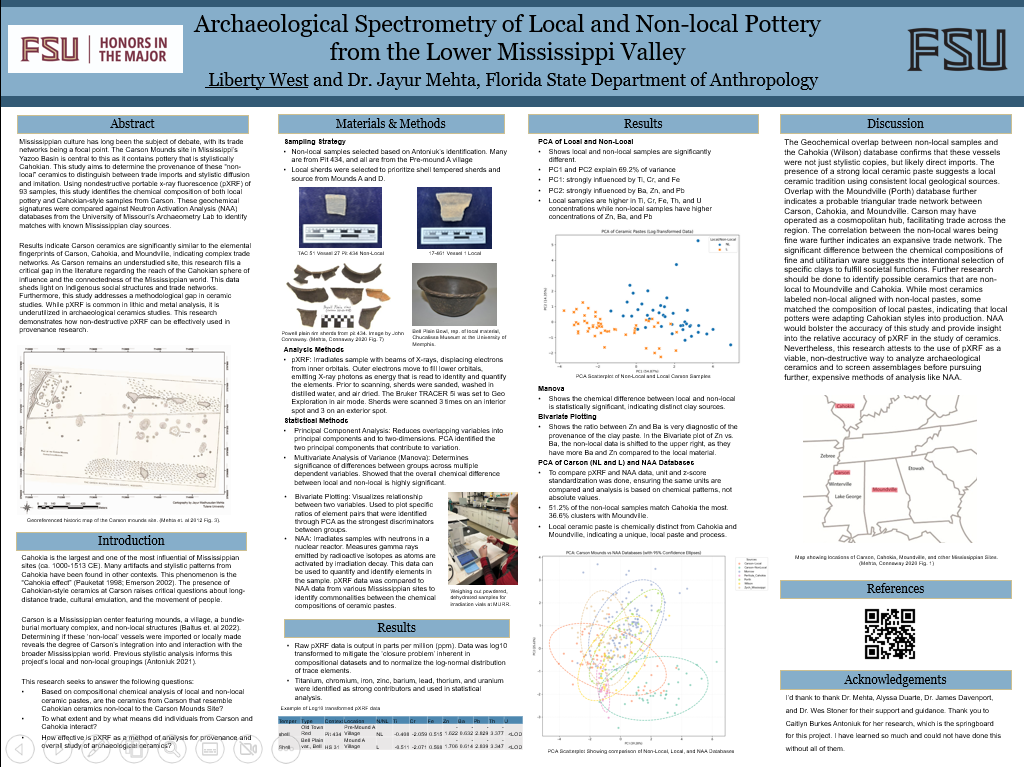
Mississippian culture has long been the subject of debate, with its trade networks being a focal point. The Carson Mounds site in Mississippi’s Yazoo Basin is central to this as it contains pottery that is stylistically Cahokian. This study aims to determine the provenance of these “non-local” ceramics to distinguish between trade imports and stylistic diffusion and imitation. Using nondestructive portable x-ray fluorescence (pXRF) of 93 samples, this study identifies the chemical composition of both local pottery and Cahokian-style samples from Carson. These geochemical signatures were compared against Neutron Activation Analysis (NAA) databases from the University of Missouri’s Archaeometry Lab to identify matches with known Mississippian clay sources.
Results indicate Carson ceramics are significantly similar to the elemental fingerprints of Carson, Cahokia, and Moundville, indicating complex trade networks. As Carson remains an understudied site, this research fills a critical gap in the literature regarding the reach of the Cahokian sphere of influence and the connectedness of the Mississippian world. This data sheds light on Indigenous social structures and trade networks. Furthermore, this study addresses a methodological gap in ceramic studies. While pXRF is common in lithic and metal analysis, it is underutilized in archaeological ceramics studies. This research demonstrates how non-destructive pXRF can be effectively used in provenance research.
Keywords: Archaeology, pXRF, Ceramics, Mississippian, Spectrometry, Neutron Activation Analysis, Provenance