
Research Symposium
26th annual Undergraduate Research Symposium, April 1, 2026
Maddalena Conti Poster Session 2: 10:45 am - 11:45 am / Poster #110
BIO
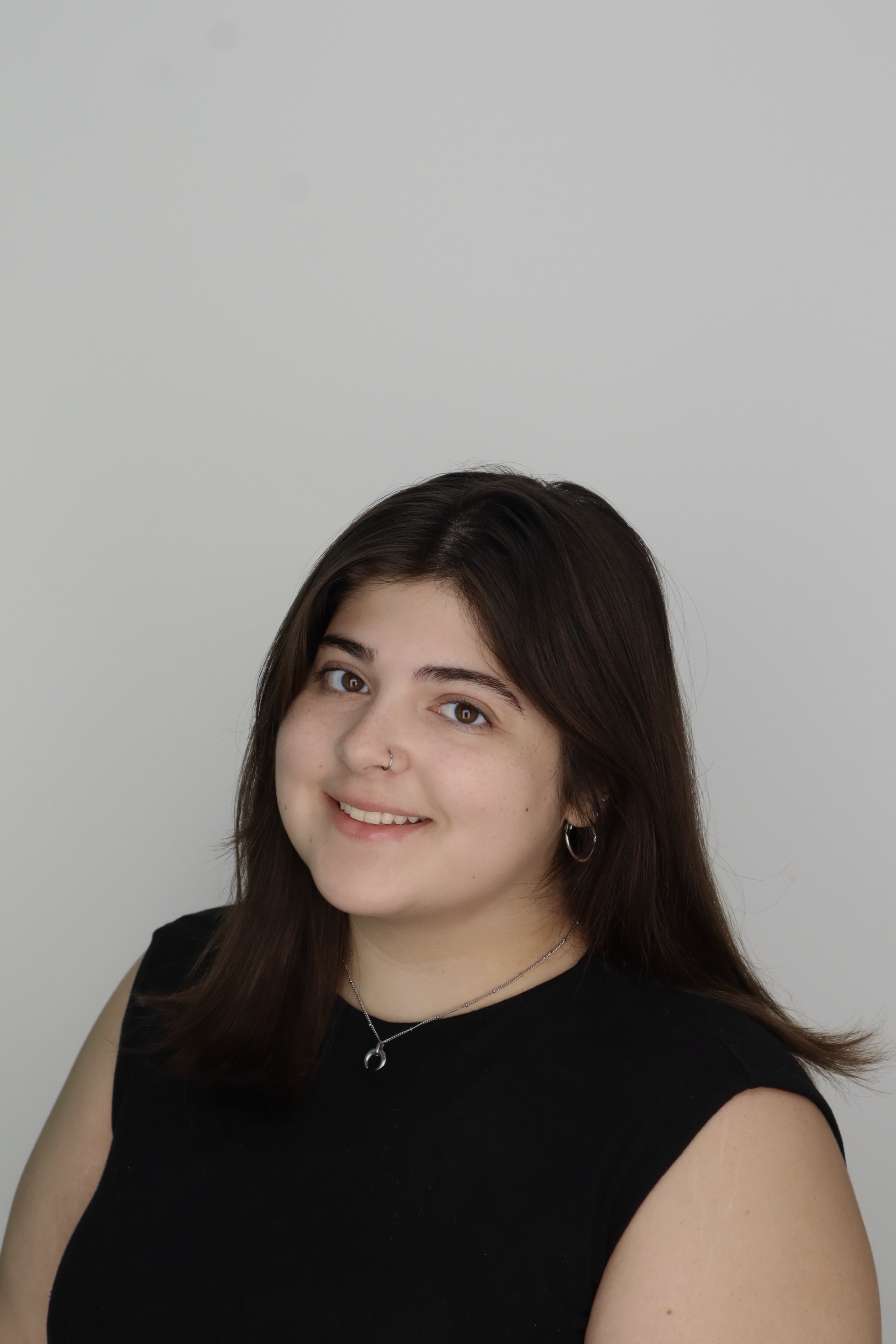
Hi, my name is Maddalena Conti. I am originally from Fort Walton Beach, Florida, and I am currently a second-year student at Florida State University, where I am pursuing a Bachelor of Science in Psychology with a minor in Criminology. I serve as a research assistant in the Learning, Memory, and Language Lab, directed by Dr. Michael Kaschak, where I contribute to ongoing research examining cognitive and linguistic processes. My current work focuses on Nelu Radpour’s project investigating sound-symbolic cross-modal correspondences, which explores how perceptual features and linguistic descriptions interact across sensory modalities. I plan to complete my B.S. in Spring 2026 and intend to pursue graduate study in Clinical Psychology, with a focus on Forensic Psychology.
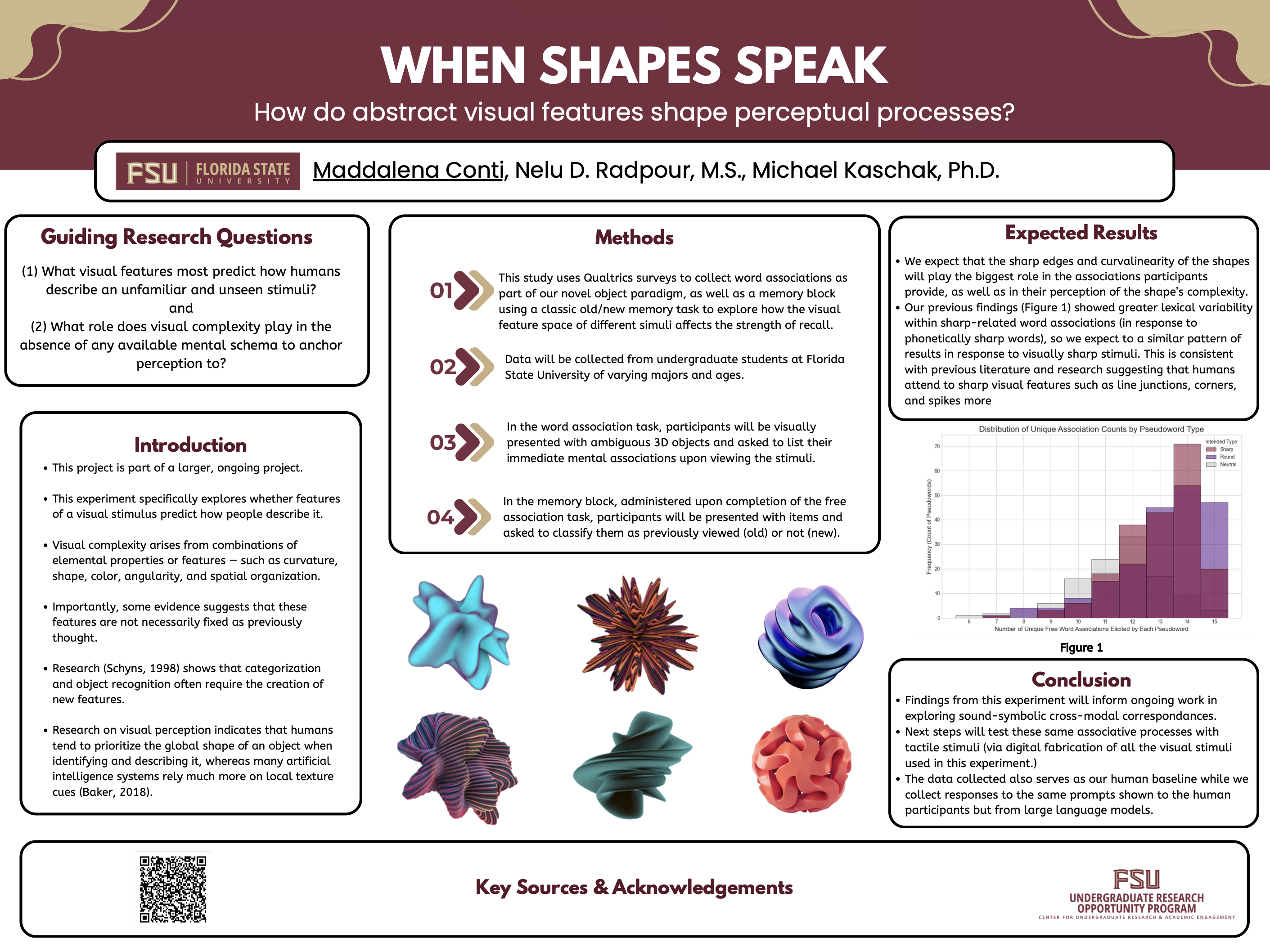
When Shapes Speak - How do abstract visual features shape perceptual processes?
Authors: Maddalena Conti, Michael KaschakStudent Major: Psychology
Mentor: Michael Kaschak
Mentor's Department: Psychology Mentor's College: College of Arts and Sciences Co-Presenters:
Abstract
Without even realizing it, the categories that exist in our minds (our mental schemas) shape how we interact with and speak about the world. This project has two main guiding research questions: (1) What features of visual complexity most predict how humans describe an unfamiliar visual stimulus and (2) How does visual complexity affect feature recognition when we don’t have any sort of mental schema to immediately anchor our perception to? This project is part of a broader research project that, overall, focuses on how and why humans choose specific words or categories when faced with various ambiguous stimuli. In this segment of the project, however, I focus on the descriptions and associations that participants generate for visual stimuli based on what elements are most salient in the given feature space.
When exploring complexity, the various features that make it up (curvature, shape, color, angularity, and spatial organization, etc.) must be considered. To answer our research question, we primarily make use of spontaneous word association generation. Since this research is still in its early stages, the main results have not yet been recorded. So far, one of the main hypotheses of this segment of the project is that the more visually complex or abstract a presented stimuli, the more variability is expected in participants’ descriptions of the stimulus.
Keywords: Perception, complexity, word association, categorization, psychology