
Research Symposium
26th annual Undergraduate Research Symposium, April 1, 2026
Reese Weicht Poster Session 2: 10:45 am - 11:45 am / Poster #182

BIO
Reese Weicht is a history major at Florida State University with a minor in Museum Studies,
pursuing professional and academic interests in archaeology and public history. She is strongly
committed to academics, working to grow valuable research and writing skills with leadership
experience through Phi Mu, Acabelles at Florida State University, and roles in the performing arts both on
and off campus. Reese is passionate about sharing history with broader audiences and making
history exciting. Reese’s career interests include archaeological field work, historical
preservation and museum curation. This summer, Reese will be studying internationally with FSU to engage in archaeological field work in Northern Italy.
Progress Over People: Consequences of Everglades Drainage Projects 1900-1930
Authors: Reese Weicht, Andrew FrankStudent Major: History
Mentor: Andrew Frank
Mentor's Department: History Mentor's College: Arts and Sciences Co-Presenters:
Abstract
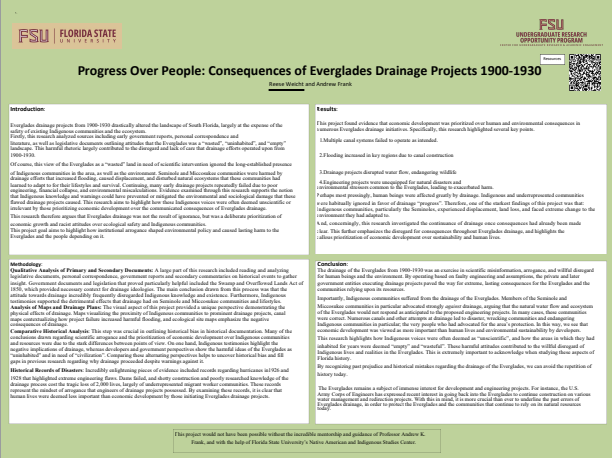
From 1900-1930, developers and the government engaged in massive drainage projects in the Florida Everglades. Drainage aimed to encourage settlement, agricultural development, and economic growth. This research examines how these decisions caused lasting environmental and cultural damage. Furthermore, it analyzes how Indigenous warnings, particularly from the Seminoles, were systematically ignored, and how developers operated on faulty knowledge because of this ignorance. Focusing on often disregarded Indigenous perspectives challenges the misconception that drainage was entirely positive.
Research methods included analysis of primary and secondary historical sources. Primary sources such as government documents and firsthand accounts of drainage create a clearer picture of how voices of protest were ignored. Secondary sources, such as environmental and tribal records, as well as canal maps, were used to evaluate lasting damage to the environment and existing communities. Synthesizing sources helped explain how economic development was prioritized over significant drainage concerns.
This research found that many drainage projects were insufficiently planned and often based on overconfidence in flawed engineering rather than scientific accuracy. Numerous canals failed to operate as originally intended. These faulty canal systems flooded Indigenous communities, endangered wildlife, and disrupted water flow in the Everglades. Evidence to this point emphasizes how economic development was prioritized over the environment and indigenous communities.
Conclusively, this research outlines that early Everglades drainage projects caused lasting damage by discounting Indigenous knowledge. Examining the consequences of such decisions allows researchers to contextualize Everglades history while preventing the repetition of that history in the Everglades today.
Keywords: Indigenous, Everglades, Seminole