
Research Symposium
26th annual Undergraduate Research Symposium, April 1, 2026
Emma Prior Poster Session 2: 10:45 am - 11:45 am / Poster #52

BIO
Emma Prior is a Junior from Jacksonville, Florida majoring in Psychology with a minor in Child Development. She has received the honor of Presidents List each semester from Fall 2023 to Fall 2025. She has been working under her faculty mentor, Tehila Nugiel, and has been a research assistant in the Learning Brain Lab since Spring 2025. Her graduate school goals are to earn her Masters Degree in Mental Health Counseling and to eventually become a Licensed Mental Health Counselor.
The Impacts of Urban vs. Rural Poverty on Brain Network Functional Connectivity and Mental Health
Authors: Emma Prior, Tehila NugielStudent Major: Psychology
Mentor: Tehila Nugiel
Mentor's Department: Department of Psychology Mentor's College: College of Arts and Sciences Co-Presenters: Abigail Okey
Abstract
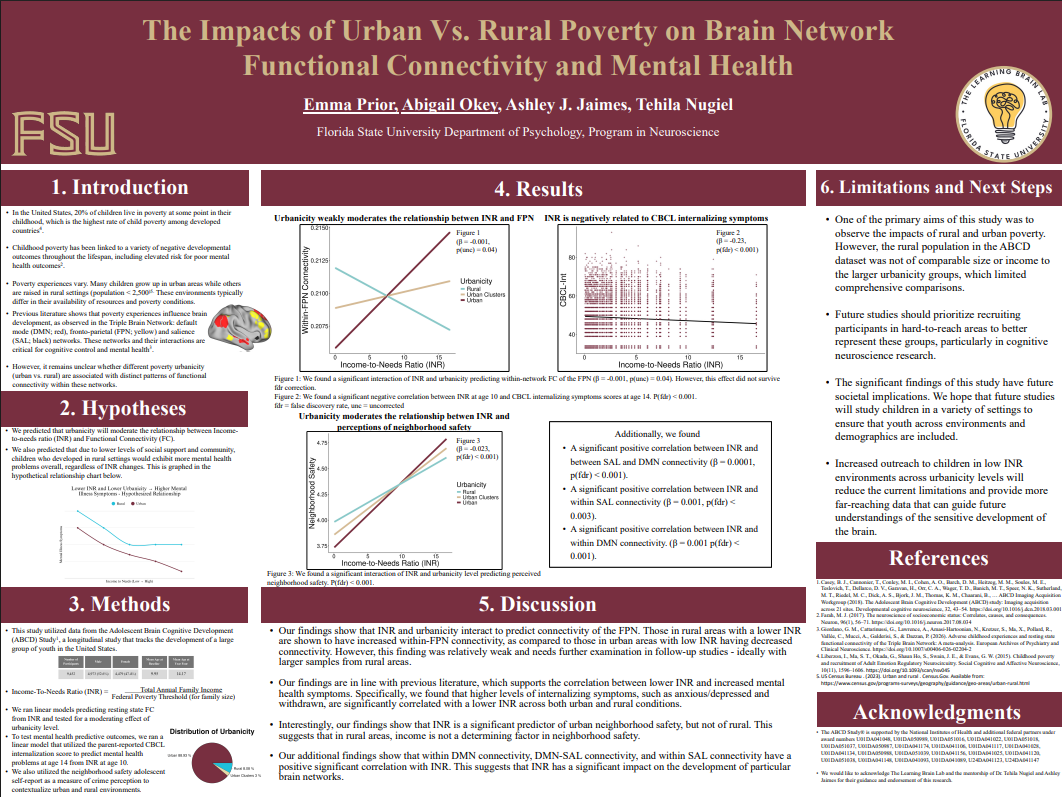
Studies show that 20-30% of children in the United States experience poverty conditions at some point in their lives. Childhood poverty has been linked to future mental health problems through its various impacts on brain development. However, poverty is not the same throughout the United States. A majority of these children will grow up in urban poverty, while others will grow up in rural settings. In these two environments, there are a variety of experiences that lead to different developmental trajectories and outcomes. Using resting-state functional magnetic resonance imaging (fMRI) data collected from the Adolescent Brain Cognitive Development (ABCD) Study at baseline (ages 9-10) and child self-report surveys and parental reports at follow-up year 4 (ages 13-14), we aimed to determine how income to needs ratio(INR) in different urbanicity conditions relates to functional connectivity in brain networks associated with psychopathology. We also aimed to study whether INR is linked to future mental health problems, as seen through impaired connectivity in the aforementioned brain networks. Our research found a significant interaction between INR and urbanicity conditions predicting within-network DMN connectivity, such that the participants in more urban environments had a stronger relationship between INR and within-network DMN connectivity. It was also found that children in lower INR demonstrated higher symptoms of internalized emotional distress, as reported in the Child Behavioral Checklist. Next steps include determining at what ages these functional connections begin to shift across urbanicity environments at different levels of INR, and whether these differences persist throughout the lifespan.
Keywords: Poverty, functional connectivity, mental health