
Research Symposium
26th annual Undergraduate Research Symposium, April 1, 2026
Alejandra Ortega Torres Poster Session 3: 1:45 pm - 2:45 pm / Poster #22

BIO
Alejandra Ortega Torres is a freshman at Florida State University pursuing a Bachelor of Science in Psychology and a Bachelor of Science in Criminology. She is actively involved in research through the Undergraduate Research Opportunity Program (UROP), where she works on a project examining cognitive models used to predict early indicators of Alzheimer’s disease. Her research focuses on differences in cognitive performance such as memory, attention, and visuospatial skills between individuals with mild cognitive impairment and healthy older adults. Through this work, she contributes to data analysis and the interpretation of preliminary findings aimed at improving early detection of neurodegenerative conditions.
In addition to her research, Alejandra is engaged in several campus organizations focused on leadership and mental health advocacy. She is an active member of FSU RENEW (Realizing Everyone’s Needs for Emotional Wellness), collaborating with Florida State University’s Counseling and Psychological Services to promote student mental health and well-being.
Alejandra plans to pursue graduate study in psychology, with the long-term goal of contributing to research and interventions that improve mental health outcomes and cognitive health across diverse populations.
Evaluating Predictors of MCI – A Meta Analysis
Authors: Alejandra Ortega Torres, Dorota Kossowska-KuhnStudent Major: Psychology
Mentor: Dorota Kossowska-Kuhn
Mentor's Department: Psychology Mentor's College: Florida State University Co-Presenters: Lauren Leis, Robert Dyer
Abstract
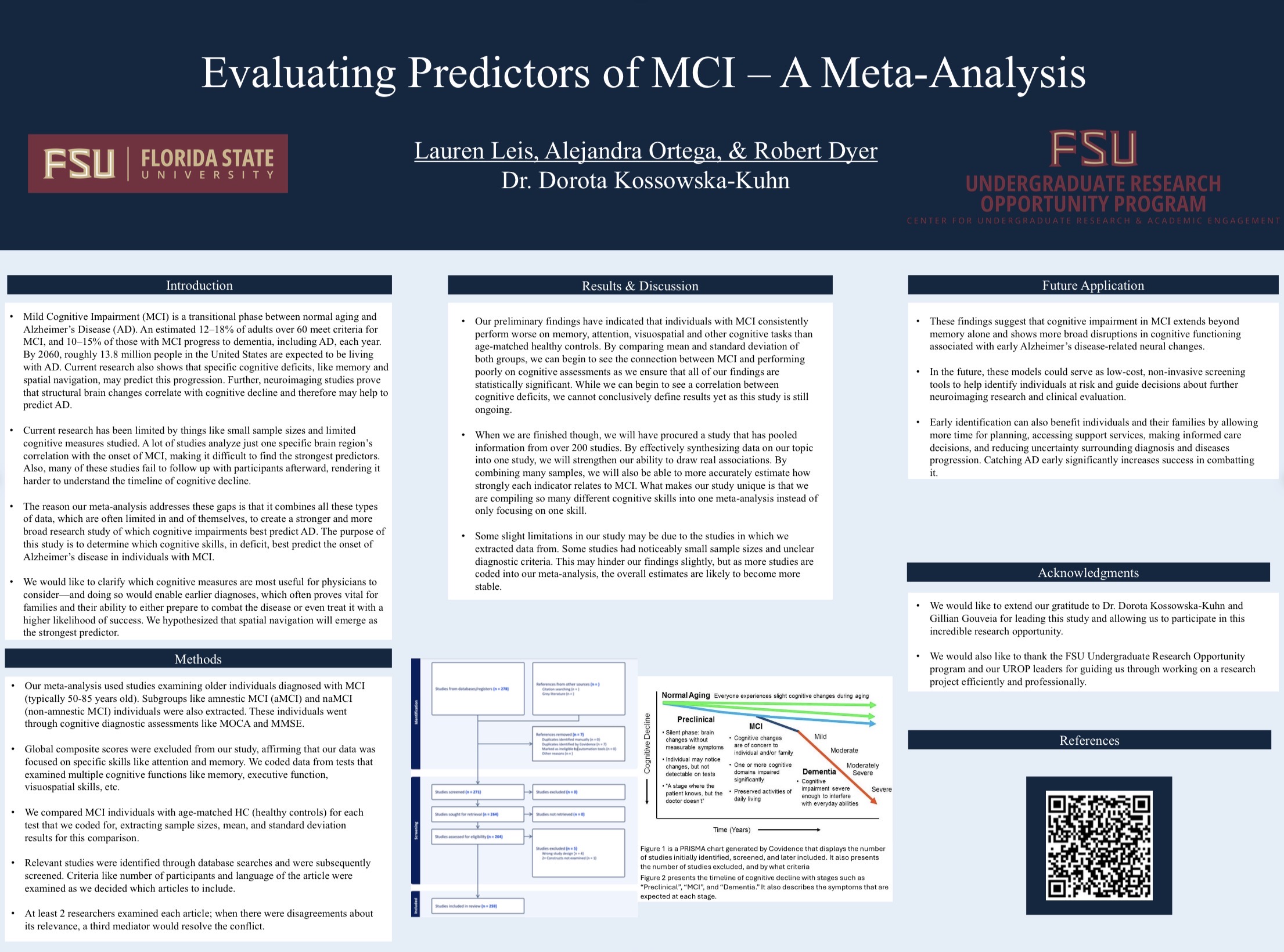
Mild Cognitive Impairment (MCI) is a transitional phase between normal aging and Alzheimer’s Disease (AD). Research shows that individuals who have MCI are more prone to progressing into AD, but not everyone with MCI develops Alzheimer’s. Current research also shows that specific cognitive deficits, like memory and spatial navigation, may predict this progression. Further, neuroimaging studies prove that structural brain changes correlate with cognitive decline and therefore may help to predict AD.
Current research has been limited by things like small sample sizes and limited cognitive measures studied. A lot of studies analyze just one specific brain region’s correlation with the onset of MCI, making it difficult to find the strongest predictors. Also, many of these studies fail to follow up with participants afterward, rendering it harder to
understand the timeline of cognitive decline. The reason our meta-analysis addresses these gaps is that it combines all of these types of data, which are often limited in and of themselves, to create a stronger and more broad research study of which cognitive impairments best predict AD. The purpose of this study is to determine which cognitive skills, in deficit, best predict the onset of Alzheimer’s disease in individuals with MCI.
We would like to clarify which cognitive measures are most useful for physicians to
consider—and doing so would enable earlier diagnoses, which often proves vital for families and their ability to either prepare to combat the disease or even treat it with a higher likelihood of success.
Keywords: Alzheimers, analysis, psychology