
Research Symposium
26th annual Undergraduate Research Symposium, April 1, 2026
Bianca Avlonitis Poster Session 1: 9:30 am - 10:30 am / Poster #35

BIO
Bianca Avlonitis is a Computer Engineering student at the FAMU-FSU College of Engineering who recently transferred from Embry-Riddle Aeronautical University and is an active member of the Institute of Electrical and Electronics Engineers (IEEE). She has both research and internship experience working at the FSU Center for Advanced Power Systems and Computer Servants. Throughout her academic and work experience, Bianca has developed a specialty in Unmanned Aerial Systems, Cybersecurity, and Autonomous Robotics.
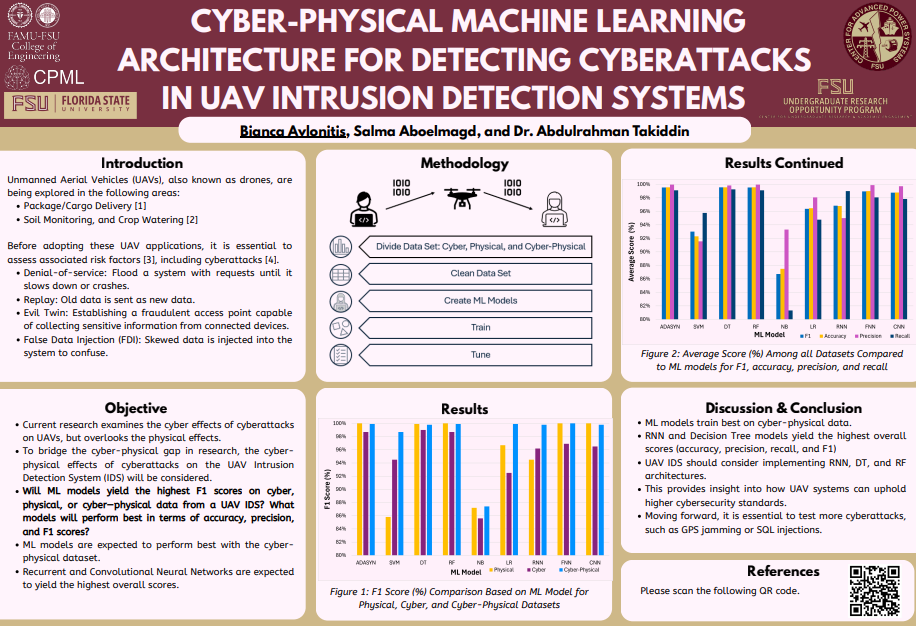
Cyber-Physical Machine Learning Architecture for Detecting Cyberattacks In UAV Intrusion Detection Systems
Authors: Bianca Avlonitis, Salma AboelmagdStudent Major: Computer Engineering
Mentor: Salma Aboelmagd
Mentor's Department: Electrical & Computer Engineering Mentor's College: FAMU-FSU College of Engineering Co-Presenters:
Abstract
Modern applications of Unmanned Aerial Vehicles (UAVs) are increasingly considered for operations such as package delivery and crop watering. Despite their versatility, UAV systems are susceptible to cyberattacks, including denial-of-service, replay, evil twin, and false data injection. Consequently, it is critical to evaluate UAV behavior and performance during real-time operations. While a UAV is deployed, an intrusion detection system (IDS) monitors system inputs to identify cyberattacks. Current research addresses how Machine Learning (ML) models can optimize IDS performance based on cyber data, but fails to acknowledge the physical inputs. This paper will bridge the cyber-physical research gap by raising the question, “Will ML models yield the highest performance from training on cyber, physical, or cyber-physical data from a UAV IDS? What ML models will yield accuracy, precision, and F1 scores? These questions are answered by training both deep and shallow ML models on cyber, physical, and cyber-physical datasets. Deep and shallow ML models were developed on a Python IDE platform and trained using a publicly available dataset that simulates a UAV experiencing incoming cyberattacks. It is expected that ML models will overall perform the best when trained on cyber-physical data, and the Convolutional and Recurrent Neural Network models will yield the highest overall results. Moving forward, as cyberattack strategies targeting UAV systems continue to develop, it is essential to research the newest approaches to enhance the safety and reliability of UAV systems.
Keywords: Unmanned Aerial Vehicles (UAV), Machine Learning (ML), Cyberattacks, Intrusion Detection System (IDS), Neural Networks