
Research Symposium
26th annual Undergraduate Research Symposium, April 1, 2026
Madison Taylor Poster Session 3: 1:45 pm - 2:45 pm / Poster #11

BIO
Madison is a highly motivated and team-oriented 2nd-year student pursuing a Bachelor of Science degree with a major in Clinical Professions. Her goal is to attend medical school followed by a career in healthcare. She has over four years of active volunteering, research, and leadership experience. Madison is passionate about helping others through service and providing care to those in need.
Meta-Analysis of Risk-Factors for Dyslexia
Authors: Madison Taylor, Richard WagnerStudent Major: IMS - Clinical Professions
Mentor: Richard Wagner
Mentor's Department: Psychology Mentor's College: Arts and Sciences Co-Presenters: Brendan McNamara, Alyssa Montanez, Brendan Hanbury
Abstract
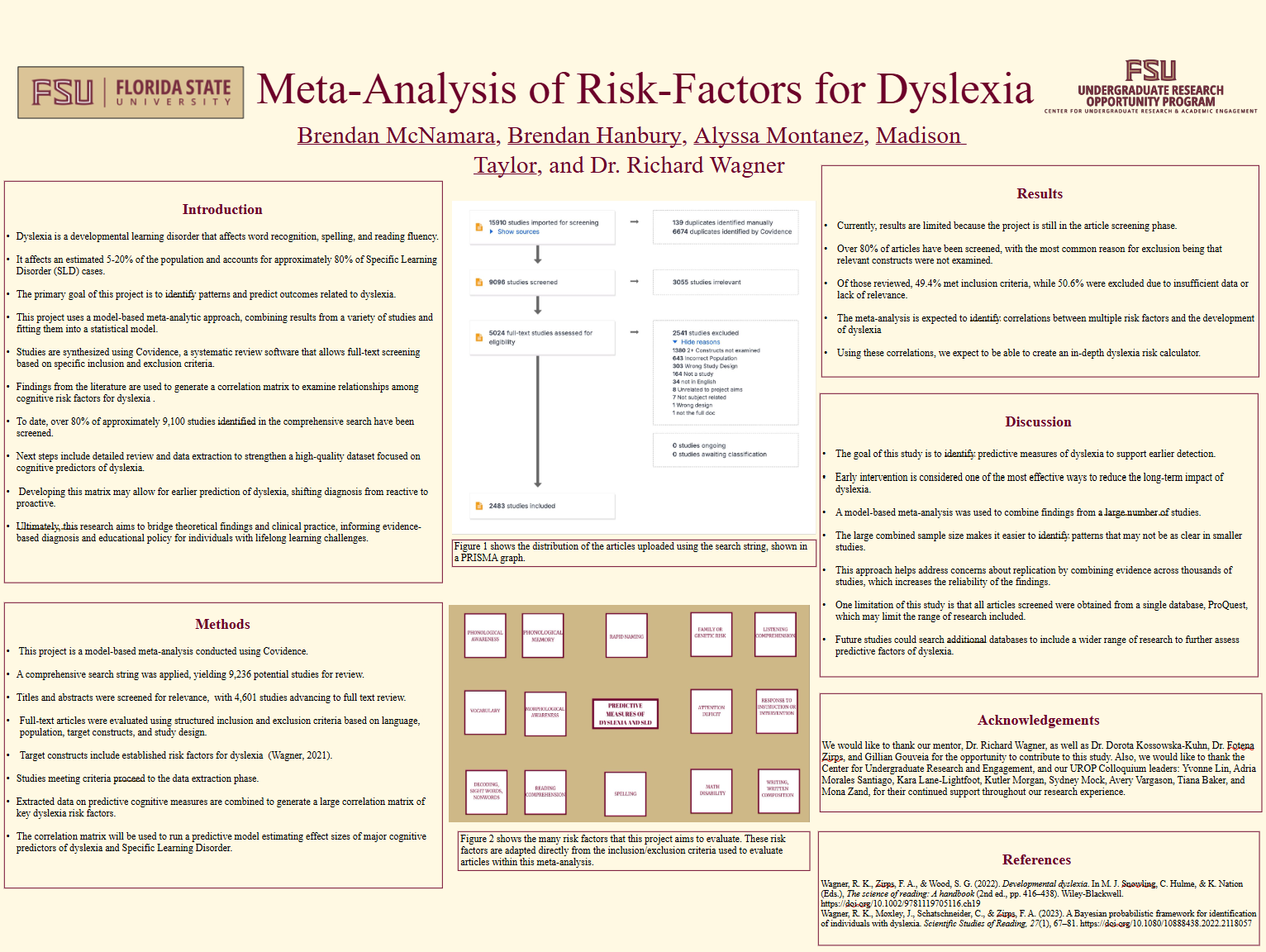
Dyslexia is a distinct, complex neurodevelopmental condition that significantly impacts lifelong educational outcomes and affects up to 20% of the population. Dyslexia is primarily characterized by impaired word recognition and decoding difficulties. While there has been much research on dyslexia, individual small-scale studies often lack the necessary statistical power to generalize these findings across a multitude of diverse groups. This research, conducted through Florida State University’s NIH Multidisciplinary Learning Disabilities Research Center, utilizes a large-scale meta-analysis to establish an evidence-based understanding of the prevalence and underlying mechanisms of dyslexia. The methodology follows a rigorous systematic framework to screen and synthesize decades of global research. Following an extensive literature review of over 3,800 identified studies, researchers applied a standardized codebook and strict inclusionary criteria to exclude methodologically unsound data and refine the sample. Preliminary results have yielded a group of high-quality studies that provide precise effect sizes regarding the cognitive and behavioral markers of this disorder. By aggregating these data, the project is developing a large-scale correlation matrix to identify and weight predictive neurobiological signs. These findings underscore the importance of treating dyslexia as a specific challenge requiring specialized, evidence-based approaches for diagnosis and intervention. Ultimately, this research aims to bridge the gap between laboratory findings and real-world application by creating a robust scientific foundation for earlier prediction, more accurate clinical diagnosis, and more effective instructional policies. This comprehensive synthesis provides the clarity necessary to improve long-term academic trajectories for all individuals who are currently struggling with these learning disabilities.
Keywords: Meta-Analysis, Dyslexia, Specific Learning Disorder, learning disorder, risk factors