
Research Symposium
26th annual Undergraduate Research Symposium, April 1, 2026
Harper Johnson Poster Session 1: 9:30 am - 10:30 am / Poster #185

BIO
Harper Johnson is a junior at Florida State University majoring in Psychology and minoring in Child Development. Originally from Winchester, Virginia, she has been involved in undergraduate research exploring genetic and environmental influences on childhood development for over a year as a Lead DIS Student and Research Assistant in the Context Lab. Her personal research interests include the understanding and treatment of OCD and anxiety across adolescence and early adulthood. Outside of research, Harper is involved on campus as a peer educator and mental health advocate for RENEW, member of the Psi Chi Honor Society, Gamma Phi Beta sorority, and Peak Pulse Run Club. Over the summer, she interns at an outpatient behavioral health clinic where she gains clinical experience with a variety of disorders, therapeutic techniques, and populations. In her free time, Harper enjoys immersing herself in weightlifting and nutrition. She strives to pursue a career as a clinical psychologist, merging her fervor for research with clinical practice to improve patient wellbeing.
GIS-Derived Contextual Predictors of Anxiety Among Children
Authors: Harper Johnson, Dr. Rasheda HaughbrookStudent Major: Psychology
Mentor: Dr. Rasheda Haughbrook
Mentor's Department: Psychology Mentor's College: College of Arts and Sciences Co-Presenters:
Abstract
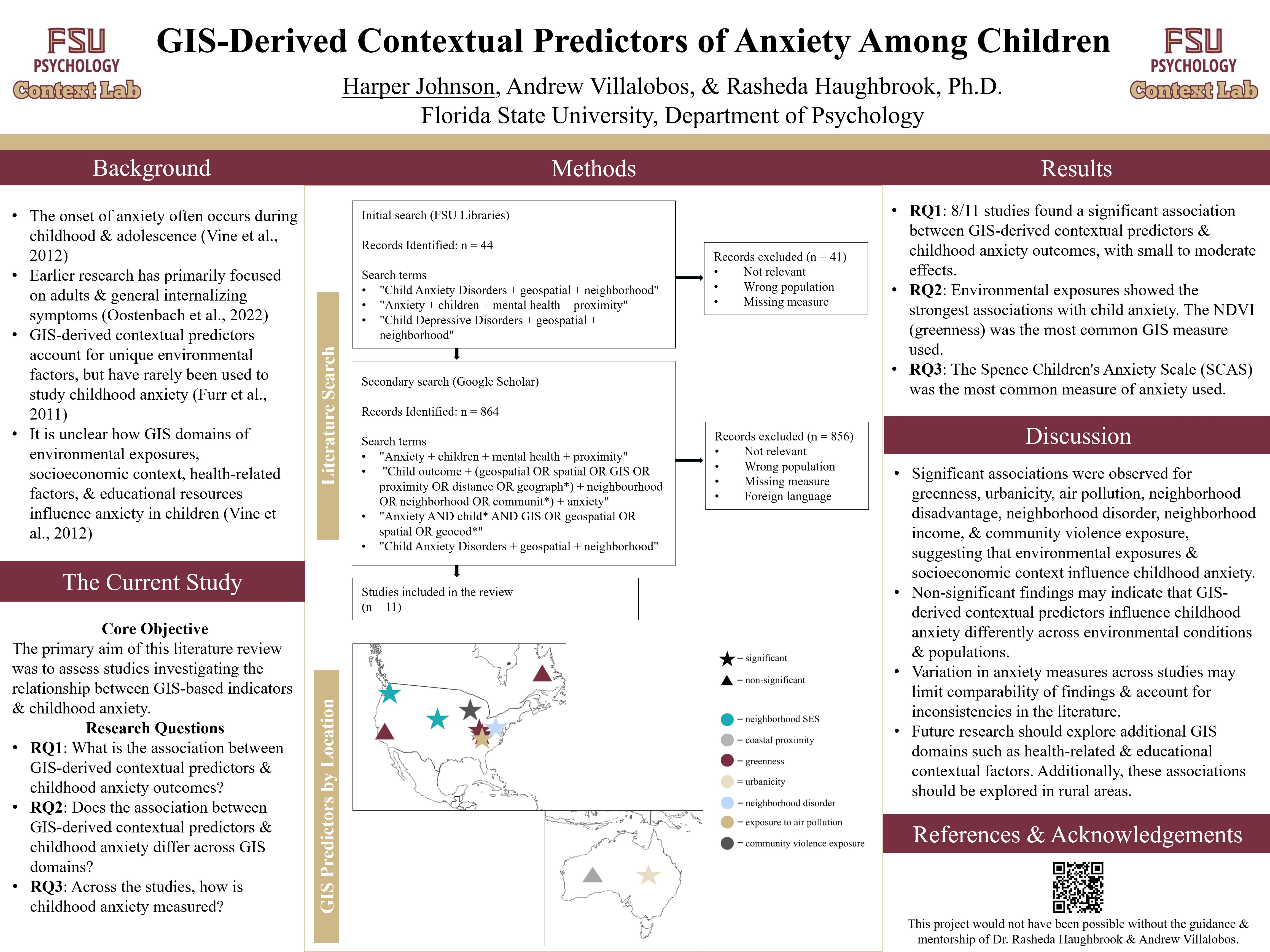
GIS-derived contextual predictors have been shown to relate to mental health outcomes. However, no systematic review has specifically examined their association with children’s anxiety. The primary aim of this literature review was to assess studies investigating the relationship between GIS-based indicators and childhood anxiety. Secondary aims were to document the range of GIS-derived indicators used across studies and to compare their associations across domains. A final aim was to examine how childhood anxiety is measured in the literature. A systematic search of FSU Libraries, Google Scholar, and Scopus identified 11 eligible studies. Eight of the eleven studies reported significant associations between GIS-derived contextual predictors and children’s anxiety outcomes, with small to moderate effect sizes. Environmental exposures emerged as the most consistently predictive domain, with the Normalized Difference Vegetation Index (NDVI) being the most frequently used GIS indicator. The Spence Children’s Anxiety Scale (SCAS) was the most commonly used measure of childhood anxiety. Overall, GIS indicators appear to be a viable tool for identifying environmental factors associated with children’s anxiety outcomes. Future research would benefit from expanding the scope of GIS domains examined, including health-related and educational contextual factors.
Keywords: childhood anxiety, Geographic Information Systems (GIS), contextual predictors