
Research Symposium
26th annual Undergraduate Research Symposium, April 1, 2026
Bianca Maresma Poster Session 4: 3:00 pm - 4:00 pm / Poster #264

BIO
Hi! My name is Bianca Maresma, and I am from Miami, Florida. I am currently a freshman Honors student at Florida State University, majoring in Nursing and minoring in Professional Communication. From a young age, I have aspired to become a registered nurse and eventually pursue advanced practice as a nurse practitioner specializing in pediatrics and spinal orthopedics.
My interest in healthcare has been shaped by hands-on experiences in clinical settings. I have shadowed healthcare professionals at Pinecrest Physical Therapy and Jackson Memorial Hospital in Miami, where I gained insight into patient care, rehabilitation, and interdisciplinary medical teamwork. At Florida State University, I am actively involved in undergraduate research through the Undergraduate Research Opportunity Program (UROP) in the Wilber Lab, where I assist my research mentor, Yicheng Zheng. Through this work, I contribute to research examining spatial navigation and neural processes involved in memory and cognition. This experience has allowed me to develop skills in scientific inquiry, data analysis, and collaborative research.
Looking ahead, I plan to continue my research through a Directed Individual Study (DIS) with the Wilber Lab while further exploring the connections between neuroscience, psychology, and the rodent brain. My long-term goal is to integrate clinical practice with research to improve care and quality of life for pediatric patients.
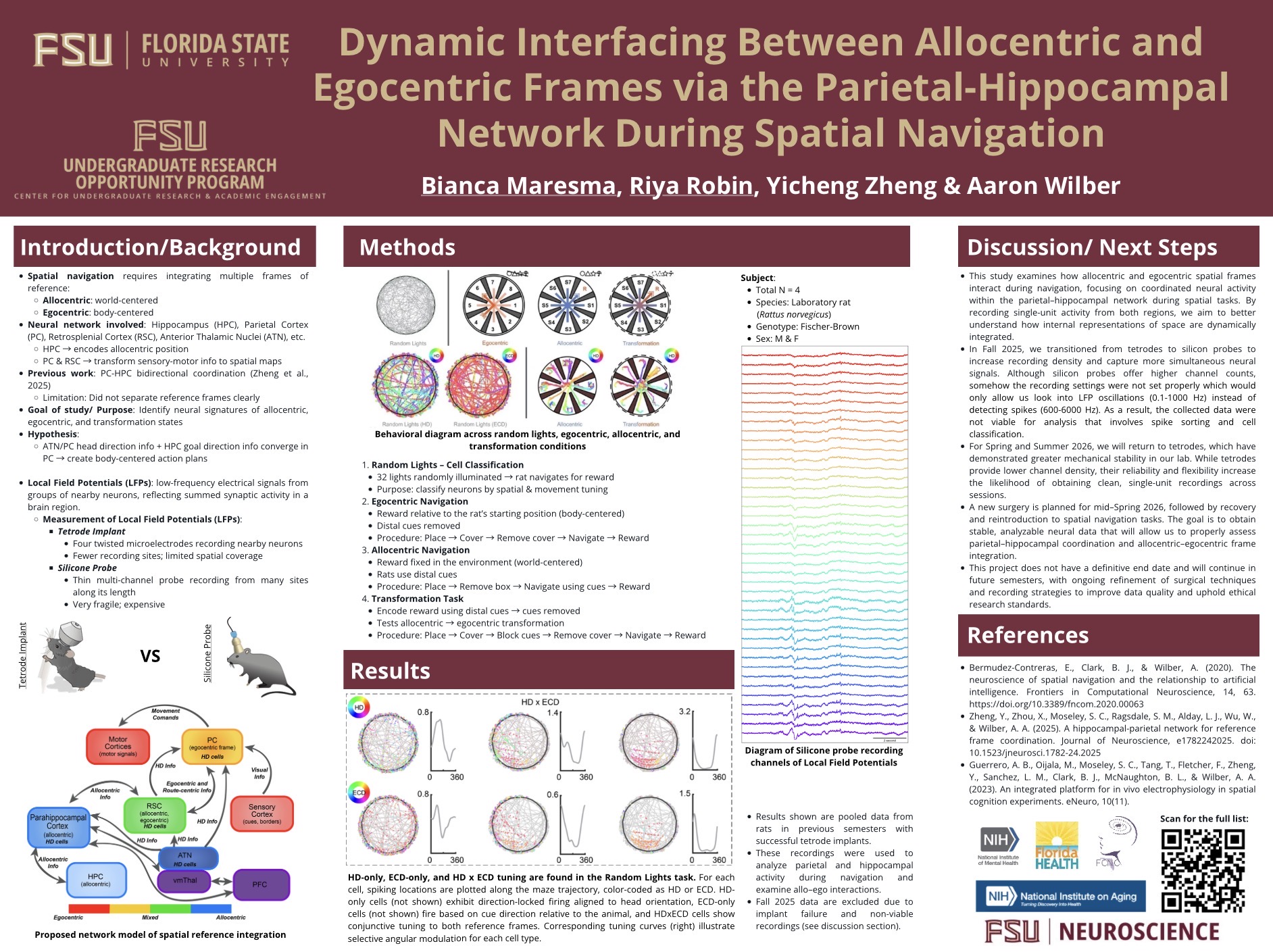
Dynamic Interfacing Between Allocentric and Egocentric Frames via the Parietal-Hippocampal Network During Spatial Navigation
Authors: Bianca Maresma, Yicheng ZhengStudent Major: Nursing
Mentor: Yicheng Zheng
Mentor's Department: Department of Psychology Mentor's College: College of Arts and Sciences Co-Presenters: Riya Robin
Abstract
Spatial navigation deficits are an early and prominent feature of Alzheimer's disease, yet the neural mechanisms underlying these impairments remain unclear. This project investigates how different spatial reference frames, including allocentric, egocentric, and transformation, are represented in the brain and how disruptions to these processes may contribute to spatial disorientation in neurodegenerative disease. Rats were trained on four navigation tasks designed to separate different aspects of spatial processing to investigate these systems. Rats moved toward randomly lit signals in the Random Lights task to evaluate brain tuning across a range of movement parameters. In the egocentric task, when distal cues were unavailable, rats learnt a fixed movement path to a reward zone defined relative to their starting position. In the Allocentric challenge, rats used distal environmental cues to identify an unmarked reward zone. In the Transformation task, rats had to translate allocentric information into egocentric movement plans after initially encoding the reward location using distal cues that were subsequently hidden. To investigate how spatial information is encoded under various situations, behavioral and neural data were gathered while the task was being performed using a silicone probe implant. Preliminary findings suggest that distinct neural activity patterns are associated with each reference frame, with coordinated hippocampal and parietal activity playing a critical role in successful navigation. These results highlight the importance of reference frame coordination in spatial cognition and provide insight into mechanisms that may be disrupted in Alzheimer's disease.
Keywords: spatial navigation, memory, cognition, Alzheimer's Disease, psychology