
Research Symposium
26th annual Undergraduate Research Symposium, April 1, 2026
Nathalia Benner Poster Session 2: 10:45 am - 11:45 am / Poster #106

BIO
Nathalia Benner is a second-year undergraduate student studying International Affairs on the pre-law track. Originally from Miami, Florida, she is a first-generation student passionate about making a meaningful impact in the field of international law. She has been involved in various areas on campus, including as an Administrative Assistant for the Office of Financial Aid and on the COSSPP Student Leadership Council. Off campus, she also serves on the Student Leadership Team for her church through various volunteer initiatives. After graduation, she hopes to continue her education and pursue a Juris Doctor degree.
Helping or Harming Humans: International Drug Policy and the Effectiveness in Pursuing Medical Availability
Authors: Nathalia Benner, Dr. Mason MarksStudent Major: International Affairs
Mentor: Dr. Mason Marks
Mentor's Department: FSU College of Law Mentor's College: FSU College of Law Co-Presenters:
Abstract
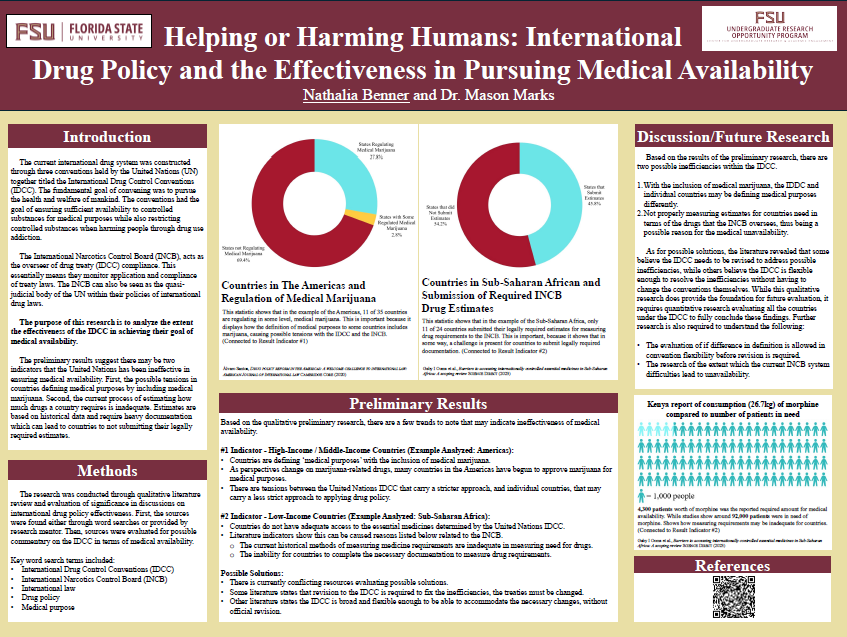
The current international drug control system was established through three United Nations conventions collectively titled The International Drug Control Conventions. The fundamental goal of convening was to pursue the health and welfare of mankind. The conventions had two goals: ensuring sufficient availability of drugs for medical purposes and ensuring adequate restriction of drugs when harming people through drug addiction. The purpose of this research is to analyze the application of medical availability to evaluate the extent of effectiveness of the International Drug Control Conventions. The research was conducted through a literature review for preliminary purposes to evaluate the significance of the literature in measuring international drug policy effectiveness. The methods of including the literature were either through word searches or provided by the research mentor. Then, sources were evaluated for possible commentary on the International Drug Control Conventions in terms of medical availability. The results suggest there may be two indicators in the literature that the United Nations has been ineffective in ensuring medical availability. First, there are possible tensions in the International Drug Control Conventions and countries defining medical purposes by including medical marijuana. Second, the current process of estimating drug requirements may be inadequate because of the estimates and documentation necessities. Overall, additional research is required to confirm if these indicators are true across other member nations of the United Nations International Drug Control Conventions. More quantitative results evaluating all impacted states are also required to make a definitive claim as to its effectiveness.
Keywords: International Law, Law, Drug Policy, United Nations, Medical Availability