
Research Symposium
26th annual Undergraduate Research Symposium, April 1, 2026
Rohan Bansal Poster Session 2: 10:45 am - 11:45 am / Poster #228

BIO
Rohan Bansal is a sophomore at Florida State University pursuing a Bachelor of Science in Economics and Political Science, with a minor in Data Analysis. Originally from Washington, D.C., his academic interests focus on political economy, behavioral economics, and applied economics. Following graduation, he aims to pursue a career in strategic or financial consulting, public policy, or economic and policy analysis. He hopes to use economic analysis to support effective decision making and improve the effectiveness of institutions and markets.
Effects of Zero-Sum Thinking on Anti-Immigration Attitudes
Authors: Rohan Bansal, Dr. Kai OuStudent Major: Economics and Political Science
Mentor: Dr. Kai Ou
Mentor's Department: Department of Political Science Mentor's College: College of Social Sciences and Public Policy Co-Presenters: Chloe Prodromou
Abstract
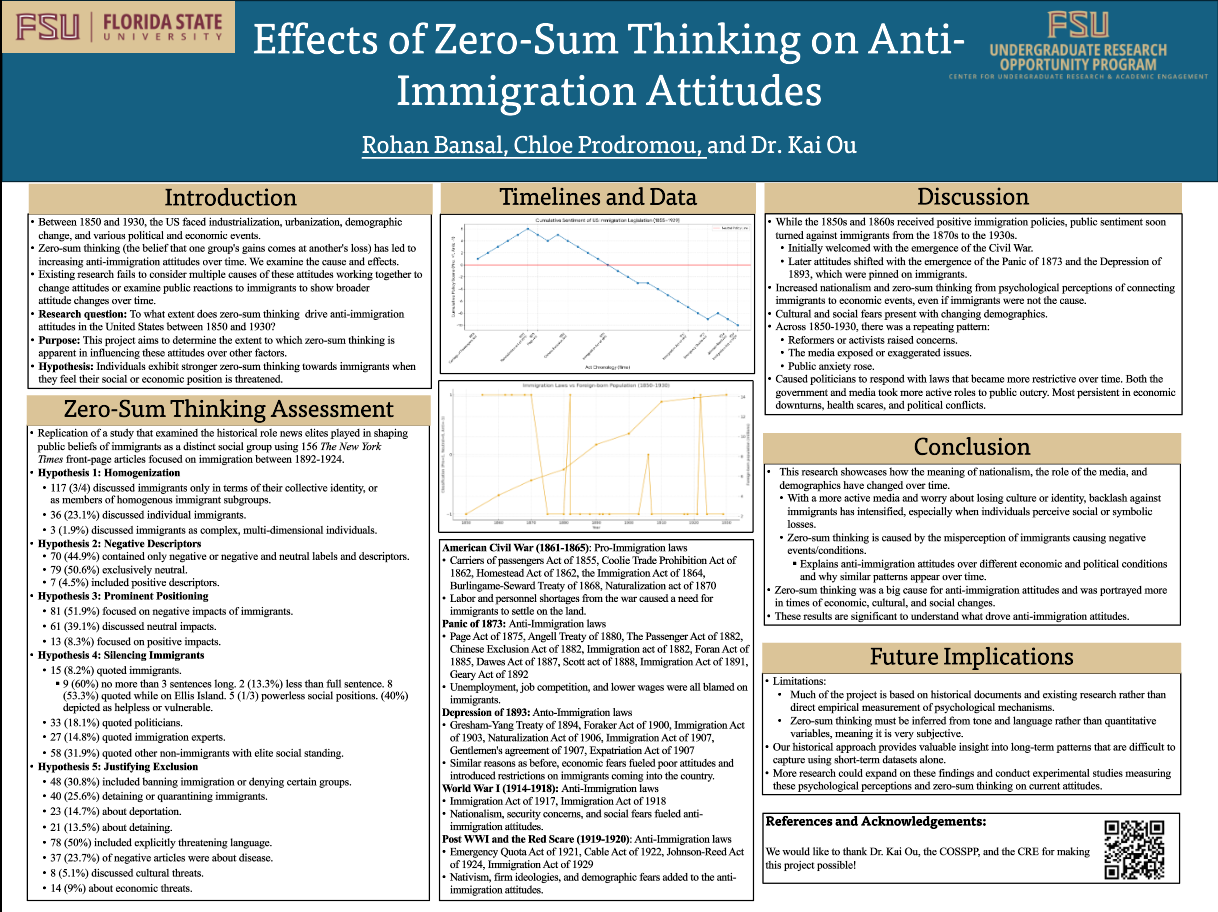
Anti-Immigration attitudes have been held by various United States and foreign citizens, but what factors influence these anti-immigration attitudes? This project aims to determine the extent to which anti-immigration attitudes can be explained by zero-sum thinking, which is the tendency to believe one group’s gains come at another's loss. By examining zero-sum thinking and other relevant factors such as nationalism, patriotism, etc., we can determine what conditions lead to anti-immigration sentiments and whether history is repeating itself. We examined federal legislation from 1850-1930 to see how attitudes shifted over time. Additionally, we replicated a study that examined the historical role news elites played in shaping public beliefs of immigrants as a distinct social group. Through our research, we found that people tend to exhibit high levels of zero-sum thinking when they feel threatened in their current role, which influences negative attitudes. These preliminary results, based on historical documents and statistics, could be further studied through various experiments to ensure strict causality and determine which factors determine anti-immigration attitudes the most. Understanding the causes of anti-immigration attitudes allows us to understand the increasing degree of political polarization, how and why exclusionary policies are enacted, and demonstrates the psychological perceptions in driving public opinion and legislation. By analyzing past and current patterns, we can make predictions about the future and target the factors causing the anti-immigration attitudes.
Keywords: Immigration, Zero-sum, American Politics, Attitudes