
Research Symposium
26th annual Undergraduate Research Symposium, April 1, 2026
Evelyn Bernal Poster Session 1: 9:30 am - 10:30 am / Poster #257

BIO
Evelyn Bernal is a second year student at Florida State University majoring in Biological Sciences while pursuing minors in Chemistry and Interdisciplinary Science. She is interested in understanding how biological and social factors influence health and learning, which has shaped both her academic and research experiences. Evelyn has conducted research with Dr. Wawire on a project examining reading difficulties in students from the perspectives of parents and teachers. This work explored how family and educational environments influence literacy development and highlighted the importance of considering multiple perspectives when studying learning challenges. Through this experience, she developed skills in research analysis and gained a deeper appreciation for how scientific inquiry can help address real world problems. Additionally, Evelyn has completed internships in both a hospital setting and as a medical front office assistant, where she gained exposure to patient care and the daily workings of healthcare environments. After completing her Bachelor of Science degree, Evelyn plans to attend medical school and pursue a career as a physician.
Language Practices and Learning Experiences of at-Risk Learners from Kenya: Parent and Teacher Perspectives
Authors: Evelyn Bernal, Brenda WawireStudent Major: Biological Sciences
Mentor: Brenda Wawire
Mentor's Department: Learning Systems Institute Mentor's College: College of Education, Health, and Human Sciences Co-Presenters: Natalia Pyatt, Drue Langeland
Abstract
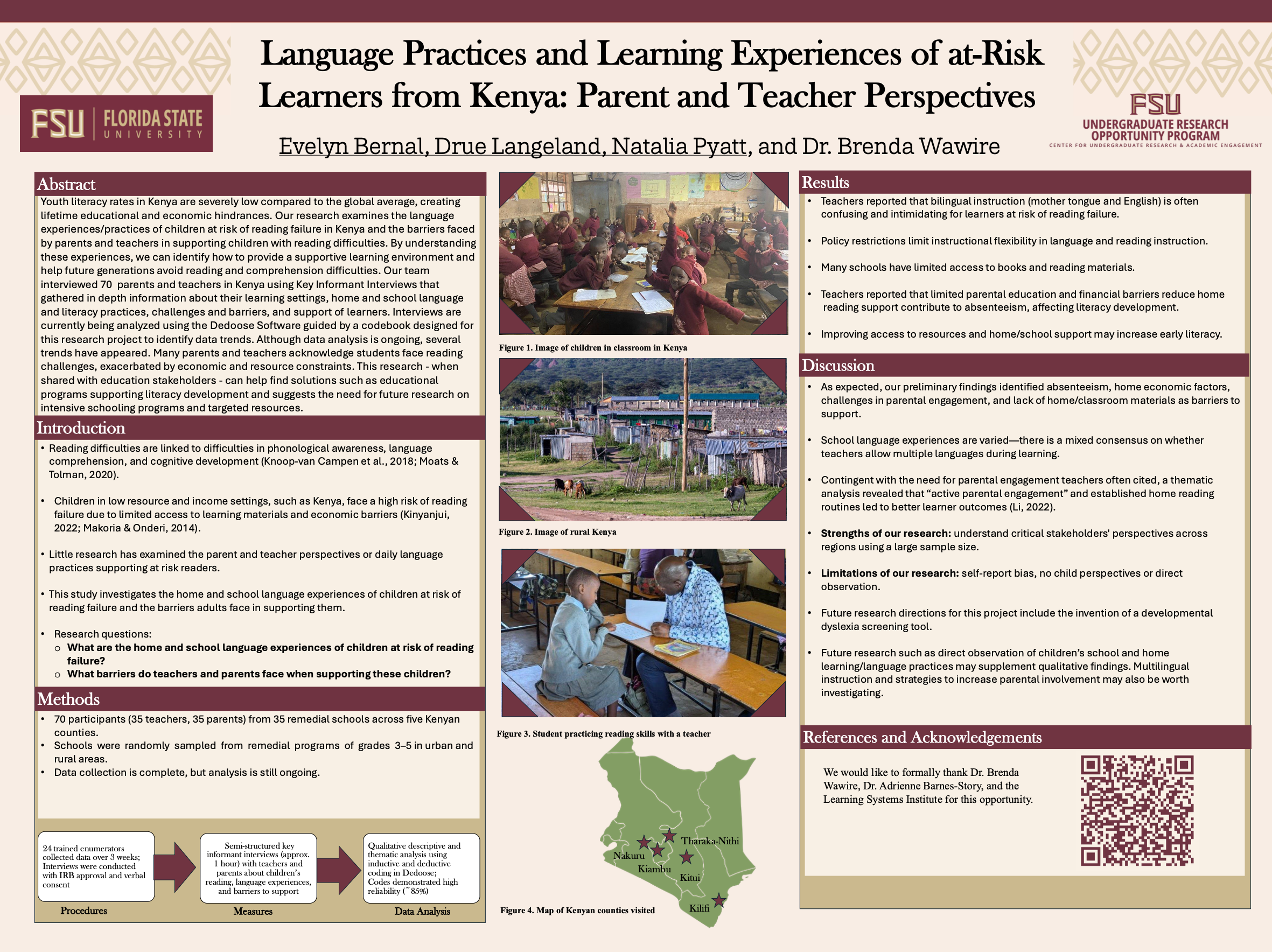
Youth literacy rates in Kenya are severely low compared to the global average, creating lifetime educational and economic hindrances. Our research examines the language experiences/practices of children at risk of reading failure in Kenya and the barriers faced by parents and teachers in supporting children with reading difficulties. By understanding these experiences, we can identify how to provide a supportive learning environment and help future generations avoid reading and comprehension difficulties. Our team interviewed 70 parents and teachers in Kenya using Key Informant Interviews that gathered in depth information about their learning settings, home and school language and literacy practices, challenges and barriers, and support of learners. Interviews are currently being analyzed using the Dedoose Software guided by a codebook designed for this research project to identify data trends. Although data analysis is ongoing, several trends have appeared. Many parents and teachers acknowledge students face reading challenges, exacerbated by economic and resource constraints. This research - when shared with education stakeholders - can help find solutions such as educational programs supporting literacy development and suggests the need for future research on intensive schooling programs and targeted resources.
Keywords: Language, Reading, Kenya, Qualitative