
Research Symposium
26th annual Undergraduate Research Symposium, April 1, 2026
Matt Shedd Poster Session 2: 10:45 am - 11:45 am / Poster #121
BIO
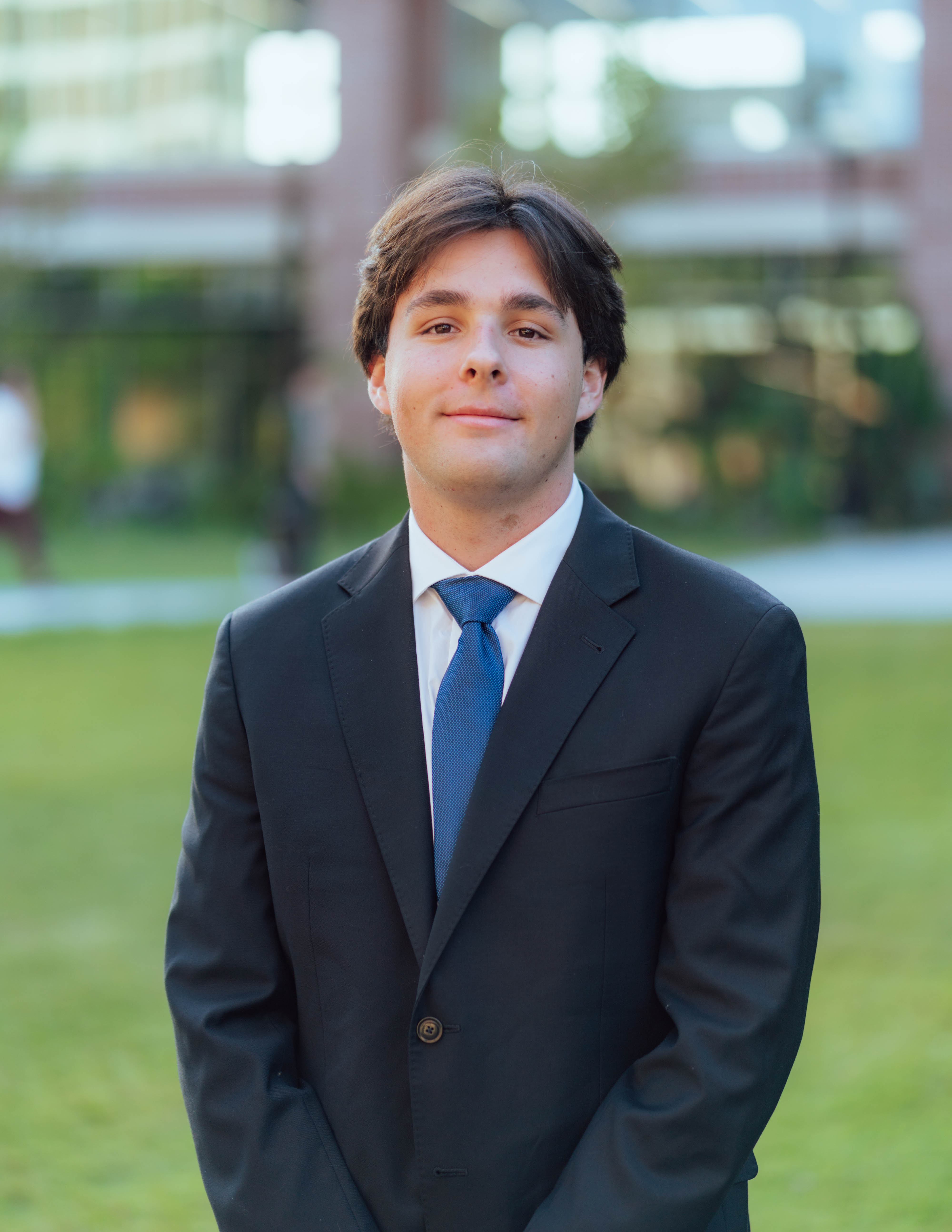
Matt Shedd is a Freshman and Presidential Scholar from Chicago, Illinois. At Florida State University, he is pursuing a dual-degree in Finance and STEM Entrepreneurship with a minor in Environmental Science. He is interested in applying financial analysis, market strategy, and data-driven decision-making to sustainability and environmental consulting. Through internship experience in marketing and leadership roles, he has developed strong analytical, communication, and project coordination skills that translate across business functions. He is passionate about helping organizations make financially sound decisions that also create long-term environmental and social value, and he is seeking opportunities to grow in finance, sustainability strategy, or environmental consulting.
Hometown Bias in Auditing
Authors: Matt Shedd, Aleksandra ZimmermanStudent Major: Finance & STEM Entrepreneurship
Mentor: Aleksandra Zimmerman
Mentor's Department: Accounting Mentor's College: Herbert Wertheim College of Business Co-Presenters: Janie Nguyen & John Barney
Abstract
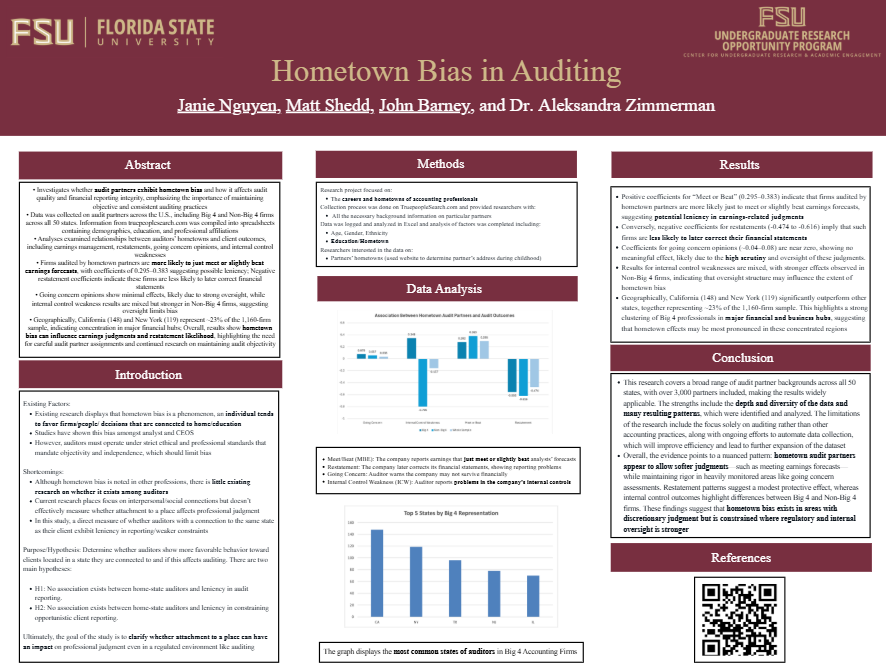
This study investigates whether audit partners exhibit hometown bias, which may affect audit quality and financial reporting integrity. Understanding this bias is important for consistent, objective auditing and broader accounting practices. Data were collected on audit partners across the U.S., including Big 4 and Non-Big 4 firms, spanning all 50 states. Information from public people-finder sources was compiled into spreadsheets capturing demographics, education, and professional affiliations. Analyses examined the relationship between auditors’ hometowns and client outcomes: earnings management, restatements, going concern opinions, and internal control weaknesses. Firms audited by hometown partners are more likely to just meet or slightly beat earnings forecasts, with positive coefficients of 0.295–0.383, suggesting leniency. Negative coefficients for restatements indicate these firms are less likely to later correct financial statements. Going concern opinions show minimal effect, likely due to high oversight. Internal control weakness results are mixed, stronger in Non-Big 4 firms, highlighting the influence of oversight. Geographically, California (148) and New York (119) account for ~23% of the 1,160-firm sample, suggesting hometown effects are concentrated in major financial hubs. The findings demonstrate that hometown bias exists among audit partners, influencing earnings judgments and restatement likelihood, while high-oversight judgments remain largely unaffected. This bias underscores the need for careful audit partner assignments and continued research into mechanisms to maintain objectivity, particularly in concentrated regions.
Keywords: Auditing, Accounting, Bias, Hometown, Firms