
Research Symposium
26th annual Undergraduate Research Symposium, April 1, 2026
Nicolas Santana Poster Session 3: 1:45 pm - 2:45 pm / Poster #197

BIO
Nicolas Santana is a student pursuing a Bachelor of Science in Biochemistry at Florida State University. He participates in the Undergraduate Research Opportunity Program, where he conducts undergraduate research under the mentorship of Dr. Helene Tigro. His work focuses on biochemical and molecular mechanisms relevant to human health, with experience in protein purification, biochemical assays, and laboratory data analysis.
Nicolas is broadly interested in molecular biology, biochemistry, and translational biomedical research. Fluent in English and Portuguese, he is passionate about understanding the molecular basis of disease and applying scientific discovery to improve human health. After completing his undergraduate studies, Nicolas plans to pursue advanced training in medicine while continuing to engage in biomedical research.
Using Co-Precipitation to Study How Phosphorylation Affects α-Actinin-2 Binding to Cardiac Actin
Authors: Nicolas Santana, Helene TigroStudent Major: Biochemistry
Mentor: Helene Tigro
Mentor's Department: Health, Nutrition, & Food Science Mentor's College: College of Health and Human Sciences Co-Presenters:
Abstract
α-Actinin-2 (ACTN2) is a structural protein in cardiac muscle that stabilizes actin filaments at the Z-disc and supports proper contraction during mechanical stress. Structural studies suggest that phosphorylation within the actin-binding domain (ABD) may alter ACTN2 conformation and influence its interaction with actin. However, direct biochemical testing of how phosphorylation-related modifications affect ACTN2–actin binding remains limited.
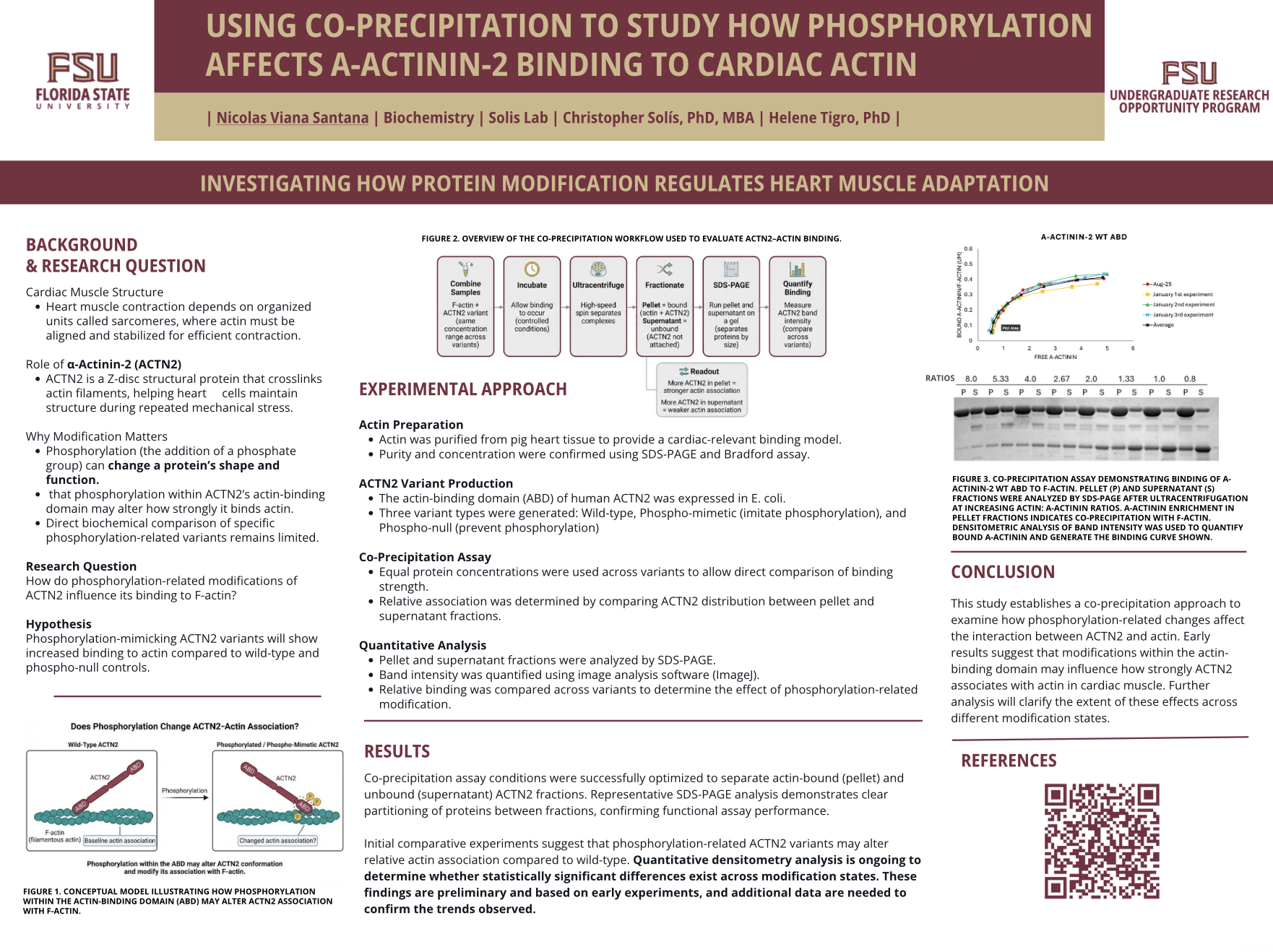
This study uses a co-precipitation assay to examine how phosphorylation-related modifications influence ACTN2 association with filamentous actin (F-actin). Purified F-actin derived from pig heart tissue was incubated with recombinant ACTN2 variants, including wild-type, phospho-mimetic, and phospho-null constructs. Following ultracentrifugation, pellet and supernatant fractions were separated and analyzed by SDS-PAGE to determine the distribution of ACTN2 between actin-bound and unbound fractions.
Preliminary experiments confirm successful separation of actin-bound and unbound protein fractions and demonstrate co-sedimentation of ACTN2 with F-actin. Quantitative densitometry analysis was used to calculate bound versus free ACTN2 across increasing actin:α-actinin ratios, generating binding curves from multiple independent experiments.
These results establish a functional co-precipitation framework to evaluate how phosphorylation-related modifications influence ACTN2–actin association. Continued analysis will further determine how specific modifications within the actin-binding domain regulate structural protein interactions in cardiac muscle.
Keywords: Actin Actinin Cardiac Protein-binding Biochemistry