
Research Symposium
26th annual Undergraduate Research Symposium, April 1, 2026
Alexandra Solitario Poster Session 4: 3:00 pm - 4:00 pm / Poster #194

BIO
Alexandra Solitario is a Florida State sophomore majoring in biological sciences with minors in psychology and chemistry. This is Alexandra's first year participating in research, and she is working with mentor Wenxiao Li in the College of Education, Health, and Human Sciences. She hopes to pursue a career as a physician assistant after undergraduate schooling, and believes that her experience working with Ms. Li has allowed her to explore the connection between mental, cognitive, and physical health. By understanding how psychological factors influence memory and motivations when it comes to language learning, she aims to apply this better understanding of the mind-body connection when it comes to patient care.
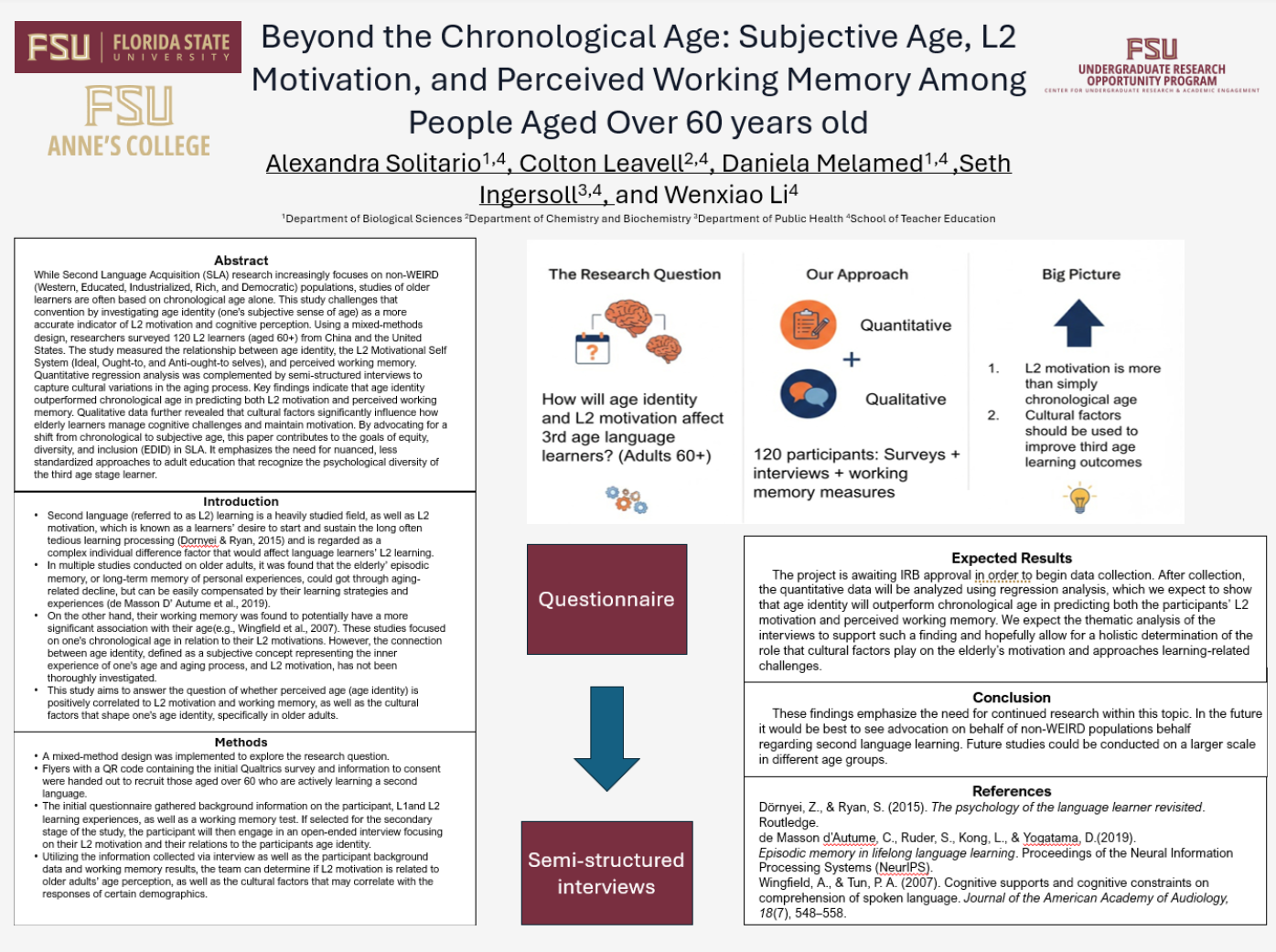
Beyond the Chronological Age: Subjective Age, L2 Motivation, and Perceived Working Memory Among People Aged Over 60 years old
Authors: Alexandra Solitario, Wenxiao LiStudent Major: Biological Sciences
Mentor: Wenxiao Li
Mentor's Department: School of Teacher Education Mentor's College: College of Education, Health, and Human Sciences Co-Presenters: Seth Ingersoll, Colton Leavell, Daniela Melamed
Abstract
While Second Language Acquisition (SLA) research increasingly focuses on non-WEIRD (Western, Educated, Industrialized, Rich, and Democratic) populations, studies of older learners are often based on chronological age alone. This study challenges that convention by investigating age identity (one’s subjective sense of age) as a more accurate indicator of L2 motivation and cognitive perception. Using a mixed-methods design, researchers surveyed 120 L2 learners (aged 60+) from China and the United States. The study measured the relationship between age identity, the L2 Motivational Self System (Ideal, Ought-to, and Anti-ought-to selves), and perceived working memory. Quantitative regression analysis was complemented by semi-structured interviews to capture cultural variations in the aging process. Key findings indicate that age identity outperformed chronological age in predicting both L2 motivation and perceived working memory. Qualitative data further revealed that cultural factors significantly influence how elderly learners manage cognitive challenges and maintain motivation. By advocating for a shift from chronological to subjective age, this paper contributes to the goals of equity, diversity, and inclusion (EDID) in SLA. It emphasizes the need for nuanced, less standardized approaches to adult education that recognize the psychological diversity of the third age stage learner.
Keywords: Language, Motivation, Memory, Working memory