
Research Symposium
26th annual Undergraduate Research Symposium, April 1, 2026
Kayla Osowski Poster Session 2: 10:45 am - 11:45 am / Poster #150

BIO
Kayla Osowski is a 2nd-year Chemical Engineering Honors student at Florida State University. This is her 4th time presenting at a research symposium. Her other research has focused on the study of birds in coastal ecosystems and the study of seagrass composition/abundance in relation to sediment composition. She plans to pursue graduate school after finishing her Bachelor of Science degree in Chemical Engineering. Some of her future research/career interests include aerospace and nuclear energy/reactors.
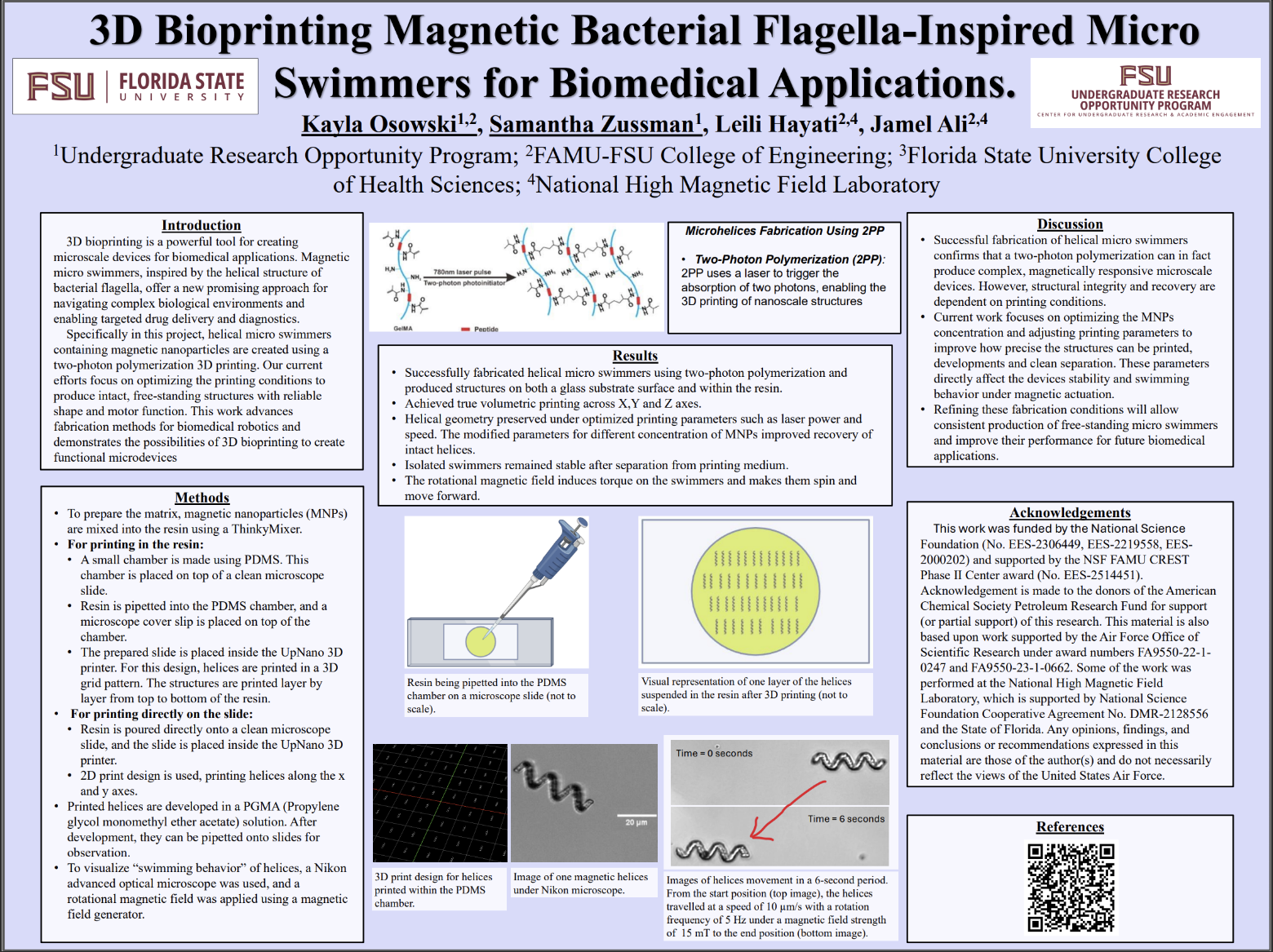
3D Bioprinting Magnetic Bacterial Flagella-Inspired Micro Swimmers for Biomedical Applications
Authors: Kayla Osowski, Dr. Jamel AliStudent Major: Chemical Engineering
Mentor: Dr. Jamel Ali
Mentor's Department: Chemical & Biomedical Engineering Mentor's College: FAMU-FSU College of Engineering Co-Presenters: Samantha Zussman
Abstract
3D bioprinting offers new possibilities for creating microscale devices capable of navigating
complex biological environments. This project focuses on developing magnetic micro swimmers
containing nanoparticles and structurally inspired by bacterial flagella. The structure poses a
helical shape capable of controlled motion when exposed to external magnetic fields. Using 2-
photon polymerization (2PP) with an UpNano 3D bioprinter and a resin formulated with
magnetic nanoparticles, we have successfully fabricated helices in a 3-dimensional array within a
silicon template in a 2-dimensional array directly on the surface of a glass slide. Our current
work focuses on refining the printing and developing conditions to obtain a solution saturated
with intact, free-standing helices suitable for biomedical applications. We are testing a range of
printing parameters and solvent materials to determine what conditions best support clean
separation and preservation of the helical structure for further testing. We aim to establish a
reliable method to produce individual helical micro swimmers that maintain their form outside
the printing medium. This research supports the development of magnetic micro swimmers for
targeted drug delivery and diagnostics. Establishing dependable fabrication practices contributes
to advancing biomedical micro robotics and highlights the potential of 3D bioprinting to create
functioning microdevices
Keywords: Microswimmers, Biology, Engineering, Bioprinting, Biomedical