
Research Symposium
26th annual Undergraduate Research Symposium, April 1, 2026
Xavier Bauman Poster Session 4: 3:00 pm - 4:00 pm / Poster #252

BIO
Xavier Bauman is a third-year International Affairs transfer student with a concentration in Political Science. Before FSU, he received a provisional patent for a biodegradable silt fence while attending high school in his hometown, Jacksonville, Florida. After graduating, he shifted his focus from engineering to social sciences, pursuing his Bachelor of Arts at Florida International University.
He became involved with the FIU Model UN program, competing in Washington, D.C. and later serving as a committee chair during FIMUN 37, the university’s yearly high school UN conference. He also served as the Pre-Law Advocates for Community Engagement and Service’s fundraising and event coordination director.
During this time, Xavier had direct exposure to the lead-up and immediate aftermath of the 2024 presidential election, as Miami-Dade County unexpectedly shifted from blue to red. After becoming familiar with how a divisive political climate interferes with public discourse, he was left with an intense interest in how ideology, opinion and discussion are filtered through a contentious information ecosystem.
After earning his Associate of Arts and transferring to FSU, he desired a change in pace, engaging with the university’s research community through UROP. Channeling that interest into his current research project, he presented his findings at the 2026 Florida Undergraduate Research Conference. After completing his bachelor’s degree, he hopes to pursue a law degree, his areas of interest being labor and environmental law.
Political Discussion and Information Transmission Under Social Pressure
Authors: Xavier Bauman, Marli DunietzStudent Major: International Affairs
Mentor: Marli Dunietz
Mentor's Department: Department of Political Science Mentor's College: Florida State University Co-Presenters: Brody Mills
Abstract
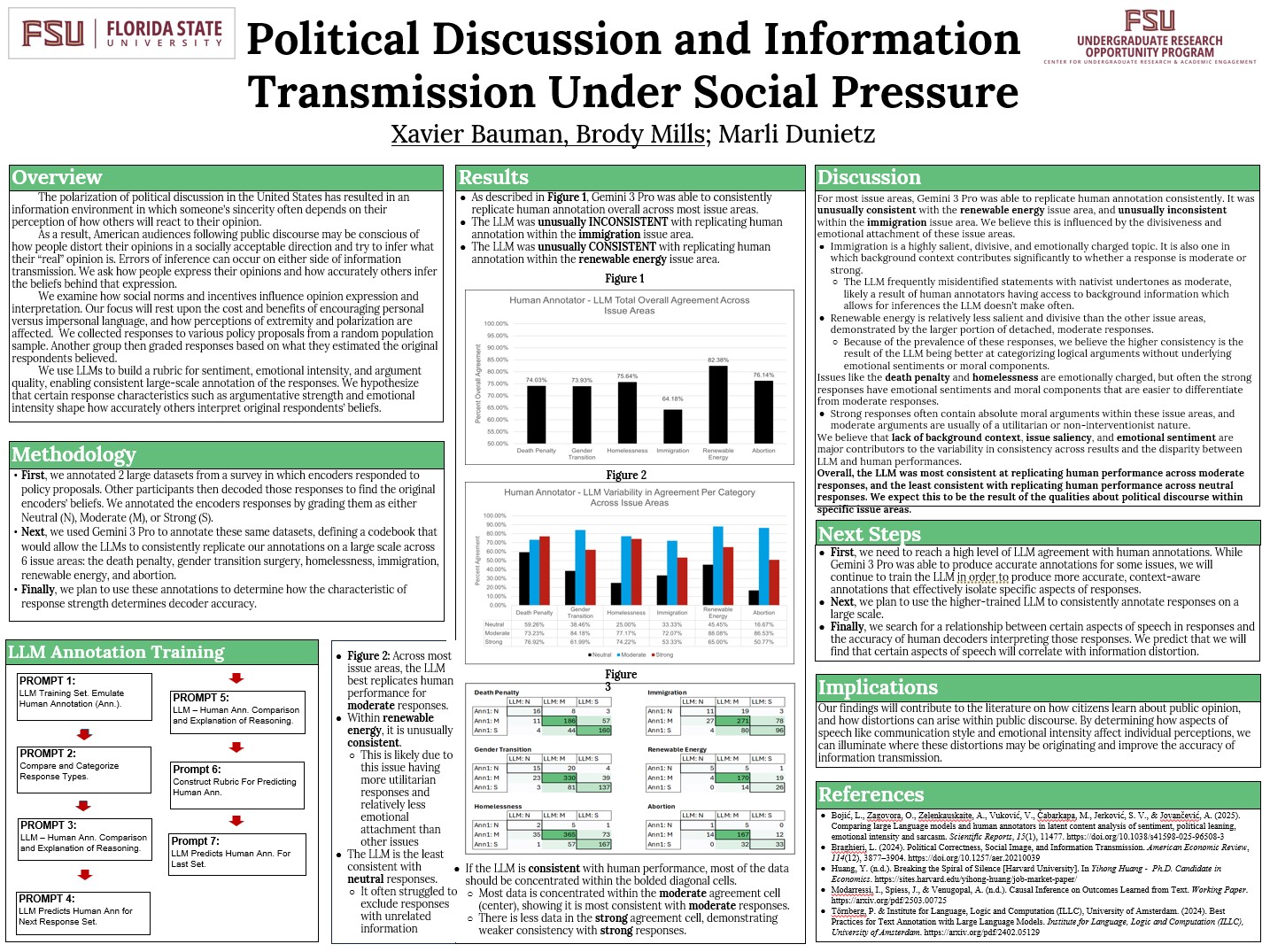
The polarization of political discussion in the United States has resulted in an information environment in which someone’s sincerity often depends on their perception of how others will react to their opinion. At the same time, American audiences following public discourse may be conscious of how people distort their opinions in a socially acceptable direction and try to infer what their “real” opinion is. Errors of inference can occur on either side of information transmission. We ask how people express their opinions and how accurately others infer the beliefs behind that expression.
We examine how social norms and incentives influence opinion expression and interpretation. Our focus will rest upon the costs and benefits of encouraging personal versus impersonal language, and how perceptions of extremity and polarization are affected. We collected responses to various policy proposals from a random population sample. Another group then graded responses based on what they estimated the original respondents believed. We use LLMs to build a rubric for sentiment, emotional intensity, and argument quality, enabling consistent large-scale annotation of the responses. We hypothesize that certain response characteristics such as argumentative strength and emotional intensity shape how accurately others interpret original respondents’ beliefs.
Our findings will contribute to the literature on how citizens learn about public opinion, and how distortions can arise within public discourse. By determining how communication style and emotional intensity affects individual perceptions, we can illuminate where these distortions may be originating and improve the accuracy of information transmission.
Keywords: Political Discussion, Information Transmission, Social