
Research Symposium
26th annual Undergraduate Research Symposium, April 1, 2026
Jaylynn Brunelli Poster Session 1: 9:30 am - 10:30 am / Poster #21

BIO
Jaylynn is a senior meteorology student who has studied climate intervention impacts under Dr. Michael Diamond since her freshman year. She has participated in both the Undergraduate Research Opportunity Program (UROP) and Honors in the Major (HITM) program. After graduating with her Bachelor of Science in the spring, she will be pursuing a PhD in atmospheric science at Indiana University-Bloomington.
Stratospheric Aerosol Injection Effects on Global Climate Distribution
Authors: Jaylynn Brunelli, Michael DiamondStudent Major: Meteorology
Mentor: Michael Diamond
Mentor's Department: Department of Earth, Ocean, and Atmospheric Science Mentor's College: College of Arts and Sciences Co-Presenters:
Abstract
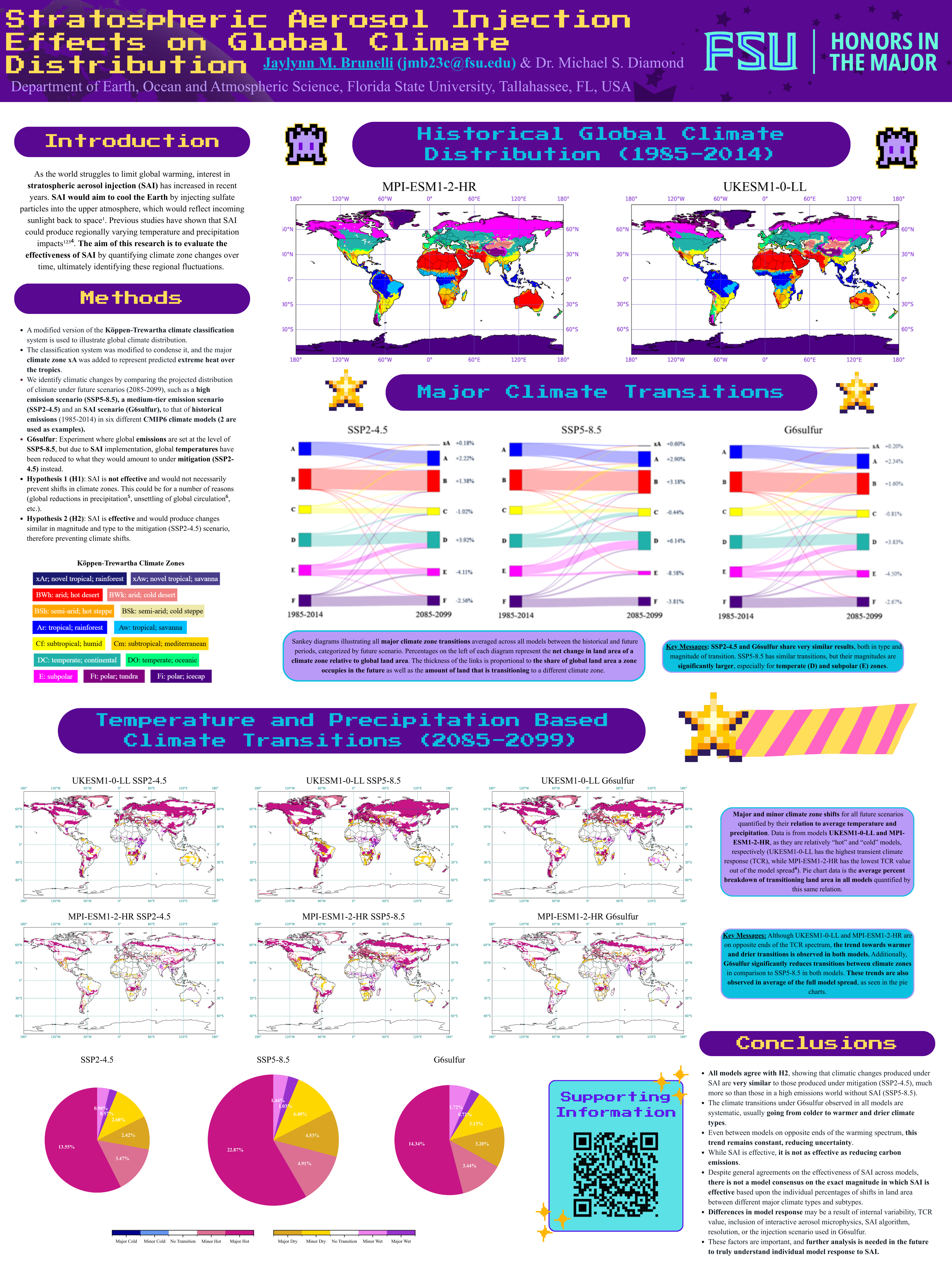
As the world struggles to limit global warming, interest in stratospheric aerosol injection (SAI) has increased in recent years. SAI would aim to cool the Earth by increasing the amount of sulfate particles in the upper atmosphere, which would reflect a small fraction of sunlight back out to space. Previous studies have shown that SAI could produce regionally varying temperature and precipitation impacts. The aim of our research Is to evaluate how effective SAI is by quantifying climate changes over time, ultimately identifying these regional fluctuations. We use a climate classification system to identify climate change by comparing the future distribution of climate under a high emissions scenario, a medium-tier emissions scenario, and a scenario in which SAI is implemented. We find that changes in climate imposed under SAI are like those under medium-tier emissions, while changes under high emissions are greater in magnitude. All models agree that SAI is effective in comparison to a high emissions scenario but individually disagree on the magnitudes of global change, indicating differing model responses to SAI and CO2-driven warming. These findings have important implications for predicting and understanding the effects of climate intervention on global climate regimes.
Keywords: climate, geoengineering, climatology