
Research Symposium
26th annual Undergraduate Research Symposium, April 1, 2026
Sofia Nuonno Poster Session 4: 3:00 pm - 4:00 pm / Poster #302
BIO
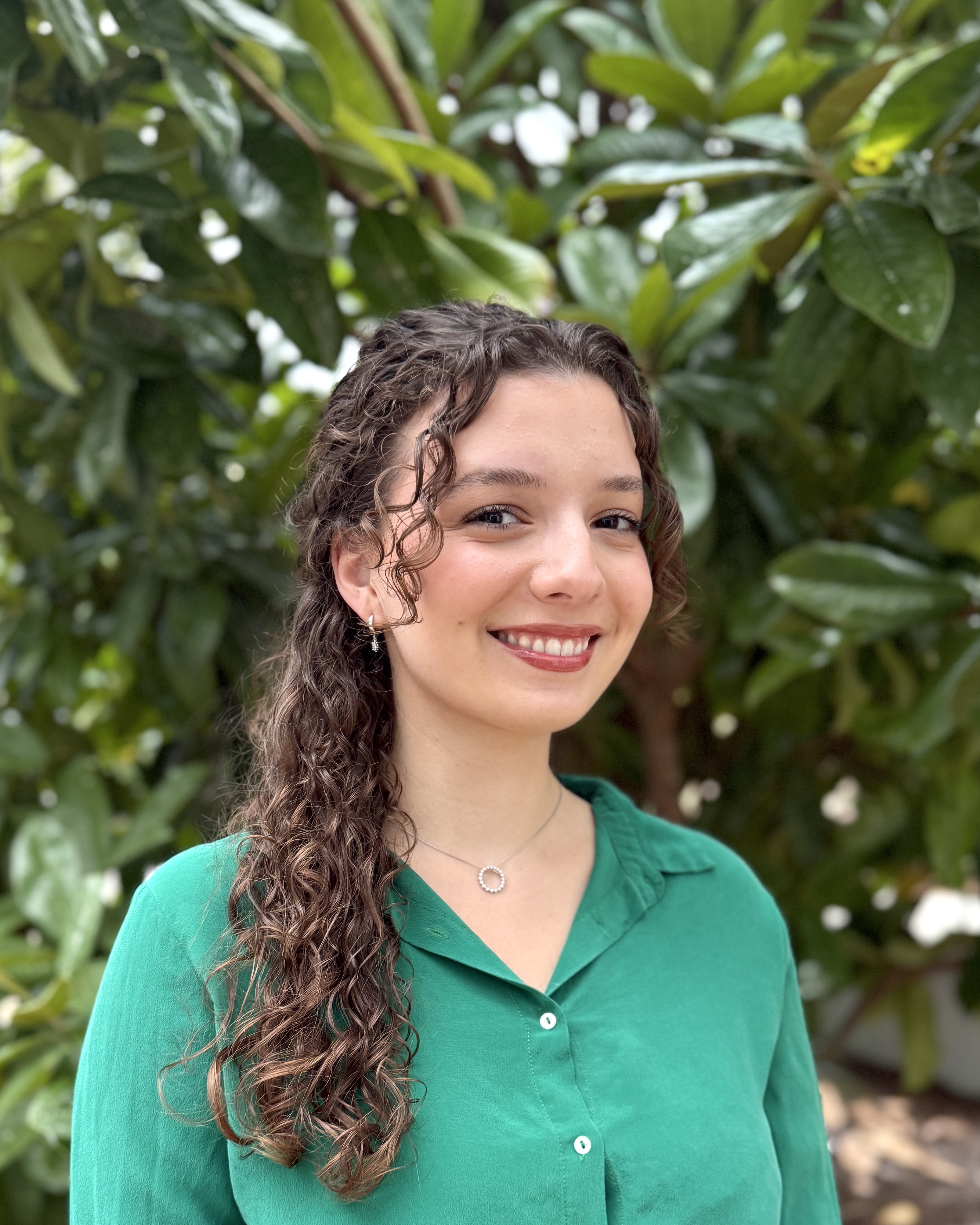
Sofia is a Senior student at FSU interested in pursuing a career as a university professor. She was born in Pisa, an Italian town, and moved to Miami at the age of ten. Throughout her childhood, she always expressed an interest for the arts — more specifically, painting and writing — which drove her to dedicate her academic career to these fields. Because of this, her research interests focus on the humanities, as creativity and self-expression have always been her main priorities within academia. She will be pursuing her MA in Art History at FSU in the Fall.
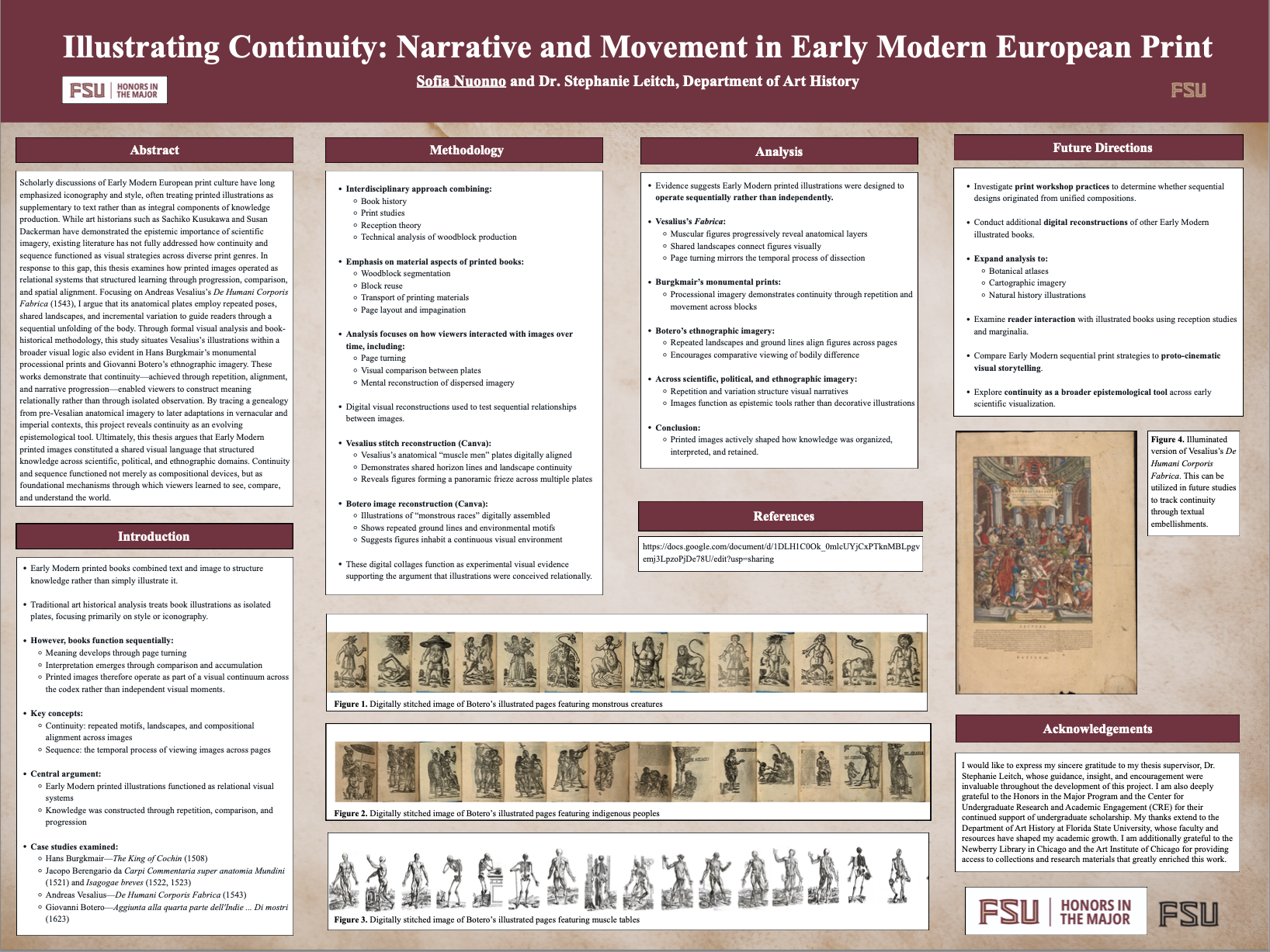
Illustrating Continuity: Narrative and Movement in Early Modern European Print
Authors: Sofia Nuonno, Stephanie LeitchStudent Major: Art History & Literature, Media, and Culture
Mentor: Stephanie Leitch
Mentor's Department: Art History Mentor's College: Fine Arts Co-Presenters:
Abstract
Scholarly discussions of Early Modern European print culture have long emphasized iconography and style, often treating printed illustrations as supplementary to text rather than as integral components of knowledge production. While art historians such as Sachiko Kusukawa and Susan Dackerman have demonstrated the epistemic importance of scientific imagery, existing literature has not fully addressed how continuity and sequence functioned as visual strategies across diverse print genres. In response to this gap, this thesis examines how printed images operated as relational systems that structured learning through progression, comparison, and spatial alignment. Focusing on Andreas Vesalius’s De Humani Corporis Fabrica (1543), I argue that its anatomical plates employ repeated poses, shared landscapes, and incremental variation to guide readers through a sequential unfolding of the body. Through formal visual analysis and book-historical methodology, this study situates Vesalius’s illustrations within a broader visual logic also evident in Hans Burgkmair’s monumental processional prints and Giovanni Botero’s ethnographic imagery. These works demonstrate that continuity—achieved through repetition, alignment, and narrative progression—enabled viewers to construct meaning relationally rather than through isolated observation. By tracing a genealogy from pre-Vesalian anatomical imagery to later adaptations in vernacular and imperial contexts, this project reveals continuity as an evolving epistemological tool. Ultimately, this thesis argues that Early Modern printed images constituted a shared visual language that structured knowledge across scientific, political, and ethnographic domains. Continuity and sequence functioned not merely as compositional devices, but as foundational mechanisms through which viewers learned to see, compare, and understand the world.
Keywords: Continuity, Early Modern, Print, Vesalius, Art History, Botero, Da Carpi, Burgkmair