
Research Symposium
26th annual Undergraduate Research Symposium, April 1, 2026
Monica Burgos Poster Session 4: 3:00 pm - 4:00 pm / Poster #292

BIO
Monica Burgos is a fourth-year undergraduate student at Florida State University, majoring in Applied Mathematics with a minor in Computer Science. Growing up in Puerto Rico—an island where diverse cultures, ideas, music, and traditions intersect—instilled in her a strong sense of civic responsibility and a desire to help bridge gaps in education. This early perspective continues to shape her academic and professional goals.
Her academic interests focus on expanding mathematical and computational knowledge, exploring the strengths and limitations of artificial intelligence, and addressing educational disparities in underfunded and developing communities. These interests have also guided her research involvement. As part of a collaborative research project, Monica has contributed to exploring matrix inversion with the theory of Optimal Transport. She hopes this research will contribute to the broader mathematical community while demonstrating how different areas of mathematics can be deeply interconnected.
Looking ahead, Monica plans to pursue graduate studies in Mathematics Education, with a focus on addressing gaps in K–12 mathematics education. Through her future work, she hopes to expand the impact of mathematics beyond the classroom by supporting underfunded communities and developing countries, helping to close educational gaps and inspire future generations of students.
Discovering Matrix Inversion Through Transport Theory
Authors: Monica Burgos, Dr. Rocio Diaz MartinStudent Major: Applied and Computational Mathematics
Mentor: Dr. Rocio Diaz Martin
Mentor's Department: Department of Mathematics Mentor's College: College of Arts & Sciences Co-Presenters:
Abstract
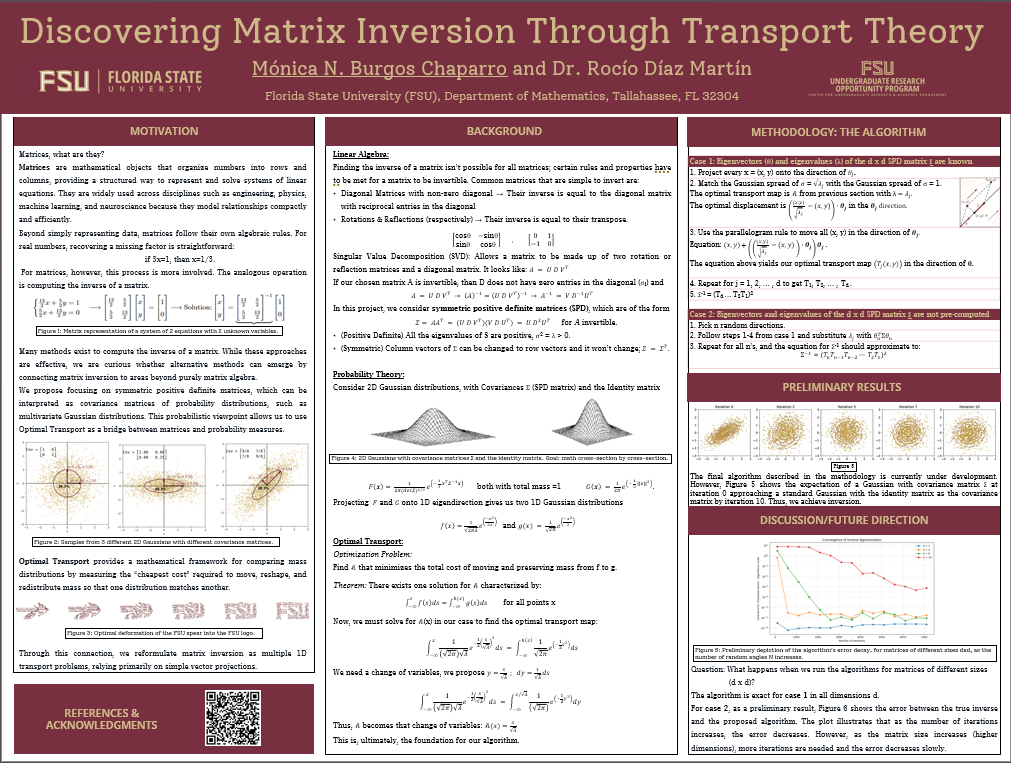
The goal of this project is to develop a new method for approximating the inverse of a matrix. Inverting matrices is useful as it allows us to solve linear systems of equations. We propose an iterative method to make it especially useful when the matrix is too large to store. Each step only requires a matrix-vector multiplication between the matrix we want to invert and a vector selected randomly. Rather than relying on traditional methods, the approach utilizes the theory of Optimal Transport. This theory offers a mathematical framework for comparing mass distributions by computing the ‘cheapest cost’ of moving, reshaping, and reallocating mass to make one distribution match the other. We will focus on a specific type of matrix: symmetric positive definite matrices. These matrices can be interpreted as the covariance matrix of probabilities, such as multivariate Gaussian distributions. Making this connection between matrices and probabilities will allow us to use transport theory. The project objectives include developing and programming an iterative algorithm for inverting matrices, analyzing how quickly and accurately the method approaches the true inverse, and evaluating its efficiency relative to standard inversion techniques. Proof-of-concept examples exploring convergence for matrices of different sizes will be used to validate our approach and to develop insight to support a formal, mathematical proof of convergence. Ultimately, we aim to provide both theoretical justification and numerical evidence supporting the validity of our method. If successful, this framework may open the possibility of extending the approach to broader classes of matrices.
Keywords: math, computer science, python, matrices, optimal transport, linear algebra, probability