
Research Symposium
26th annual Undergraduate Research Symposium, April 1, 2026
Victoria Camacho Arismendi Poster Session 1: 9:30 am - 10:30 am / Poster #293

BIO
Victoria is a first-year Honors student at Florida State University pursuing a dual degree in Political Science and Economics with minors in Political Philosophy and Business on the pre-law track. She is deeply interested in the intersection of law, policy, and economic inequality, with a strong focus on current events and social justice. She recieved Garnet and Gold Key's Torch Night Award for her leadership in those fields and will present reasearch on the impact of artificial intelligence on minority rights at the Oxford Consortium for Human Rights this summer.
Beyond academics, Victoria is passionate about art and food as cultural expressions that shape identity and community. She is driven by a commitment to research, community organizing, and policy based solutions, and hopes to contribute to meaningful change through a career dedicated to advancing equity, particularly for immigrants in the United States.
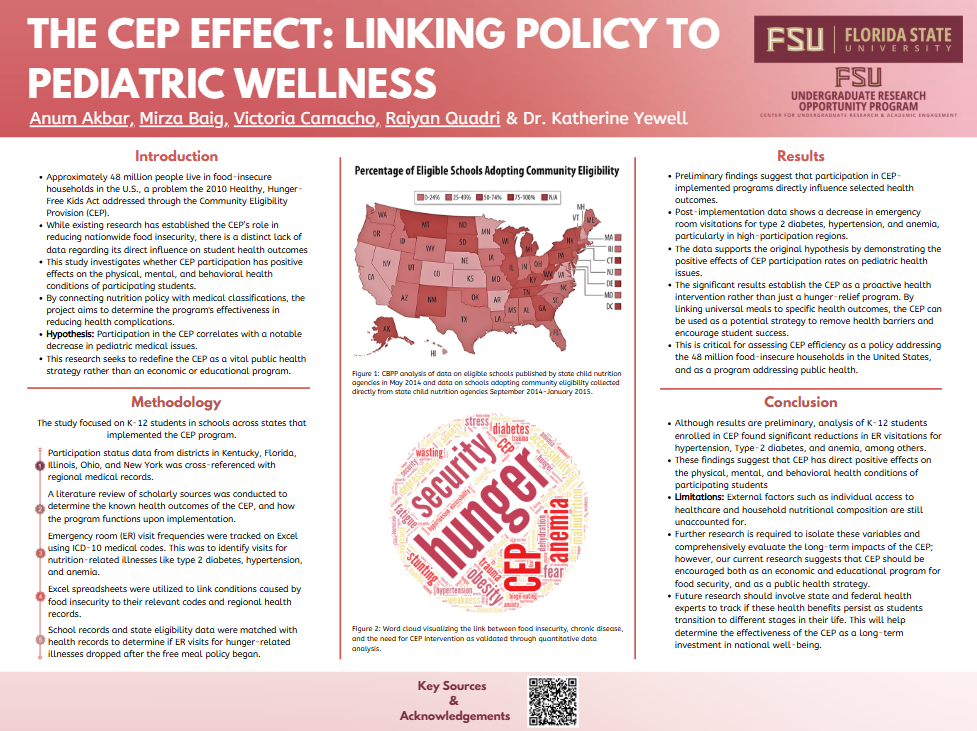
The CEP Effect: Linking Policy to Pediatric Wellness
Authors: Victoria Camacho Arismendi, Katherine YewellStudent Major: Political Science, Economics
Mentor: Katherine Yewell
Mentor's Department: Department of Economics Mentor's College: College of Social Sciences and Public Policy Co-Presenters: Anum Akbar
Abstract
The Community Eligibility Provision (CEP) is a USDA Federal program that aims to
provide free school-meals to all children regardless of household income. The project
involves researching the direct, positive health impacts of the CEP to conclude if it is
responsible for reducing food insecurity and associated diseases, and to better inform
on its importance on a national scale.
To get a sense of how the policy functions in schools that adopted it, a literature review
was conducted on relevant scholarly sources. Additionally, articles on food insecurity
and associated diseases were matched to their relevant emergency room (ICD-10)
codes using Excel spreadsheets. These codes specify what is happening to a patient’s
health, and why it has occurred. By cross-referencing regional medical codes with CEP
data in select states, it was assessed whether the program effectively lowered the
spread of diseases linked to food insecurity.
The analysis showed a correlation between CEP implementation and a decrease in ER
codes for nutrition-related illnesses. The data also suggested that removing social
barriers and providing universal access to meals significantly increases student
participation. Such findings indicate that the program effectively boosts health outcomes
in high-poverty regions across states.
The results prove that the CEP serves as an important measure to reduce long-term
healthcare burdens and food insecurity, promoting the national implementation of
universal meal programs to improve overall public health. Future research conducted on
the program should track whether these health benefits persist as students transition to
different stages in their life.
Keywords: Community Eligibility Provision, CEP, Meals