
Research Symposium
26th annual Undergraduate Research Symposium, April 1, 2026
Sophia Vizoso Poster Session 1: 9:30 am - 10:30 am / Poster #243

BIO
Hi! My name is Sophia Vizoso, and I’m a senior at Florida State University studying Neuroscience and Public Health. I’ve always been fascinated by how science and healthcare connect to improve people’s lives. Over time, that curiosity grew into a passion for understanding disease patterns, health disparities, and the factors that shape well-being, particularly through epidemiology and cardiovascular research.
I’ve had the chance to work in both lab and clinical settings, learning from amazing mentors and seeing how research can make a real difference. Outside of research, I love mentoring other students as a UROP Leader and Teaching Assistant, helping them explore their own interests in science.
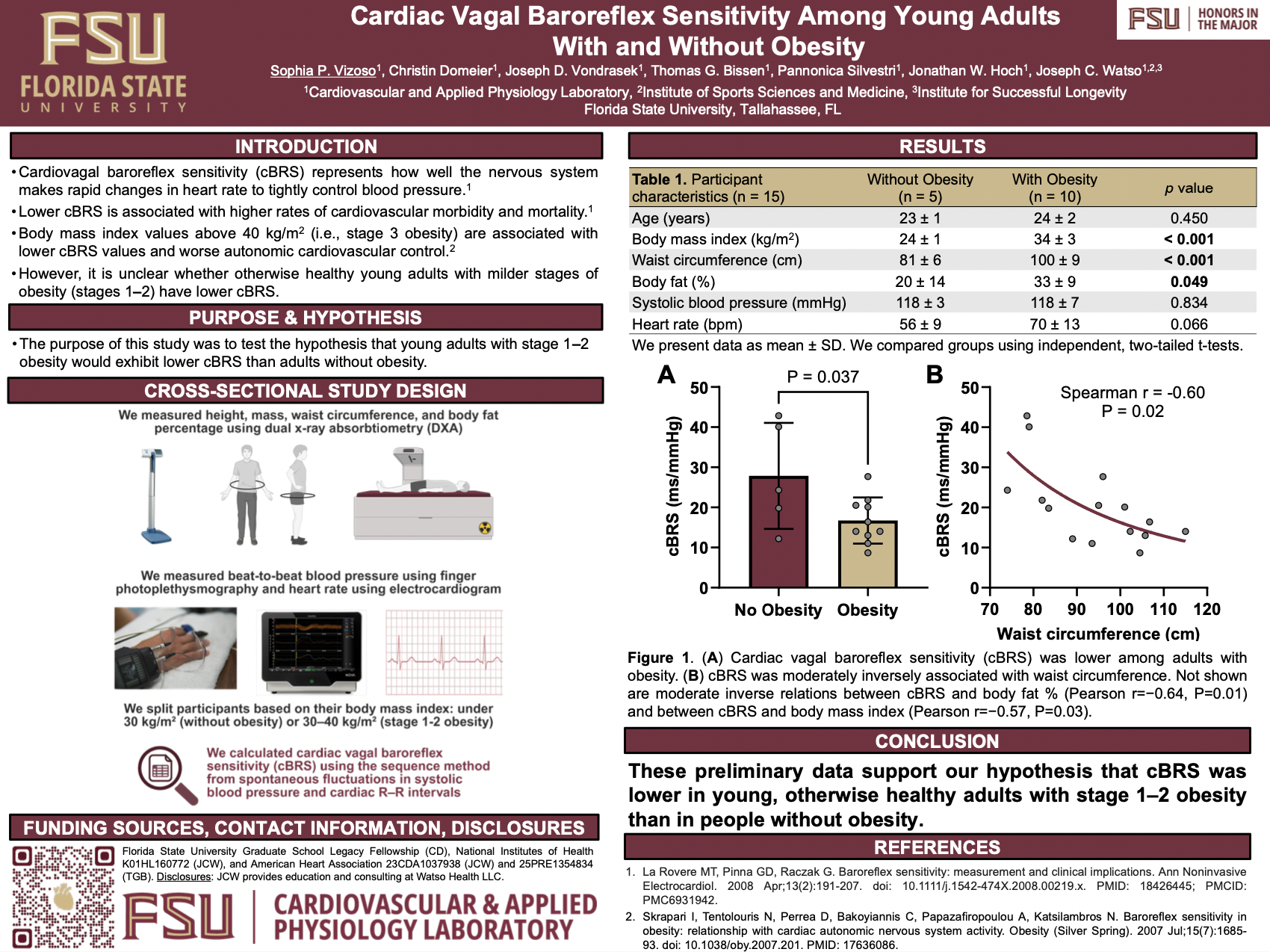
Cardiac Vagal Baroreflex Sensitivity Among Young Adults With and Without Obesity
Authors: Sophia Vizoso, Dr. Joseph WatsoStudent Major: Cell and Molecular Neuroscience and Public Health
Mentor: Dr. Joseph Watso
Mentor's Department: Health, Nutrition, and Food Science Mentor's College: Anne Spencer Daves College of Education, Health, and Human Sciences Co-Presenters:
Abstract
Background: Reduced cardiovagal baroreflex sensitivity (cBRS) reflects nervous system dysfunction and is linked to increased cardiovascular risk. Although stage 3 obesity can disrupt autonomic cardiovascular control, it’s unclear whether adults with stage 1–2 obesity already exhibit early autonomic impairments. We tested whether adults with stage 1–2 obesity would show lower cBRS compared to adults without obesity. Methods: Beat-to-beat blood pressure and heart rate were recorded during a 10-minute resting baseline in adults without obesity (n = 5, BMI < 30 kg/m²) and adults with obesity (n = 10, BMI 30-40 kg/m²). Anthropometrics and DXA body composition were collected. Spontaneous cBRS was calculated using the sequence method. After confirming normality (Shapiro–Wilk), independent t-tests assessed group differences, and Pearson correlations evaluated relations between adiposity indices and cBRS. Results: Adults with stage 1–2 obesity had higher BMI (33.9 ± 2.6 vs. 24.4 ± 1.1 kg/m², p < 0.001), greater waist circumference (100 ± 9 vs. 81 ± 6 cm, p < 0.001), and higher body fat percentage (32.7 ± 9.3 vs.19.7 ± 13.9%, p = 0.049) compared to adults without obesity. cBRS was significantly lower in adults with obesity (16.7 ± 5.7 vs 27.9 ± 13.2 ms/mmHg, p = 0.037). Waist circumference (r = -0.65, p = 0.009), body fat percentage (r = -0.64, p = 0.010), and BMI (r = -0.57, p = 0.026) were negatively associated with cBRS. Conclusion: These preliminary data support our hypothesis that cBRS was significantly lower in adults with stage 1–2 obesity compared with those without obesity.
Keywords: Health, science, cardiovascular, heart, neuroscience