
Research Symposium
26th annual Undergraduate Research Symposium, April 1, 2026
Amanda Lowry Poster Session 3: 1:45 pm - 2:45 pm / Poster #307

BIO
Amanda Lowry is a first-year honors student pursuing a Bachelor of Science in Environmental Science, with minors in Museum Studies and Urban & Regional Planning. They received their Associates of Arts from Valencia College in Kissimmee, FL prior to attending FSU. They hope to pursue a graduate degree and career in library science. They are also passionate about the environment and animals. Work on Dr. Rebecca Ballard's manuscript allowed for a crossover between their interests in environmentalism and literature while developing their citational and library system skills.
Framing of Individual vs. Structural Responsibility for Environmental Harm
Authors: Amanda Lowry, Rebecca BallardStudent Major: Environmental Science
Mentor: Rebecca Ballard
Mentor's Department: English Mentor's College: Arts & Sciences Co-Presenters:
Abstract
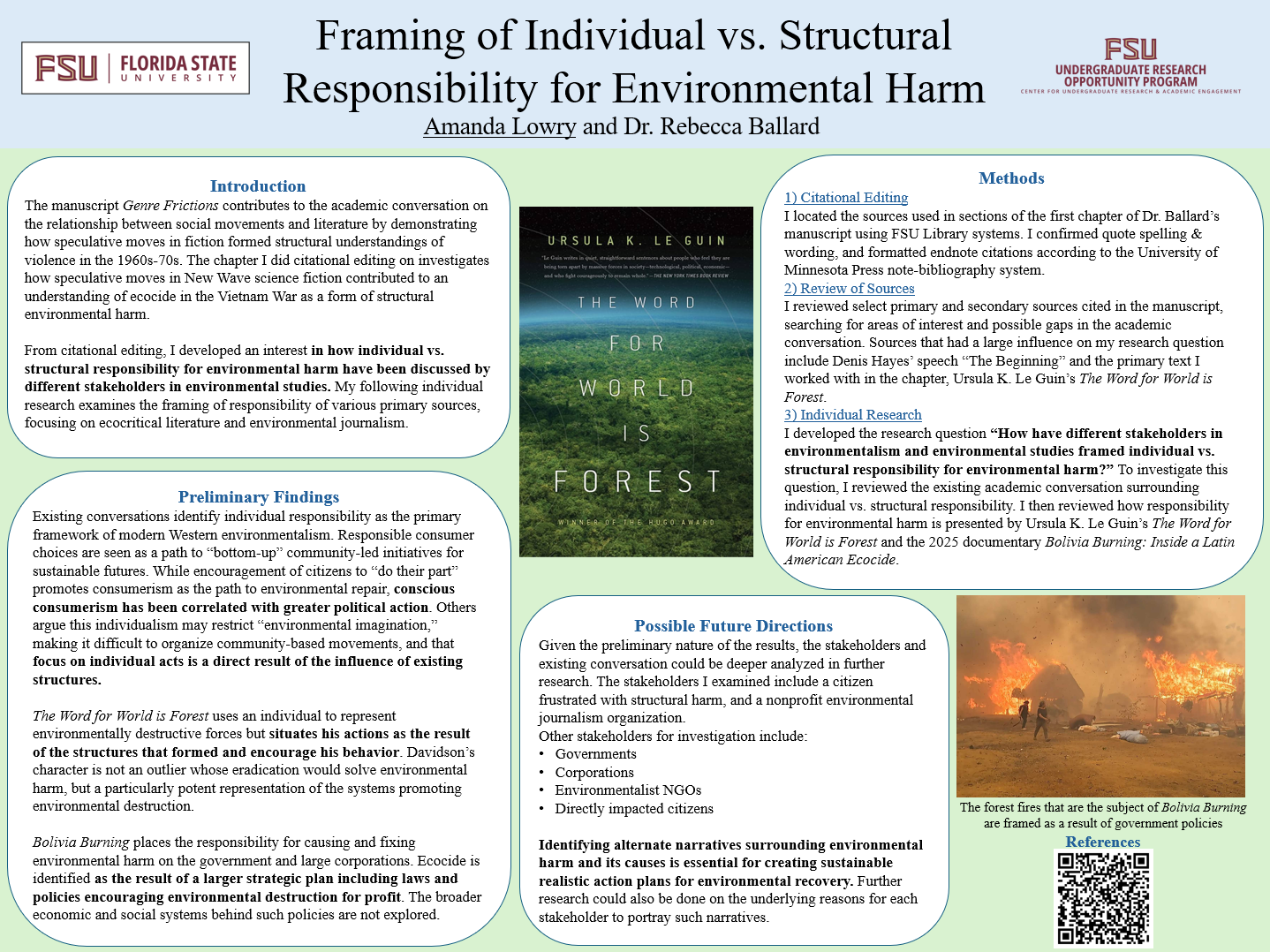
The in-progress manuscript Genre Frictions investigates the impact of structural and environmental harm on U.S. fiction and social movements in the 1960s-70s, arguing that writers utilized speculative genres to form deeper understandings of structural harm. My project began with citational editing on the chapter addressing the role of speculative moves in New Wave science fiction on understanding ecocide in the Vietnam War as a structural form of environmental harm. Sources were located through library systems and cited according to provided guidelines. Review of sources prompted an interest in how different voices in environmental studies have framed individual vs. structural responsibility for environmental harm. Primary sources were reviewed to summarize the existing conversation on individual vs. structural responsibility. I then observed how responsibility was framed by two stakeholders of interest: ecocritical literature and environmental documentaries. I selected Ursula Le Guin’s The Word for World is Forest and the documentary Bolivia Burning to represent these stakeholders. Current findings suggest individual responsibility as the primary framework in Western environmentalism, and identify an overall emphasis on structural responsibility by the chosen stakeholders. Further research could be done on alternative stakeholders, such as corporations, governments, or political activists. The overarching project delves into the role of fiction in processing structural harm, and how speculative fiction and environmental activism have mutually influenced each other. My independent research hopes to further add to this conversation on the intersection of media and environmentalism, allowing deeper understandings of the interactions between the written and real worlds.
Keywords: environment, literature, environmentalism, responsibility