
Research Symposium
26th annual Undergraduate Research Symposium, April 1, 2026
Gianna Diaz Poster Session 1: 9:30 am - 10:30 am / Poster #246

BIO
Gianna Diaz is a first-year student at Florida State University from Miami, pursuing a Bachelor of Science in Biomedical Sciences as a Clinical Professions Major. She is on a pre-med track with a strong interest in serving underserved and diverse communities as a physician. She is also a President’s List student and a member of the Honors College and the Honors Medical Scholars Program. At FSU, Gianna works as a research assistant under Dr. Dorota Kossowska-Kuhn, contributing to a meta-analysis investigating a cognitive skills model for predicting Mild Cognitive Impairment and Alzheimer’s disease. In the project, she focuses on literature review, sorting articles, and data extraction. In the past, she also worked as a research trainee for Lombard Lab at the University of Miami Comprehensive Cancer Center. There, she learned how to create and scan Western blots and also enjoyed being part of a weekly research meeting where researchers presented their findings to the group. She also enjoys serving the community as a Spanish interpreter for the Health and Hope Clinic and a volunteer for Tallahassee Memorial Hospital Surgical Care Unit.
Cognitive Skills Model for Predicting Alzheimer's Disease
Authors: Gianna Diaz, Dr. Dorota Kossowska-KuhnStudent Major: Clinical Professions
Mentor: Dr. Dorota Kossowska-Kuhn
Mentor's Department: Psychology Mentor's College: Arts and Sciences Co-Presenters: Alana Banton, Davion Slocum
Abstract
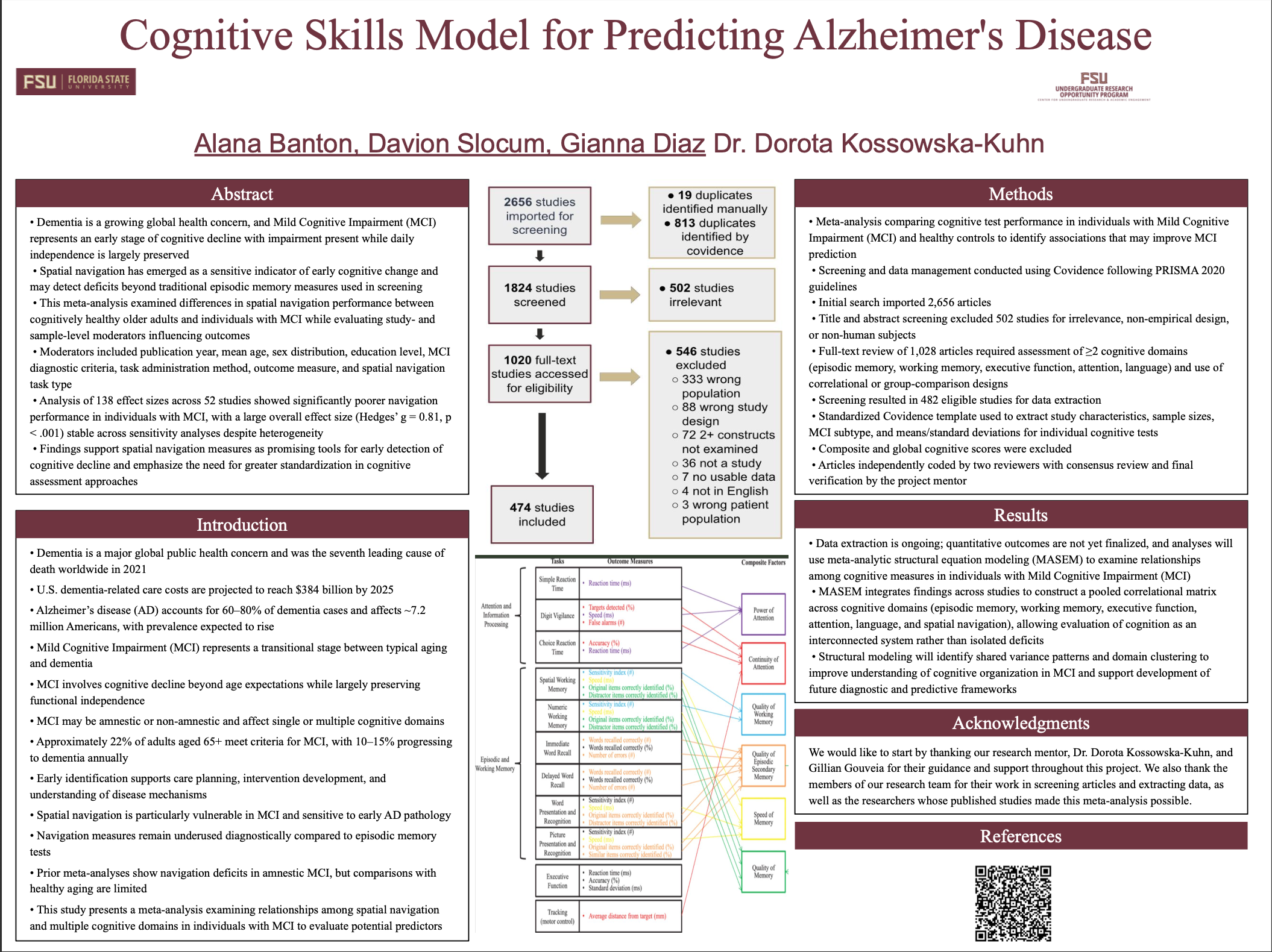
Dementia is a growing global health concern that places substantial psychological, social, and economic burdens on affected individuals and their families. Mild Cognitive Impairment (MCI), often considered an early stage along the dementia continuum, involves cognitive decline beyond normal aging while daily functional abilities are largely maintained. Although episodic memory impairments have traditionally guided early detection efforts, spatial navigation has emerged as a potentially sensitive indicator of early cognitive change. This meta-analysis quantified differences in spatial navigation task performance between cognitively healthy (CH) older adults and individuals with MCI, and examined study- and sample-level factors that may influence these differences. Moderators included publication year, mean age, sex distribution, education level, MCI diagnostic criteria, task administration method, outcome measure, and spatial navigation task type. A total of 138 effect sizes from 52 studies were included. Results revealed that individuals with MCI performed significantly worse on spatial navigation tasks than CH older adults, with a large overall effect size (Hedges’ g = 0.81, p < .001). This finding remained stable across sensitivity analyses, despite significant heterogeneity across studies (Q(137) = 683.54, p < .001). Moderator analyses indicated marginal trends associated with the proportion of male participants, use of matrix-based navigation tasks, and MCI diagnostic criteria, suggesting potential sources of variability that warrant further investigation. These findings support the value of spatial navigation measures as promising tools for detecting early cognitive decline and highlight the need for greater standardization in assessment approaches.
Keywords: MCI, Alzheimer's Disease, dementia, cognitive test