
Research Symposium
26th annual Undergraduate Research Symposium, April 1, 2026
Morgan Wilson Poster Session 4: 3:00 pm - 4:00 pm / Poster #137

BIO
Morgan Wilson is an undergraduate student at Florida State University pursuing a Bachelor of Arts in History and Political Science. Her academic interests include constitutional law, American political development, and historical analysis of race and legal institutions.
Morgan is currently a research assistant in Florida State’s Undergraduate Research Opportunity Program (UROP), where she studies hate crimes in historic “sundown towns.” Her research examines patterns of racial exclusion and violence through both qualitative historical sources and quantitative data collection. Working with faculty mentors through UROP, she analyzes archival material and contemporary datasets to better understand how these communities enforced racial boundaries and how those patterns continue to shape social and political outcomes.
Her broader academic work explores the intersection of law, history, and democratic institutions, with a particular focus on constitutional interpretation and civil rights. After completing her undergraduate studies, Morgan plans to attend law school and pursue a career in appellate litigation, focusing on constitutional law and legal scholarship.
Sundown America Today: Understanding Public Experiences of Modern Racism in Historical Sundown Towns
Authors: Morgan Wilson, Jack MillsStudent Major: History and Political Science
Mentor: Jack Mills
Mentor's Department: Criminology Mentor's College: Criminology and Criminal Justice Co-Presenters: Ella Osweiler, Jahkaris Johnson
Abstract
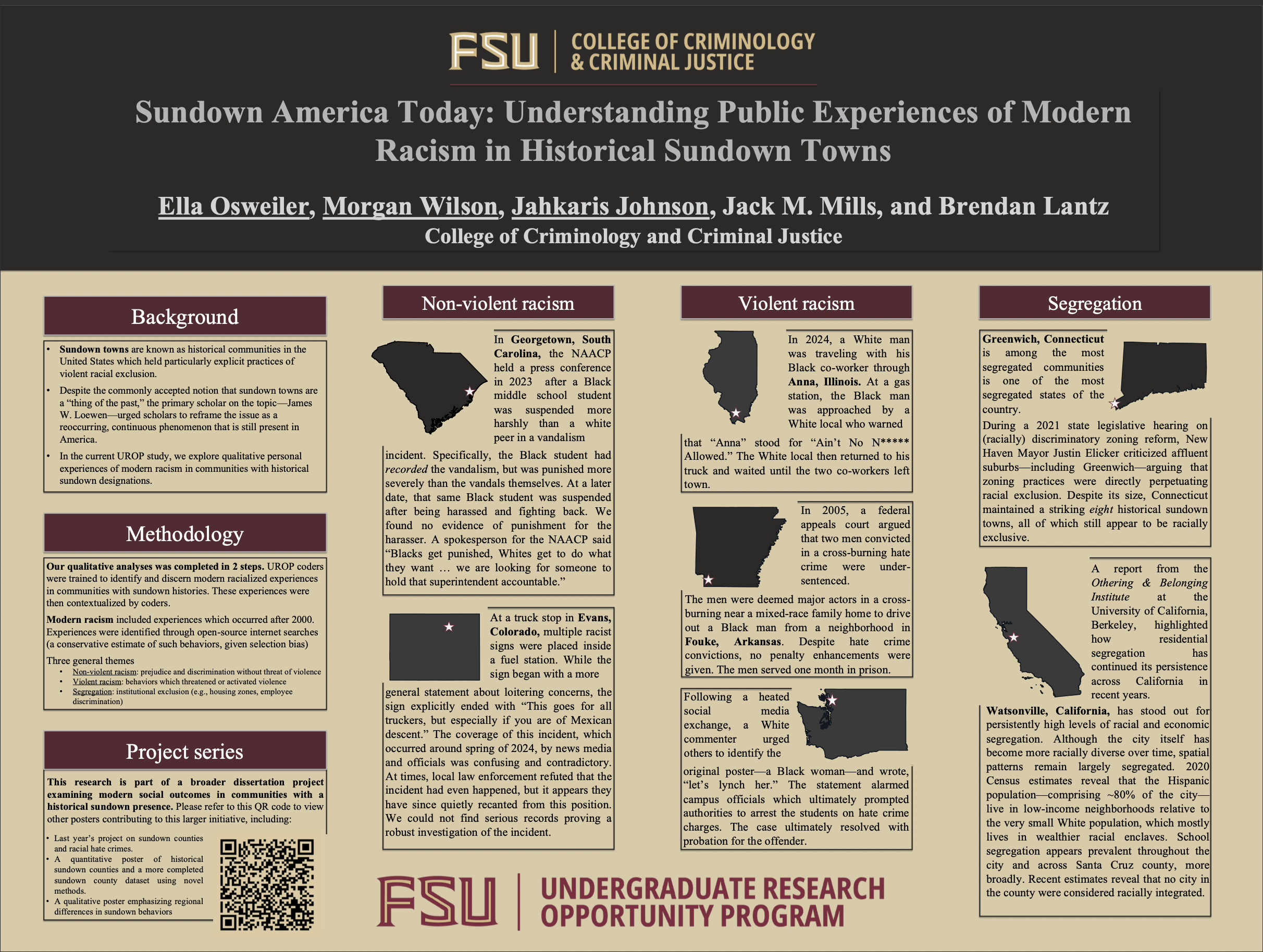
Sundown towns were, by definition, communities which systematically excluded non-White inhabitants. To date, the primary shepherd of knowledge on sundown towns has been James W. Loewen, who was a public scholar and historical sociologist. Throughout his research, he repeated central claims that sundown towns in America had not necessarily integrated at pivotal Civil Rights landmarks for racially marginalized communities (e.g., the Fair Housing Act of 1968). Instead, he convincingly argued the case for sundown evolution in America and called upon the public to submit known accounts and experiences of racism—broadly conceived—to his data collection project. Building on this foundation, the current project explores data submitted in response to Loewen’s call alongside systematic open-source searches documenting modern experiences of racism in historical sundown towns from 2000 to 2026. Broadly, this analysis affirms Loewen’s notion of sundown evolution into the present day. Specifically, our project demonstrates that these lived experiences include a host of incident types, including violent racism that plausibly meets hate crime designation thresholds, despite being in policing jurisdictions which reported no such hate crimes during these reports. Taken together, these findings underscore the continued relevance of sundown towns, not only as a structural form of racial exclusion, but as communities in which policing differentially impacts racially marginalized victims of targeted violence. While our work is ongoing, our results point to a clear pattern: Sundown America continues its influence today.
Keywords: Sundown towns, racism, racial violence