
Research Symposium
26th annual Undergraduate Research Symposium, April 1, 2026
sharon hopengarten Poster Session 1: 9:30 am - 10:30 am / Poster #143

BIO
Sharon Hopengarten is a sophomore at Florida State University pursuing a dual degree in International Affairs and Business Management. She is currently completing the remaining coursework for both the U.S. National Intelligence Certificate and the Global Citizen Certificate, which focus on global security, international policy, and cross-cultural understanding.
Her academic interests center on international politics, law, and the relationship between culture and public policy. Sharon is currently conducting undergraduate research that examines how historical and cultural relationships with ayahuasca shape how different states interpret and implement the 1971 UN Convention on Psychotropic Substances, with a comparative focus on Brazil, Peru, and France. Through this project, she explores how international frameworks interact with national traditions and legal systems.
In the future, Sharon hopes to pursue a career related to international policy, national security, or business solutions, where she can apply interdisciplinary perspectives to complex global issues.
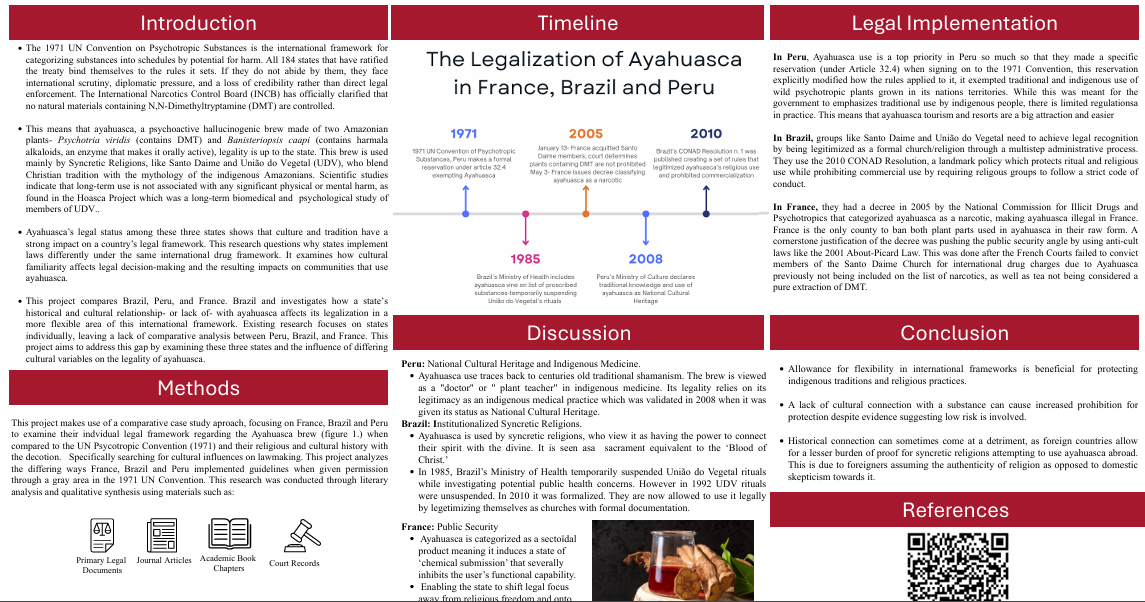
Culture’s Impact on Ayahuasca’s Legality in France, Brazil and Peru
Authors: sharon hopengarten, Mason MarksStudent Major: International Affairs and Business Managment
Mentor: Mason Marks
Mentor's Department: Florida Bar Health Law Section Professor Mentor's College: College of Law Co-Presenters:
Abstract
The 1971 UN Convention on Psychotropic Substances serves as the international
framework for categorizing substances into schedules by potential for harm through abuse
or public health and therapeutic value. However, the International Narcotics Control Board
(INCB) has officially clarified that no natural materials containing DMT are controlled.
Which means that ayahuasca (a decoction of two Amazonian plants- Psychotria viridis and
Banisteriopsis caapi that naturally contain DMT) legality is up to the state.
This project investigates how a state’s historical and cultural relationship-or lack of- with
ayahuasca affects its legalization using this legal loophole. This project compares Brazil,
Peru, and France. Brazil and Peru both have used ayahuasca for centuries for both
traditional and religious practices and now have more lenient laws. Peru considers it as
apart of its National Cultural Heritage, and Brazil allows for religious usage under a code
of conduct made by representatives from the religions that use it. Whereas France a country
with no traditional background with ayahuasca has a zero-tolerance policy for it and
considers it a narcotic.
This project is expected to find that state implementation is due to cultural familiarity or
lack of, as opposed to its psychoactive properties. This project aims to explore
the assumption that drug use is inherently harmful when confronted by centuries old
practices using psychoactive substances for religious and for traditional healing and
guidance.
Keywords: Ayahuasca, comparative law, culture