
Research Symposium
26th annual Undergraduate Research Symposium, April 1, 2026
Santiago Omegna Poster Session 2: 10:45 am - 11:45 am / Poster #12

BIO
Santiago Omegna is a second-year student pursuing a double major in Political Science and History. Originally from Madrid, Spain, working on a project centered around Spanish history was a major benefit as he was able to read and translate unique first-hand sources in Spanish. Through the UROP experience, he was able to secure a committee of professors to aid him in an Honors in the Major thesis focused on the historical memory of the Spanish Civil War.
An Approximation to Banditry in Andalucia: Origins and Importance
Authors: Santiago Omegna, Dr.Benjamin DoddsStudent Major: Political Science, History
Mentor: Dr.Benjamin Dodds
Mentor's Department: History Mentor's College: College of Arts and Sciences Co-Presenters:
Abstract
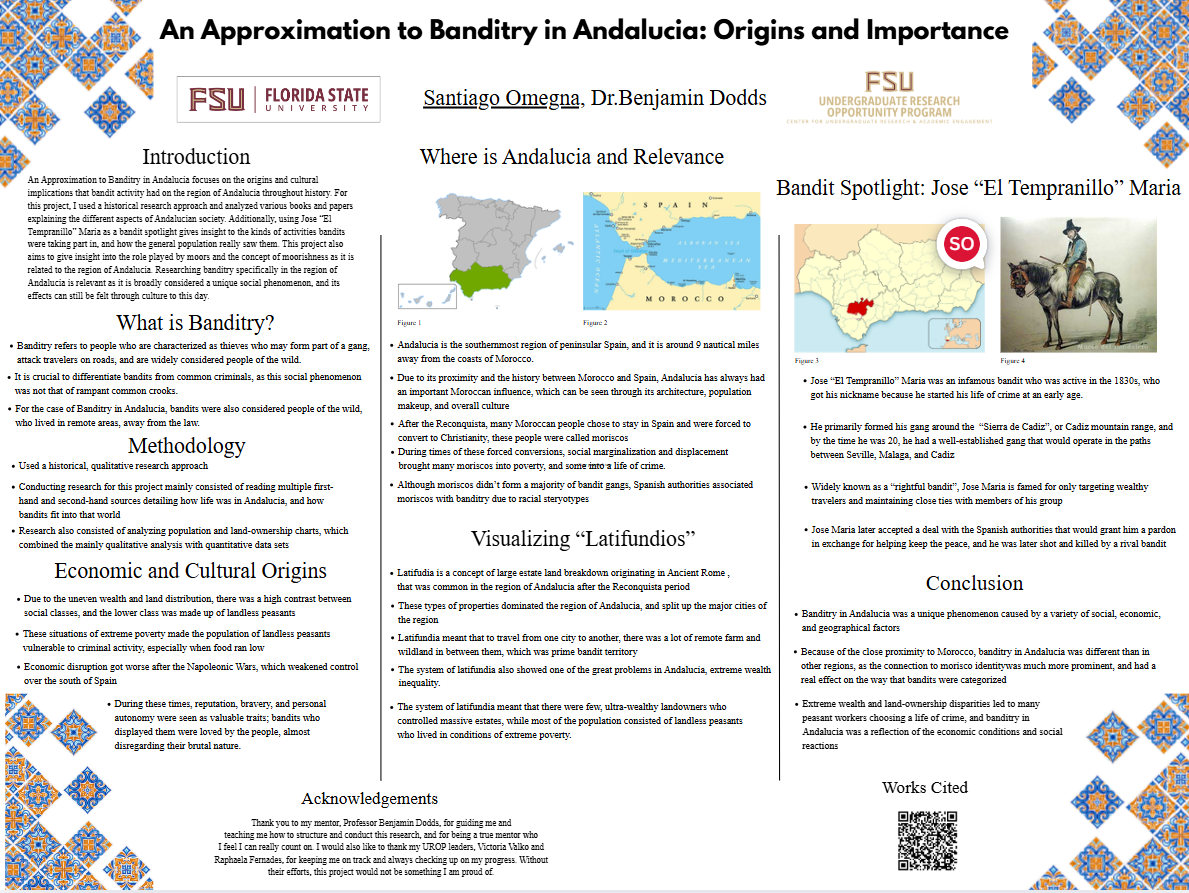
An Approximation to Banditry in Andalucia focuses on the origins and cultural implications that bandit activity had on the region of Andalucia throughout history. In order to get a more complete grasp of the origins of bandit activity in the region, maps of large-estate properties are featured, as well as a population breakdown, to understand the cultural implications. For this project, I used a historical research approach and analyzed various books and papers explaining the different aspects of Andalucian society. Additionally, using Jose “El Tempranillo” Maria as a bandit spotlight gives insight to the kinds of activities bandits were taking part in, and how the general population really saw them. This project also aims to give insight into the role played by moors and the concept of moorishness as it is related to the region of Andalucia. Researching banditry specifically in the region of Andalucia is relevant as it is broadly considered a unique social phenomenon, and its effects can still be felt through culture to this day.
Keywords: Andalucia, Banditry, Spanish History