
Research Symposium
26th annual Undergraduate Research Symposium, April 1, 2026
Melanie Porter Poster Session 4: 3:00 pm - 4:00 pm / Poster #168
BIO
Melanie Porter is a sophomore at Florida State University working to get a Bachelor's of Science in Interdisciplinary Social Science with concentrations in Sociology and Economics along with a certificate in Public Policy. She is pursuing knowledge of the several social science disciplines to integrate in understanding and addressing salient social issues. She has a particular interest in the justice system and this project has allowed for a deepened understanding of juvenile justice and the ways that it is still being shaped and must be improved to create a fair and effective system. From undergrad, she plans to spend time in the workforce before entering law school to do further work addressing injustice and social issues specifically from the perspective of law and policy.
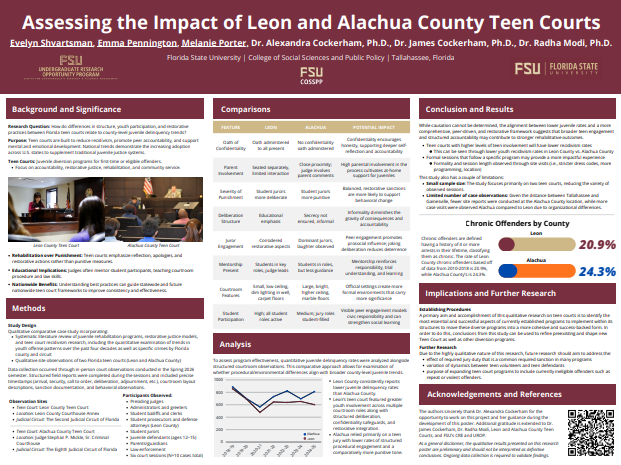
Assessing the Impact of Leon and Alachua County Teen Courts
Authors: Melanie Porter, Alexandra CockerhamStudent Major: Interdisciplinary Social Science
Mentor: Alexandra Cockerham
Mentor's Department: Interdisciplinary Social Science Mentor's College: College of Social Science and Public Policy Co-Presenters: Emma Pennington, Evelyn Shvartsman
Abstract
Teen courts are diversion programs that are an increasingly utilized approach that emphasize mental and emotional development within the juvenile justice system, aiming to reduce recidivism and promote accountability and community service. While these programs aim to provide an effective and supportive way to get juveniles back on the right footing, in comparison to other traditional justice programs, they have limited evidence for what works in the status quo. This study examines Leon and Alachua counties’ teen courts to determine which practices are most effective. Through a qualitative research design, this project expands upon the initial literature review with site visits to both counties’ teen courts to observe court structure, accommodations, physical properties, procedures, youth participation, and restorative practices, highlighting procedural and environmental differences to determine which methods are most effective. The anticipated outcome is the development of a preliminary framework to be used to create a future teen court operations manual, proving relevant to assisting the juvenile community in increasing rehabilitation and improving program effectiveness and consistency across state and federal lines. Future steps include expanding observations to additional counties throughout Florida to broaden the range of observation and data, enhance the accuracy of findings through multiple site visits at each location, and develop a better understanding of the best practices statewide to be used as an introductory demonstration for the nation.
Keywords: teen court, juvenile justice, recidivism