
Research Symposium
26th annual Undergraduate Research Symposium, April 1, 2026
Nick Weides Poster Session 3: 1:45 pm - 2:45 pm / Poster #74

BIO
I'm Nick Weides, a Presidential Scholar at Florida State University pursuing a bachelor's degree in Finance. With a history in entrepreneurship, aviation, and market analysis, I aim to combine industry knowledge with investment strategy to build a career at the intersection of investing and entrepreneurship.
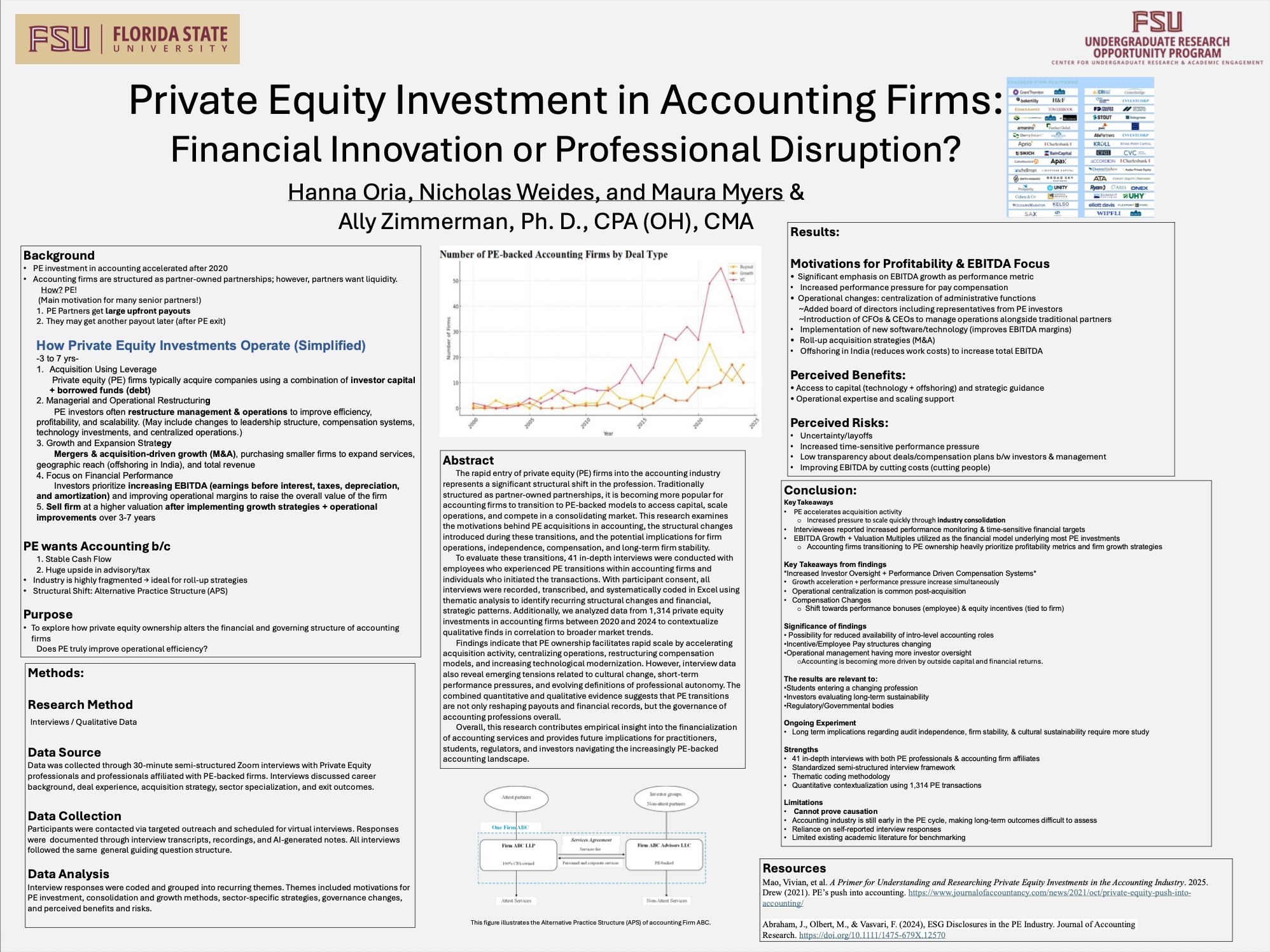
Private Equity Investment in Accounting Firms: Financial Innovation or Professional Disruption
Authors: Nick Weides, Dr. Aleksandra ZimmermanStudent Major: Finance
Mentor: Dr. Aleksandra Zimmerman
Mentor's Department: Department of Accounting Mentor's College: Herbert Wertheim College of Business Co-Presenters: Hanna Oria, Maura Myers
Abstract
The rapid entry of private equity (PE) firms into the accounting industry
represents a significant structural shift in the profession. Traditionally
structured as partner-owned partnerships, it is becoming more popular for
accounting firms to transition to PE-backed models to access capital, scale
operations, and compete in a consolidating market. This research examines
the motivations behind PE acquisitions in accounting, the structural changes
introduced during these transitions, and the potential implications for firm
operations, independence, compensation, and long-term firm stability.
To evaluate these transitions, 41 in-depth interviews were conducted with
employees who experienced PE transitions within accounting firms and
individuals who initiated the transactions. With participant consent, all
interviews were recorded, transcribed, and systematically coded in Excel using
thematic analysis to identify recurring structural changes and financial,
strategic patterns. Additionally, we analyzed data from 1,314 private equity
investments in accounting firms between 2020 and 2024 to contextualize
qualitative finds in correlation to broader market trends.
Findings indicate that PE ownership facilitates rapid scale by accelerating
acquisition activity, centralizing operations, restructuring compensation
models, and increasing technological modernization. However, interview data
also reveal emerging tensions related to cultural change, short-term
performance pressures, and evolving definitions of professional autonomy. The
combined quantitative and qualitative evidence suggests that PE transitions
are not only reshaping payouts and financial records, but the governance of
accounting professions overall.
Overall, this research contributes empirical insight into the financialization
of accounting services and provides future implications for practitioners,
students, regulators, and investors navigating the increasingly PE-backed
accounting landscape.
Keywords: Private Equity, Accounting, Investment Strategy