
Research Symposium
26th annual Undergraduate Research Symposium, April 1, 2026
Olugbeminiyi Odewole Poster Session 2: 10:45 am - 11:45 am / Poster #174

BIO
Olugbeminiyi Odewole is a second-year student pursuing a Bachelor of Science in chemistry. She is currently conducting research at the National High Magnetic Field Laboratory with Dr. Tomas Orlando and hopes to continue researching various topics in chemistry throughout her time as an undergraduate.
Electron-Nuclear Hyperfine Coupling Simulations with Novel Molecular Dynamics Tools
Authors: Olugbeminiyi Odewole, Tomas OrlandoStudent Major: Chemistry
Mentor: Tomas Orlando
Mentor's Department: National High Magnetic Field Laboratory Mentor's College: National High Magnetic Field Laboratory Co-Presenters:
Abstract
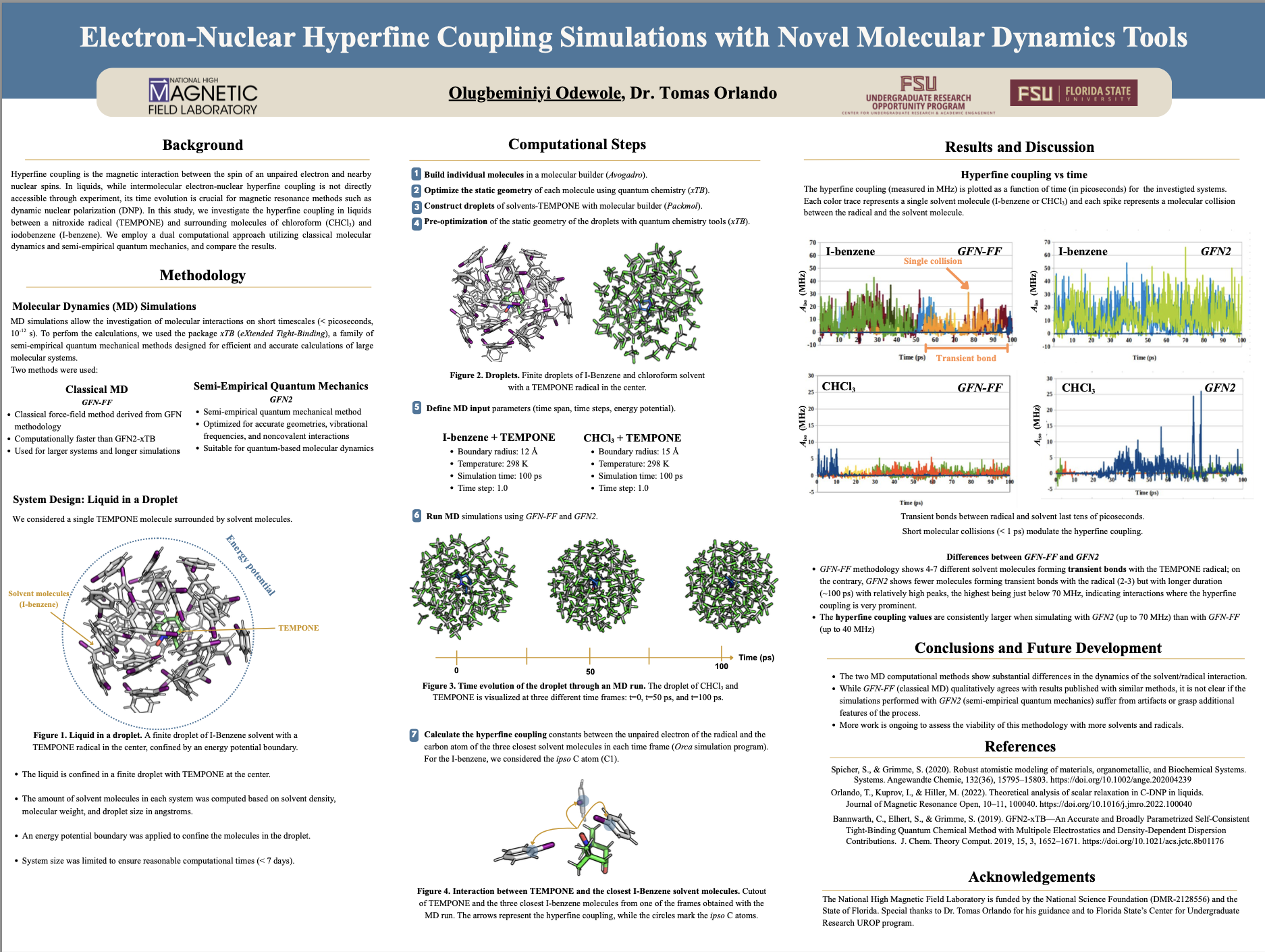
Interactions between organic radicals and small molecules in liquid states are essential in many catalytic and biological processes. However, these interactions are complicated to measure experimentally, especially when the timescale of these interactions is on the order of picoseconds (10^-2 s) or lower. This knowledge gap stresses the importance of developing reliable simulation tools to assess organic radical and small molecules’ interactions in the liquid state.This project utilizes the computational tools xTB (Extended Tight-Binding), Packmol, and PyMol to perform quantum molecular dynamics simulations of radical–solvent systems. Focus was placed on a TEMPONE radical in solvents such as chloroform and carbon tetrachloride, Benzene-F, Benzene-Cl, Benzene-Br, and Benzene-I. The simulations were used to analyze the distances between the nuclei of the three nearest solvent molecules and the radical’s carbon atom, as well as estimate the magnitude of hyperfine coupling interactions. These results are compared with previously reported data obtained using classical molecular dynamics methodologies. By maintaining comparable simulation parameters, including temperature, time, and system size, this study aims to assess the reliability and viability of this computational approach for future investigations of radical–solvent interactions.
Keywords: Chemistry, Physics, Computational tools