
Research Symposium
26th annual Undergraduate Research Symposium, April 1, 2026
Isabella Moraes Poster Session 2: 10:45 am - 11:45 am / Poster #312
BIO
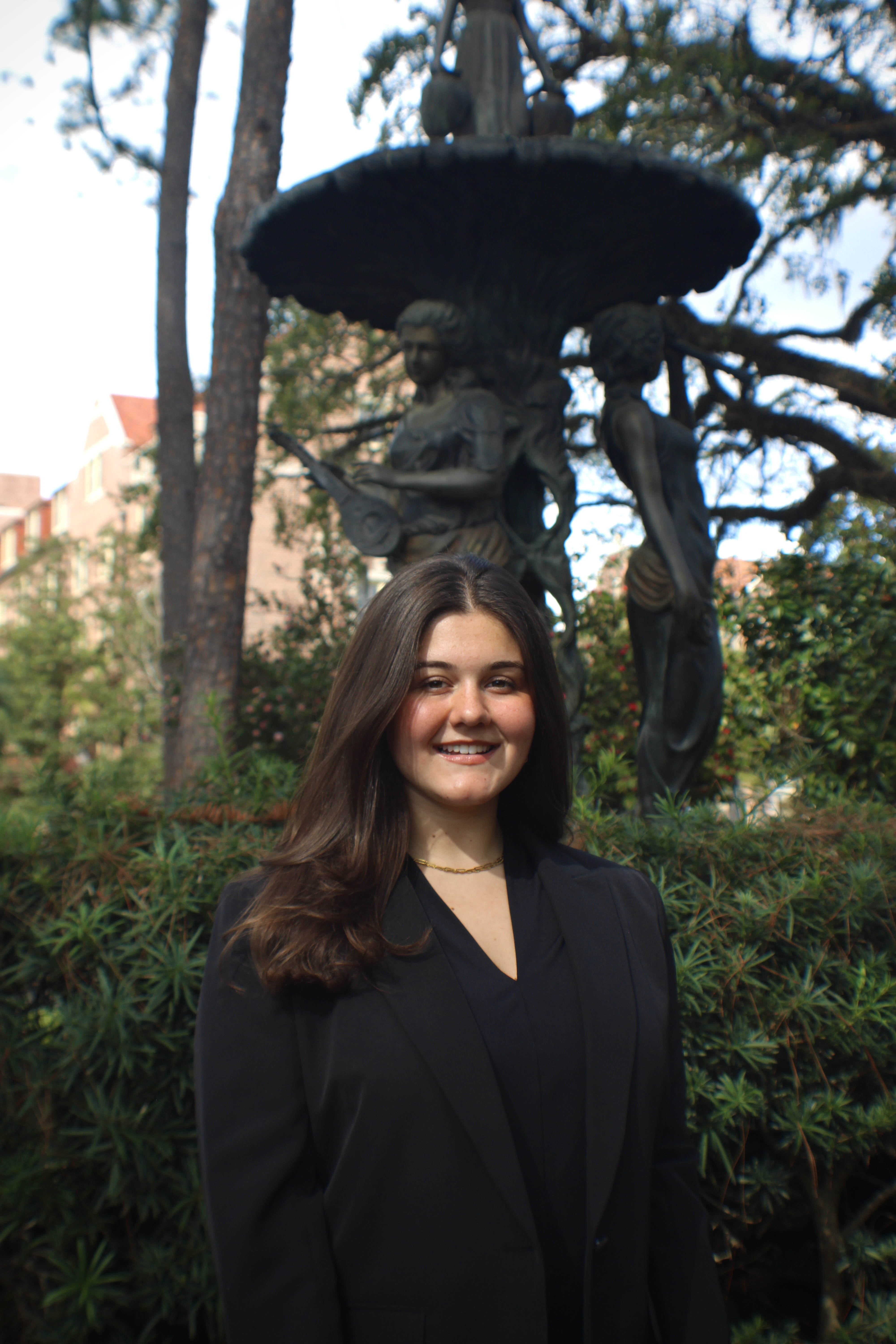
Isabella Moraes is a freshman at Florida State University pursuing a Bachelor of Science in Biology on a pre-veterinary track. Originally from Brazil, she brings a global perspective to her academic and research experiences. Isabella is involved in research examining how cognitive and language skills affect pronunciation in native English speakers learning Spanish, working closely with Dr. Matthew Patience to explore the connections between cognitive processes and language development. In addition to her research, Isabella has gained hands-on experience through volunteer work with animal rehabilitation and conservation projects, strengthening her interest in veterinary medicine and animal welfare. She is developing skills in scientific analysis, experimental design, and data management that will support her future research and professional goals. Looking ahead, Isabella plans to attend veterinary school and specialize in large animal and exotic medicine. She hopes to contribute to wildlife conservation and animal care through both clinical practice and research. Her combination of academic study, hands-on experience, and research involvement reflects her dedication to advancing knowledge in biology and improving animal welfare.
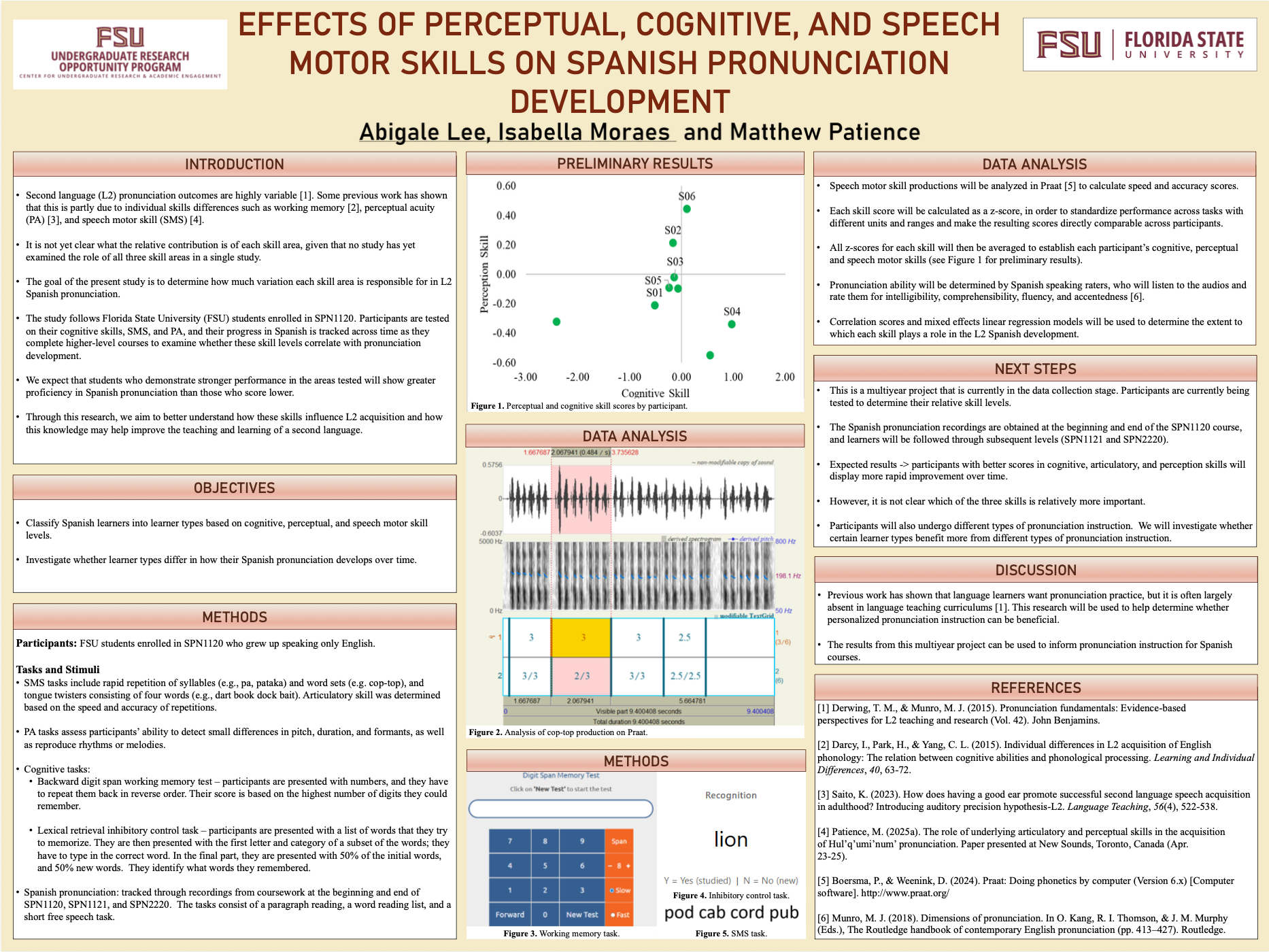
Effects of Perceptual, Cognitive, and Speech Motor Skills on Spanish Pronunciation Development
Authors: Isabella Moraes, Matthew PatienceStudent Major: Biology
Mentor: Matthew Patience
Mentor's Department: Department of Modern Languages and Linguistics Mentor's College: College of Arts and Sciences Co-Presenters: Abigale Lee
Abstract
The acquisition of pronunciation is highly variable for learners of a second language (L2). In this ongoing study, our goal is to understand how individual skill differences contribute to the pronunciation development of native English-L2 Spanish speakers. This study builds on previous research showing that cognitive skills such as working memory and inhibitory control (Simard et al., 2025; Darcy et al., 2025), as well as auditory acuity (AA) (Saito, 2022) and speech motor skill (SMS) (Patience, 2025), play a role in L2 acquisition. Participants were Florida State University students enrolled in SPN1120. They performed a series of tasks to establish their skill levels: a backward digit memory span task and a lexical retrieval inhibitory control task (cognitive); DDK-type tasks (e.g., Icht & Ben David, 2014) and tongue twisters (SMS); and various speech perception tasks to test sensitivity to small differences in pitch, duration, or formants, as well as tasks encoding rhythm and melody (from Saito, 2022). Participants’ Spanish pronunciation ability was obtained from students’ coursework across three semesters of Spanish. We will run statistical analyses to determine which skills were the best predictors of Spanish pronunciation ability and development over time. We expect that students who demonstrate stronger performance in the areas tested will show greater proficiency in Spanish pronunciation than those who score lower. Through this research, we aim to better understand how these skills influence L2 acquisition and how this knowledge may help improve the teaching and learning of a second language.
Keywords: Linguistics, Spanish, Second language acquisition, Cognitive skills, Speech motor skills